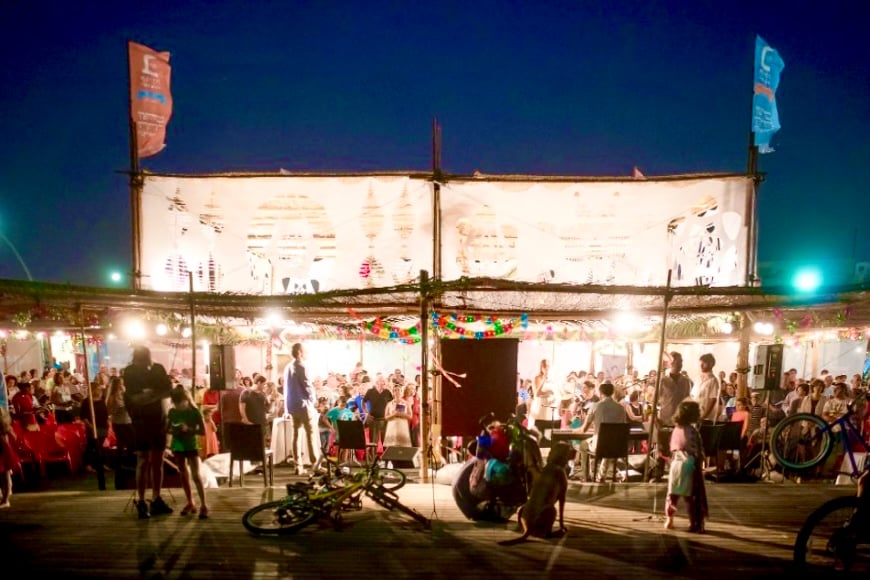
As I write, a 600-meter sukkah is rising in the Tel Aviv port. Its walls are covered with the art of the great gay painter-laureate of Tel Aviv, Rafi Peretz. The “Israeli Sukkah” will be big enough for 500 people, more in a pinch, and over the course of the eight days it will be up, and through the 68 events it will host, tens of thousands will visit.
The sukkah was thought up and carried out by a new organization in the city called “Yahaduta” (יהדות״א), a portmanteau of Yahadut (Judaism) and the acronym for Tel Aviv. Yahaduta is a forum of dozens of organizations and communities of every sort – Reform, Conservative, Orthodox, Renewal, Reconstructionist, secular – who share the belief that Judaism thrives best when it is open to different voices, perspectives and ways of doing things. The Sukkah is so big because the message (as a sign in the Sukkah will read) is “Herein, there is place for everyone.”
In a way, Yahaduta’s Israeli Sukkah is the revival of something called “Oneg Shabbat” (literally, “The Pleasure of the Sabbath”) that was started in Tel Aviv a century ago, in 1926, and went on, week-in-week-out, until 1958, ten years after the State of Israel was created. The idea for “Oneg Shabbat” originated with the great Hebrew Poet Hayyim Nahman Bialik, who said of it in 1928:
We come to the Land of Israel to renew ourselves; we want to create for ourselves here our own way of life, with its own profile and special character.
To do this, Bialik said, we need to take what has long been part of Jewish life and make it part of our own lives in new ways. Tel Aviv – “the first Hebrew city” to rise in 2,000 years – is the place to do this. It was the city, where on the streets you heard Hebrew, Arabic, Yiddish, Ladino and a hundred other languages; where socialists sat in cafes alongside rabbis; where few people saw any contradiction between being worldly and being Jewish, where the fondest hope of parents was not that their kids would grow to be like them, but that they’d grow to be different, better, more whole.
Each week, hundreds gathered – bricklayers, cement pourers, stonemasons, plumbers, shopkeeps, clerks, teachers, bookkeepers, tailors, pressmen, cobblers, musicians, doctors, writers, policemen, smiths, and peddlers – to hear poets like Shaul Tchernichovsky read his poems, and scholars like Gershom Scholem talk about Kabbalah, or Martin Buber set out his philosophy; and painters like Nahum Gutman describe his vision for Jewish art in a Hebrew city.
The spirit of Bialik’s Oneg Shabbat is precisely the spirit of the Israeli Sukkah. The Sukkah will host study, discussion, plays, prayer, poetry, meals, dance and music of every sort. Maor Cahana, a professor of Jewish philosophy, will speak about how water shapes our consciousness, social theorist Tomer Persico will explore how and when Judaism and democracy go together (and how and when they don’t), the peitanit Shir Ifrach will sing Andalusian liturgical songs. From morning till night, Jewish culture.
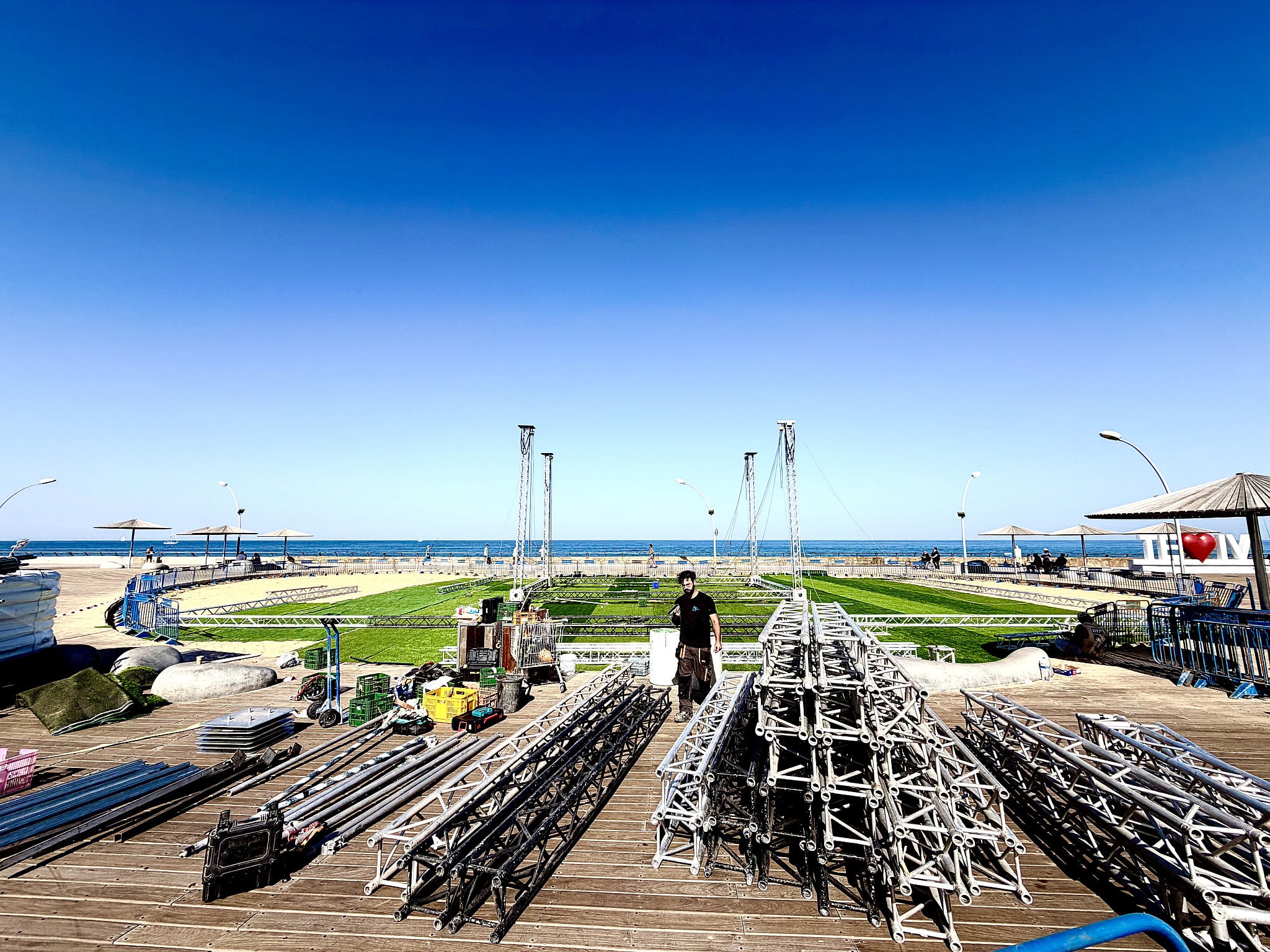
Construction begins on Yahaduta’s ‘Israeli Sukkah’ at The Tel Aviv Port. October, 2025 (Courtesy)
Anyone who lives in Tel Aviv-Jaffa knows that in recent years, especially in this season, the city has been roiled by fights over religion in the public square. The Israeli Sukkah in the port is an answer to that. It is a demonstration of how there can rise not just different streams of Judaism – Orthodox, Conservative, Reform, Renewal, secular; egalitarian and traditional; Ashkenazi and Mizrahi – but something we can all call “Israeli Judaism.” It shows that, in Tel Aviv, Judaism can unite us rather than divide us.
In these days of war, it is easier to see what has been destroyed than what is being built. A sukkah, by its nature, is a temporary thing. When the festival ends, the Israeli Sukkah in the heart of the Tel Aviv Port will come down. But the thousands of people and dozens of communities behind it, committed, as Bialik urged, to creating for ourselves here our own way of life, rich in spirit and creativity and with a place for everyone, are building something enduring. Something that will shape this city for years and years to come.
Noah Efron is a member of Tel Aviv-Jaffa’s City Council, representing the green party, Hayarok Bamerkaz, and chair of the municipal Committee on Pluralism and Committee on Environment & Sustainability. Efron hosts TLV1’s ‘The Promised Podcast’. He is also chair of the Graduate Program on Science, Technology & Society at Bar Ilan University. He’s written lots about the intertwine of science, technology, religion and politics. His biggest regret is that he is not NORA Ephron.