Homosexuality remains a difficult topic in sport, and coming out is a rarity, especially in men’s football, according to a leading Luxembourg women’s international player.
“It’s completely different for men than it is for us women,” said 30-year-old Andreia Machado, who came out in private as a teenager. “Women have a different sensitivity, which may help them to deal with this topic more openly.”
“There was no real coming out in sport. It’s not unusual in women’s football,” she said. Within the team, it doesn’t matter who you’re with. “You can talk about it openly. It was never a taboo subject,” stressed Machado.
I rarely talk openly about it. Not because I don’t want to, but it’s never brought up
Eric Glod
Tennis table player
Handball player Tina Welter agrees it is less of a taboo in women’s sport. She came out in private aged 13, but the topic came up when she switched from the U-19 teams to the women’s team. “There were a few couples in the team back then. As a result, the topic was dealt with openly,” she said.
Contrasting attitudes in men’s sport
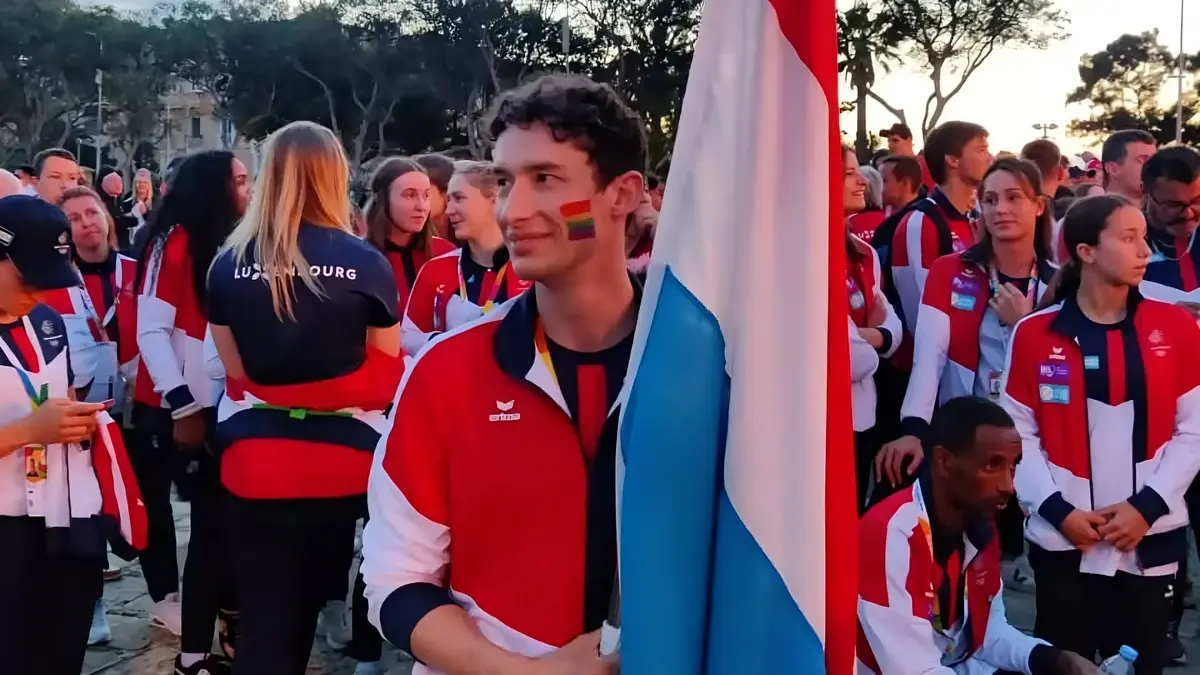
However, what seems self-evident in women’s sport is still the elephant in the room in men’s sport. “I rarely talk openly about it. Not because I don’t want to, but it’s never brought up,” explained Eric Glod, a former international tennis table player.
“On the one hand, we are athletes who want to prioritise our performance and not our personal lives. On the other hand, I sometimes have the feeling that it’s being hushed up,” he said.
Andreia Machado sees big differences in the acceptance of homosexuality between men’s and women’s football © Photo credit: Christian Palmisano
Eric Glod rarely talks openly about his sexuality © Photo credit: Ben Majerus


It took the 31-year-old some time to come out publicly. “After I came out at home, I tried to open up bit by bit,” said Glod, which also included in his sporting life.
However, like Machado and Welter, there was no speech in front of the team. “There were lots of little moments,” said the reigning national champion.
Many of these had already taken place before the first public statement. “It took a long time for me to build up enough confidence to say it in a public space,” recalled Glod, adding that confiding in his team mates was a risk. “Of course I was aware of the danger that it could spread, but it was also a kind of wishful thinking,” he said.
Lack of tolerance and incomprehension
Glod is now open about his homosexuality. “I think it makes life easier when everyone knows,” he said, a view shared by Welter. “I’d rather be happy and take the occasional negative headline than have to fool everyone,” she said.
However, she believes that men have a harder time than women in this respect. “For a large part of the population, a man doesn’t have a feminine side, so many people can’t understand that,” said Welter.
I admire well-known athletes who come out. I think the more people do it, the more normal it will become
Tina Welter
Handball player
“In sport, a certain assertiveness is always required. It’s a stereotypical male attribute,” said Glod.
The issue is particularly pronounced in football. “If someone in a team were bisexual or homosexual, it would be difficult for them to admit it because there would always be a certain amount of marginalisation,” said Machado, citing the example of a potential difficulty with the obligatory shower after training or a game.
“I’m not saying that everyone in a team of 20 men would have a problem with it, but definitely some of them. Something like that blocks you,” she said.
Tina Welter believes that the topic of homosexuality should be addressed more openly © Photo credit: Christian Kemp
According to Welter, a lack of tolerance, a lack of understanding or the fear of damaging one’s image can also prevent people from coming out. In professional sport in particular, coming out makes a big splash. But that doesn’t have to be a bad thing. “I admire well-known athletes who come out. I think the more people do it, the more normal it will become.”
‘It’s already better than it used to be’
A change in attitudes has long been recognisable in society, said Glod. “It’s already better than it used to be. But we can’t stop drawing attention to it. We should keep raising awareness of it.”
Welter believes the introduction of same-sex marriage and events such as Christopher Street Day have already been steps towards greater tolerance. Nevertheless, she would like to see more big names coming out. “Unfortunately, there are far too few who do.”
The 32-year-old said that education on the topic of homosexuality also leaves a lot to be desired. “It’s still suppressed. It should be dealt with more openly in schools,” she said.
More far-reaching changes are needed in football in particular, however. “The mentality in men’s football needs to change, and that’s complicated,” said Machado, who, like Welter, sees the focus as working with the next generation. “That has to start at youth level.”
If you’re homosexual, it’s not a problem, it’s a characteristic. But it doesn’t define who you are
Andreia Machado
Footballer
According to Machado, it is also the next generation that could be responsible for a change in thinking. “You see more and more homosexual couples having children. In a few years’ time, all these children will ensure that this is no longer considered abnormal,” she said.
However, she does not believe that same-sex orientation will be tolerated by everyone at some point. “There will always be a section, even if only a small one, that won’t accept it,” said Machado. Welter agrees, but added: “It doesn’t have to be that way.”
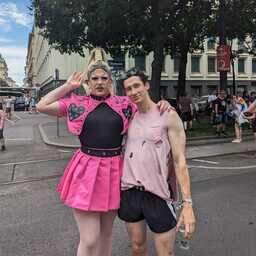
Eric Glod at Pride in Vienna © Photo credit: privat
The drag queen Ryta Tale also took part in the parade © Photo credit: privat

In sport, it is important that homosexuality, especially among men, is not seen as a weakness. “It can even be a strength if you think and feel differently,” said Glod, adding: “You can be different from what the system has demanded so far and still be successful.”
After all, sexuality is just one of many characteristics of a person, as Machado sums up: “If you’re homosexual, it’s not a problem, it’s a characteristic. But it doesn’t define who you are.”
(This article was originally published by the Luxemburger Wort. Machine translated, with editing and adaptation by John Monaghan.)