On her mobile phone, DBS Group CEO Tan Su Shan keeps a black-and-white photograph of herself at age 4, sitting beside her grandmother and her mother at Singapore’s Nanyang Kindergarten. It’s a snapshot of three generations of powerful women. Tan’s grandmother, widowed during the Japanese occupation, raised seven successful children. “She grew up in a time when women were not educated,” Tan recalls. Denied schooling, she taught herself to read and insisted that her daughters—including Tan’s mother, the youngest—excel academically, get jobs, and be financially independent. Tan remembers her grandmother as a “hurricane force,” and credits her mother, a pharmacist, for “inculcating that in me.”
Tan is drawing on that legacy as the first woman to lead Southeast Asia’s largest bank. In March, she took over as chief executive, succeeding Piyush Gupta, who during his 15-year tenure transformed DBS from a stolid national lender to one of the world’s most digitally advanced—and profitable—financial powerhouses. As CEO of a bank that now has 38,000 employees, operates in 19 countries, and manages assets of more than $600 billion, Tan faces a formidable challenge: to sustain that extraordinary momentum and keep wresting market share from much larger global competitors in a moment marked by geopolitical turmoil, falling interest rates, and warp-speed technological change.
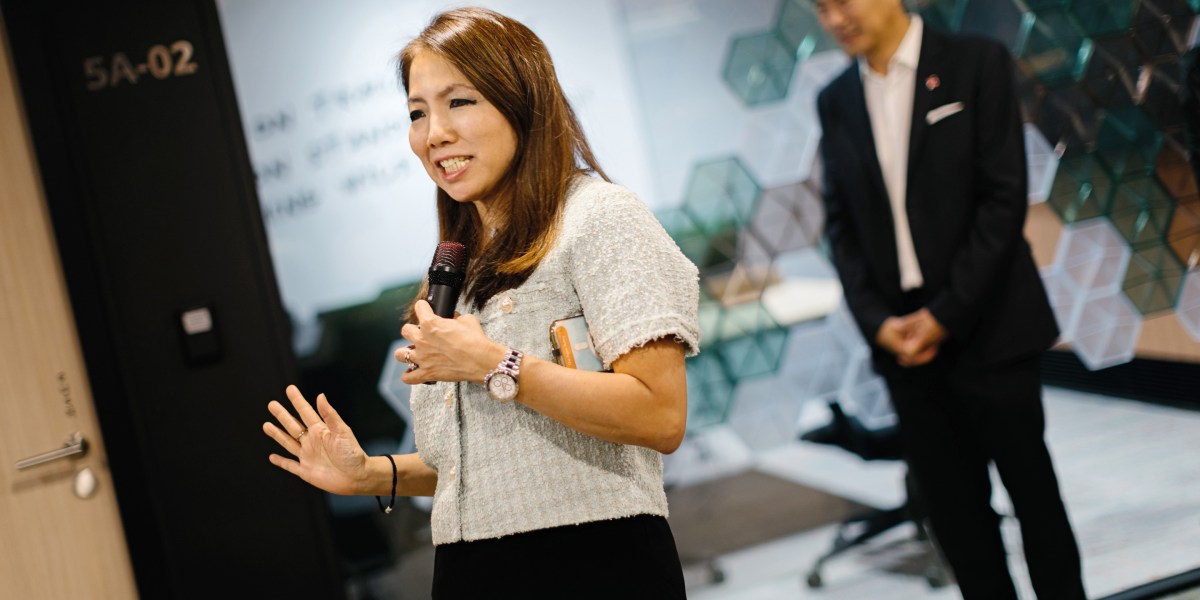
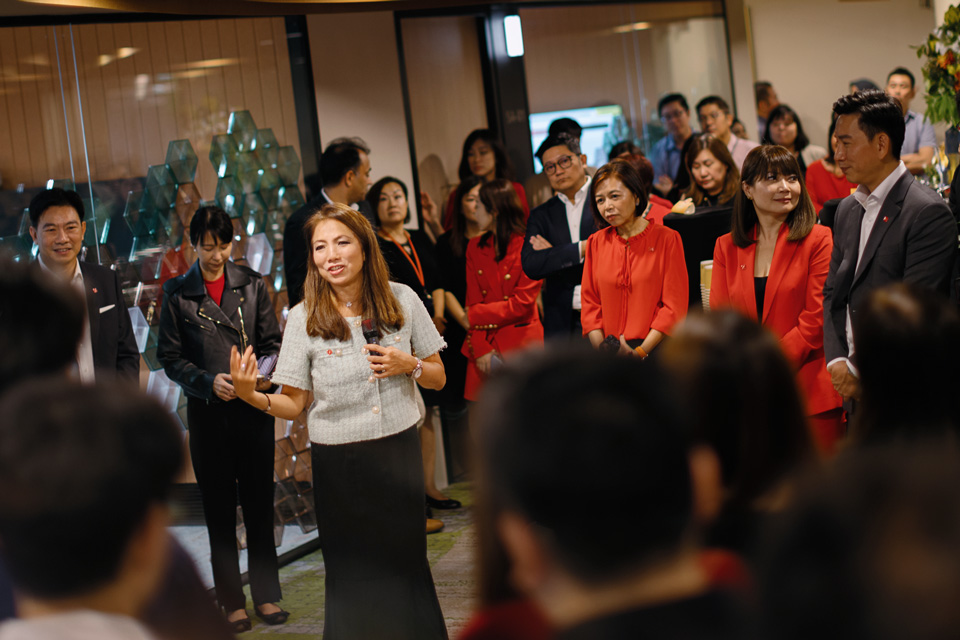 Tan meets with leaders of sustainability-oriented businesses at a DBS event in September.
Juliana Tan for Fortune
To that end, Tan and her leadership team have embraced a strategy that combines old-fashioned values of trust and safety with newfangled technologies like artificial intelligence, blockchains, and cryptocurrencies. She is eyeing new markets in Asia and the Gulf states, and revamping DBS’s organizational structure and culture to make it feel more like “one bank” and less like a collection of siloed services.
“Resilience” is a recurrent theme in conversations with Tan. “I think Piyush’s leadership enabled us to build a really solid foundation to navigate what’s ahead,” she says. “But I also think what’s ahead is going to be tough…I’ve told colleagues, ‘This is going to be a volatile year, so you better buckle up.’”
DBS, like Tan, was born to austerity. Originally named the Development Bank of Singapore, DBS was established by the government of Singapore in 1968, three years after the city-state declared its independence from Malaysia, and was tasked with providing long-term financing for industrial and infrastructure projects deemed crucial to Singapore’s survival. That meant large, illiquid investments in sectors like shipping, manufacturing, real estate, and utilities— endeavors most private banks considered too risky.
The fledgling institution struggled to raise capital, attract partners, and recruit experienced bankers to fulfill its development mandate. Nonetheless, in its first decade, DBS underwrote power plants and water treatment facilities; Singapore’s flagship industrial zone and sprawling container port; the national shipping line; Singapore Airlines and Changi Airport; as well as the government’s ambitious public housing program.
In the 1980s and 1990s, as Singapore’s economy matured, DBS moved into full-service commercial and consumer lending. In 1998, DBS acquired Singapore’s Post Office Savings Bank, adding 3 million customers, making DBS the dominant retail bank in Singapore. DBS has also expanded overseas, acquiring Hong Kong’s Dao Heng Bank (in 2001) and Citigroup’s consumer business in Taiwan (in 2022). DBS has more than 500 branches in India and 30 in Indonesia, and overseas markets now account for more than 30% of group profits.
But until Gupta, a veteran Citigroup executive, took the reins as CEO in 2009, DBS had a reputation for being a cautious, bureaucratic lender that paid little heed to customer experience. Gupta led a far-reaching overhaul that started with company culture. He championed experimentation, collaboration, and putting customers first. He also pushed the company to invest heavily in digital technologies, declaring that DBS should “act less like a bank and more like a tech company.” That philosophy led to the adoption of large-scale cloud platforms and the use of data analytics and AI long before such methods were embraced by other banks. DBS rolled out mobile-first banking in Singapore, simplified the process of opening a digital account, and created seamless payment systems. In India and Indonesia DBS built “digibanks” that reached millions of customers at a fraction of the cost of building a network of physical branches.
The payoff was dramatic. In 2024, Gupta’s final year on the job, DBS reported revenues of $17.3 billion, a fivefold increase from when he joined in 2009. Profits last year soared to a record $8.8 billion, while return on equity has risen to 18%, up from around 7% at the beginning of Gupta’s tenure, making DBS one of the world’s most profitable banks.
Tan began her banking career at Morgan Stanley’s Singapore office shortly after earning her degree from Oxford University in politics, philosophy, and economics. She focused on investment banking and wealth management and, after a stint at ING Barings, joined Citi Private Bank, where she rose quickly to become head of private banking for Singapore, Malaysia, and Brunei and gained a reputation as one of Asia’s savviest private bankers.
Gupta lured her to DBS in 2010 to scale and modernize DBS’s wealth management franchise. In 2013 she was promoted to head consumer banking as well as wealth management. Tan earned praise for her relentless focus on customer experience and zeal for using data and artificial intelligence to develop innovative, more personalized financial products. Under her leadership, DBS became Asia’s top private bank.
 From left: Tan Su Shan’s grandmother, Tan’s mother, and Tan at age 4.
Courtesy of Tan Su Shan
In 2019, Gupta asked Tan to head DBS’s institutional banking group, which serves large corporate and government clients and, along with wealth management and consumer banking, is the other main driver of group revenue. In that role, she pressed colleagues to figure how to apply AI and machine learning models to evaluate corporate cash flow—an exercise she says helped DBS dodge a host of unprofitable deals and avoid the worst of mainland China’s residential property market collapse.
“We’ve made all our bankers go through very rigorous testing and learning around cash flow,” she says. “It was the best thing we did. Now, when our bankers look at a company, they don’t just see the assets—‘Oh, nice ship, nice hotel.’ No! Figure out the cash flow, honey! Because you can have the best hotel in the world, but if you haven’t got the cash to pay for it, it’s just a white elephant.”
As head of institutional banking, Tan has been deeply involved with DBS’s corporate client relationships and overseas operations, and wrestled with questions of credit risk, regulatory compliance, geopolitics, and long-term corporate strategy.
Tan hails Gupta as a “great mentor and a tough boss.” But in a wide-ranging conversation at DBS’s sleek headquarters overlooking Singapore’s Marina Bay, she emphasized that, as CEO, her leadership style will differ from her predecessor’s—in at least two important ways.
“I’ve told colleagues, ‘This is going to be a volatile year, so you’d better buckle up.’”
Tan Su Shan, CEO, DBS Group
The first is that she has elevated longtime colleague Derrick Goh to a newly created role as chief operating officer where he has broad oversight for all functions and business lines of the bank. “[Piyush] and I complemented each other a lot,” she says. “I brought a lot of customer savvy to the relationships we have. I go deep into businesses, and I think I have a good business instinct. He had strong process-orientation, and he dared to move stuff…I’ve created a COO office to complement me. I want a strong COO, that guy is Derrick, to help me see things end to end, to be very process-oriented, very disciplined, to have data, to have strong governance, a resiliency framework.”
The second shift is what Tan calls the “one-bank initiative.” “Piyush organized us according to business line—consumer, corporate, markets. I’ve kept that but am taking a more one-bank, one-customer approach. Because our small and medium-size enterprise customer could also be a wealth customer. And we’ll also be trading with our treasury and markets operations. How do we pull all that data together? How do we have the tech and ops work with the marketing message—across countries, across segments, across businesses?”
Tan believes that the new corporate structure facilitates that shift. “If a client wants to open an account somewhere else [at DBS], I shouldn’t be asking for their data all over again,” she says. “If we’re using agentic AI for payments then I should use that in serving small enterprises as well. I want to reduce duplicative efforts. I’ve strung all my ops together in one person, all my tech together in one person, in order to have that whole-of-bank journey.”
She also hopes the onebank approach will help DBS identify new ways of serving clients in the “white spaces” between its traditional business lines. “It used to be my financial institutions guys would see the private equity funds without my private banking guys,” she says. “But today they see them together. Because if it’s a great fund, my private banking guy should be distributing that to our customers. And if the fund is investing in companies we know because we bank them, they need an expert. I want to see our people bring the whole bank to the customer.”
Tan sees AI as a critical tool for delivering on that “whole bank” vision—and she is constantly badgering staff to “drink the Kool-Aid” on the new technology. “With AI, you can type in, ‘What should I say to this client I’m going to see in 10 minutes? How do I bring all of DBS to the client?’” she says. “You don’t have to stay in your own silo.”
Tan heeds her own advice. At the Fortune Brainstorm AI conference in Singapore in July, she gleefully recalled “going to a client pitch quite unprepared” and peeking at her phone under the table to surreptitiously ask an AI engine for help. “The client said: ‘Wow, you know my business so well!’ So I cheated,” she admitted with a grin.
“The day my CEO role was announced, I’m in a WhatsApp group with my board,” Tan recalled at the Fortune event. “I get a WhatsApp saying that even the CEO’s job will be replaced, or can be replaced, by AI. If I can be replaced by AI, so can everything else.”
Tan exhorts staff to embrace AI as something that can transform them into “superhuman bankers” rather than as a sinister technology that is coming for their jobs. She cites the example of service staff, who field customer queries by phone. “We’ve got a great service staff. But more and more of their work is getting shifted to our ‘digibots.’ So our guys say, ‘How do I reinvent myself?’ And I say, ‘This is great! I’ve got a whole bunch of clients that aren’t tied to any relationship manager. Couldn’t you reinvent yourself as a relationship manager?’ That’s a bit of a psychological change, and it’s a change in your scope of work. But it’s an upgrade: You don’t have to think about mundane questions. You can start thinking about constructive ideas for customers.”
Tan was among the first DBS executives to champion AI’s potential. She remembers trying to figure out how to use IBM Watson for wealth management in 2014. “It didn’t work,” she says, laughing, “but it didn’t matter because we learned from it. We got a team. Those people are still with us.”
Today DBS uses AI in myriad ways including fraud detection, algorithmic credit-scoring, employee training, and hyper-personalized customer engagement through AI-powered “nudges.” If a DBS credit-card holder spends more than usual on dining out, the bank might send a prompt suggesting the client put aside a few hundred dollars to meet savings goals. If the cardholder is spending on hotels and airlines, he might get a prompt asking if he’d like to purchase DBS travel insurance. Tan estimates the bank will send more than a billion nudges to retail clients this year. In all, the bank claims to have developed more than 350 use cases for AI, and estimates that DBS’s use of AI will generate economic value of more than $780 million this year.
“[AI is] an upgrade. You don’t have to think about mundane questions. You can start thinking about constructive ideas.”
Tan Su Shan
Tan wants DBS to lean in on other complex technologies, too. Among them: blockchains, digital assets and cryptocurrencies, which she believes will take on growing significance for global companies and high-net-worth families. Tan argues geopolitical strains, especially in the relationship between the world’s two largest economies, are driving demand for “alternative payment rails.” In today’s world, “everything can be weaponized, including the dollar,” she says. “So in that weaponized world, how do you continue to help your clients in a regulated, anti-money-laundering kosher way?”
She also views the GENIUS Act, a regulatory framework for U.S.-dollar-backed stablecoins approved by the U.S. Congress in July, as the beginning of much greater tolerance for digital assets by global regulators. “It came out, and we were like, ‘What? Okay, that was quick!’” Tan says. “So now Singapore is scrambling, Hong Kong is scrambling, we’re all scrambling. We need to be nimble.”
Over the past five years, DBS has developed an ambitious portfolio of blockchain- and cryptorelated offerings for institutional and accredited investors. In 2020 the bank launched DBS Digital Exchange (DDEx), a full-service digital asset exchange offering tokenization, trading, custody, and securities-token services. In 2022, DBS teamed with JPMorgan and Temasek (Singapore’s sovereign investment fund and DBS’s largest shareholder) to create Partior, a blockchain-based interbank and clearing and settlement platform.
Last year the bank introduced DBS Token Services, integrating tokenization and smart contract services for banking clients, and teamed with China’s Ant International to introduce a pilot for multicurrency treasury and liquidity management using DBS blockchains for approved investors.
DBS is betting this diverse suite of services offers the right mix of innovation, trust, and global reach to appeal to ultrahigh-net-worth families from Asia and the Gulf states looking to diversify their assets. “We strongly believe that ultrahighnet-worth families should have investments in three different jurisdictions: Switzerland, the U.S., and Singapore. The Singapore bank should be someone who’s digitally engaged, can tokenize. That’s us.”
Tan is an outspoken advocate for gender equality and female participation in the workplace. In 2001, after the birth of her son, she created the Financial Women’s Association, a group dedicated to supporting women in Singapore’s financial industry who wanted to return to the workplace after leaving to have children or care for older family members. “I realized there were a lot of working moms who left and then couldn’t come back,” she says. “It’s not that the companies don’t want them. It’s that they don’t have confidence to go for the interviews.” Now approaching its 25th anniversary, the group has what Tan describes as a “huge ecosystem” that over the years has supported hundreds of successful female professionals.
By most metrics of gender equality, DBS outperforms its Asian peers. Women account for nearly half of the bank’s total employees, 40% of its senior managers, about a third of the Group Management Committee, and a fifth of the board members. But there is still room for improvement. The company has set a goal to increase the percentage of women on its board to 30%, the norm for publicly listed companies in the U.S. and Europe, by 2030.
DBS has also acknowledged that women are underrepresented in its technical and engineering roles and has launched hiring and internal development programs to address that gap. Tan’s appointment as CEO sends a powerful message of what female leaders can achieve.
Tan credits the presence of strong women role models during her formative years—she cites her grandmother, her mother, and as she shares the black-and-white image on her mobile phone she remembers another formidable woman: Nanyang’s principal, severe in her cheongsam and pointy glasses, “like that lady in The Incredibles,” she says, chuckling. The principal terrified the children, and yet was the personification of female authority, who later singled Tan out to give a speech in Chinese at the kindergarten graduation. Tan recalls preparing for that appearance as a daunting ordeal, but also a source of pride—one of her earliest memories of being invited to step forward.
On weekends when she is in Singapore, Tan often spends time mentoring young female founders she calls her “reverse mentors.” “I have a whole coterie of female founders I helped along their journey,” she says. “I mentor them. Sometimes I invest in them. And when they get more mature, they come back and teach me. They critique me all the time, tell me I am such a dinosaur, and that my social media sucks.”
The harsh verdict on her social media game is open to debate. But a dinosaur? As she presses what is already one of the world’s most nimble, digitally savvy financial players to keep innovating, experimenting, and evolving, Tan—and the bank she leads—seem in no danger of extinction.
This article appears in the October/ November Asia issue of Fortune.