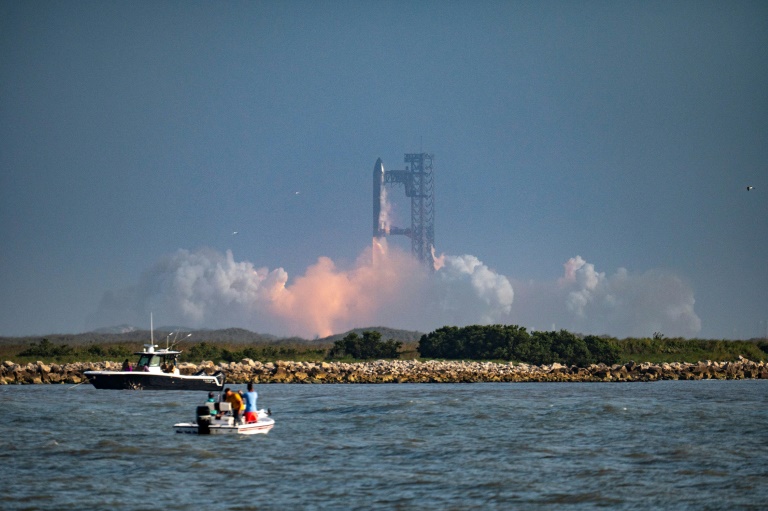
The SpaceX Starship rocket launches from Starbase, Texas, as seen from South Padre Island on May 27, 2025 – Copyright AFP/File Sergio FLORES
Olga Nedbaeva and Bénédicte Rey
Europe must quickly get its own reusable rocket launcher to catch up to billionaire Elon Musk’s dominant SpaceX, European Space Agency director Josef Aschbacher told AFP in an interview.
While the US company has an overwhelming lead in the booming space launch industry, a series of setbacks, including Russia’s withdrawal of its rockets, left Europe without an independent way to blast its missions into space.
That year-long hiatus ended with the first launch of Europe’s much-delayed Ariane 6 rocket in July 2024. But the system is not reusable, unlike SpaceX’s Falcon 9 workhorse.
“We have to really catch up and make sure that we come to the market with a reusable launcher relatively fast,” Aschbacher said at AFP’s headquarters in Paris.
“We are on the right path” to getting this done, he added.
– ‘Paradigm shift’ –
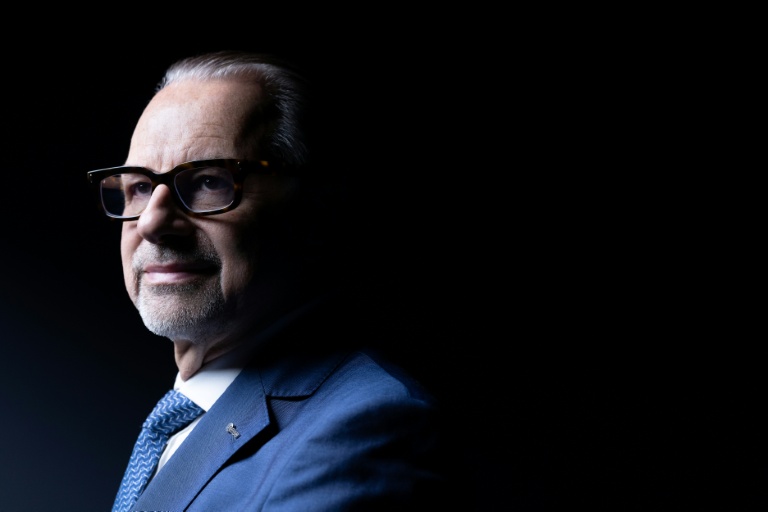
European Space Agency director Josef Aschbacher is calling on Europe to pay up to compete in a booming space economy – Copyright AFP JOEL SAGET
The ESA has already announced a shortlist of five European aerospace companies bidding to build the continent’s first reusable rocket launch system.
That number will be narrowed down to two — or even one — at the agency’s ministerial council in the German city of Bremen next month, Aschbacher said.
“Ariane 6 is an excellent rocket — it’s very precise,” Aschbacher said. “We have now had three launches,” with two more expected before the year’s end, he added.
Despite finally getting Ariane 6 and the new, smaller Vega C launcher off the ground, the ESA has decided on a “paradigm shift”, Aschbacher said.
“The next generation of launchers will be very different,” he told AFP.
When Ariane 6 was being planned more than a decade ago, reusability was not considered worth the extra cost and time.
But it has come under criticism when compared to the relatively cheap, reusable Falcon 9, which has completed well over 100 launches this year alone.
So the ESA has decided to emulate NASA, which also used to develop its own rockets but now outsources its launches to private companies such as SpaceX or Jeff Bezos’s Blue Origin.
– A European Starlink? –
Many of the Falcon 9 flights have carried the more than 8,000 satellites that make up Musk’s Starlink internet network into space.
The European Union is planning to create its own internet satellite constellation called IRIS2, scheduled to become operational in 2030.
“Europe needs it absolutely urgently,” Aschbacher said.
“We have to make sure that we have the rockets to bring our satellites to space.”
He stressed that IRIS2 would be “very different” from Starlink, with fewer satellites, while focusing more on “secure communication”.
The constellation will mark a technological leap forward, even though Europe sometimes lags “a few years behind” its competitors, Aschbacher said.
Aschbacher noted that the EU’S navigation satellite system Galileo and Earth observation programme Copernicus started out 10 to 15 years behind US competitors GPS and Landsat.
Now both EU programmes are “the best in the world”, he said.
Aschbacher lamented that European public investment in space is declining, even as the global space economy grows.
He called for “very strong financial engagement” from the ESA’s 23 member states, which includes the United Kingdom, at next month’s ministerial council.
– Impact of Trump cuts? –
In the United States, President Donald Trump’s administration has proposed slashing NASA’s budget, signalling it wants to cancel the joint Mars Sample Return mission with the ESA.
If the cuts go ahead, Aschbacher said, they could also affect shared missions such as the use of the International Space Station and the Artemis programme to put astronauts back on the Moon, he said.
The three ESA missions most likely to be affected are the EnVision mission to Venus, LISA gravitational wave observatory and NewAthena X-ray telescope, Aschbacher said.
However, Europe intends to complete these “flagship missions” even if the United States pulls out — perhaps by bringing in other partners, he added.
Aschbacher also said there had been “interest from our colleagues in the United States” in applying for jobs at the ESA.