
Visitors to the National Park Service’s Outer Banks Group — which includes Cape Hatteras National Seashore, Wright Brothers National Memorial, and Fort Raleigh National Historic Site — generated nearly $913 million in total economic output for Outer Banks communities in 2024, according to a new federal report.
“The report underscores the importance of our local National Park Service sites in attracting visitation to the Outer Banks,” said Lee Nettles, Outer Banks Visitor Bureau Executive Director.
“Aside from the economics, these three sites help to tell the story of our area, historically, culturally, and recreationally,” Nettles said.
The three national parks helped contribute to the overall $2.7 billion spent by visitors in the three Outer Banks counties of Dare, Currituck and Hyde last year, with Dare ranking fourth-highest in North Carolina at $2.1 billion alone.
The 2024 National Park Visitor Spending Effects report found that spending by visitors to national parks nationwide produced a $56.3 billion benefit to the U.S. economy, underscoring the value of America’s public lands to local and regional tourism.
According to the report, 2.8 million visitors to Cape Hatteras National Seashore spent an estimated $650 million in nearby communities, supporting 7,010 jobs, $277 million in labor income, $493 million in value added, and $852 million in total economic output.
Of the jobs supported by Seashore visitation in the area, 4,050 were in the lodging sector, 573 at restaurants, 252 in recreational industries, 222 in retail, 109 at campgrounds, 102 at grocery stores, 28 with fuel providers, and 26 with transportation providers (ride sharing, rental cars, etc.). Another 1,650 were classified as jobs from “secondary effects”.
Secondary effects are the sales, income and employment resulting from the ripple effect of National Park Service visitor spending throughout a regional economy, according to the report.
These ripple effects are the result of local businesses purchasing supplies and labor (indirect effects) and employees spending their incomes in the local economy (induced effects).
Secondary effects are equal to the sum of indirect and induced effects, and are estimated using economic multipliers.
Labor income generated by CHNS visitation was also led by accommodations providers at $154 million, followed by restaurants ($20.3 million), recreational industries ($9.6 million), retail ($6 million), grocery stores ($4.4 million), camping ($4.1 million), fuel providers ($1.6 million) and transportation providers ($1.3 million). Labor income from secondary effects totaled $75.7 million.
Value added impacts from Cape Hatteras were $279 million from lodging, $31.6 million restaurants, $13.9 million recreational industries, groceries $7.9 million, camping $7.4 million, fuel $2.8 million, transportation $2.8 million, and secondary effects $140 million.
Total economic output by sector from the Seashore: lodging $463 million, restaurants $61.1 million, recreational industries $24.1 million, retail $13.5 million, camping $12.4 million, transportation $13.5 million, groceries $10.7 million, fuel $4 million, and secondary effects $257 million.

At Wright Brothers National Memorial in Kill Devil Hills, 407,000 visitors spent about $28.6 million, supporting 311 jobs and $36.5 million in total output.

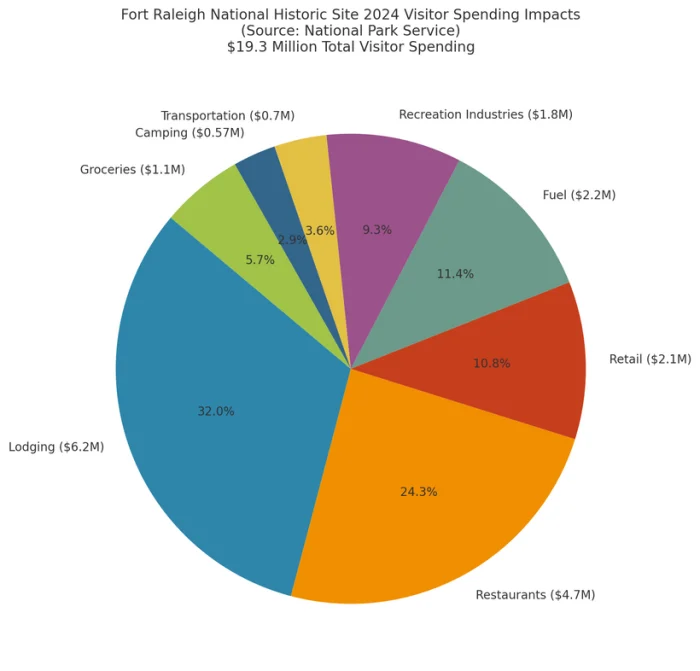
Fort Raleigh National Historic Site on Roanoke Island had 275,000 visitors that generated $19.3 million in local spending, supporting 208 jobs and $24.5 million in economic output.
When combined with Cape Lookout National Seashore and Moores Creek National Battlefield, visitors to the coastal national parks in North Carolina spent more than $732 million, supporting 7,879 local jobs.
Across North Carolina, national park sites welcomed 18.8 million visitors, whose combined spending totaled $2.3 billion in local gateway regions.
That activity supported 25,800 jobs, $1.2 billion in labor income, and $3.5 billion in total state economic output.
Nationally, visitors spent $29 billion in communities near parks, generating $18.8 billion in labor income and sustaining thousands of small businesses and tourism jobs.
Lodging led all categories with $11.1 billion in direct output, followed by restaurants with $5.7 billion.
“National parks deliver a clear economic return—supporting communities, driving tourism, and strengthening local economies in every state,” said Acting Assistant Secretary for Fish and Wildlife and Parks Kevin J. Lilly.
“As we approach the 250th anniversary of American independence in 2026, I encourage all Americans to reflect on our history and honor those who shaped it,” Lilly said. “Every visit to a park not only deepens that connection but also helps sustain the communities and economy that benefit from these treasured places.”
“Our parks are making a meaningful difference in local communities,” said Jessica Bowron, comptroller exercising the delegated authority of the NPS director. “These communities are essential partners in creating memorable visitor experiences, advancing conservation goals, and strengthening the economic health of areas surrounding public lands.”
The latest report includes updated economic and visitor data, reflecting both inflation and increased visitation at a number of national park units.
Results are available online through an interactive tool that allows users to explore visitor spending and economic impacts by park and state at https://www.nps.gov/subjects/socialscience/vse.htm