By David D’Arcy
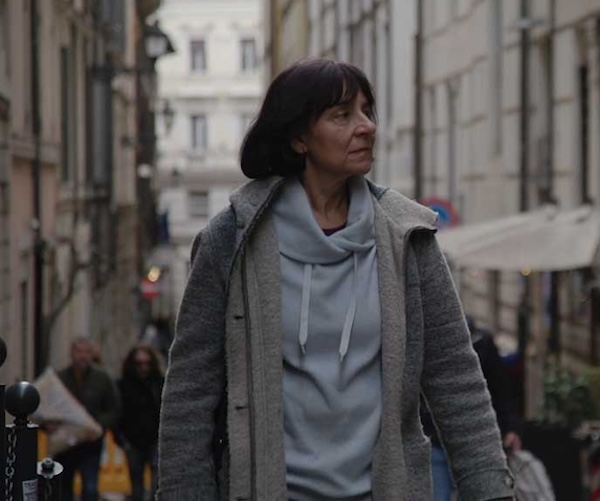
Nuns vs. The Vatican prepares its audience for an ongoing story that is expanding each time one more victim agrees to talk publicly. Do not doubt that there will be a sequel.
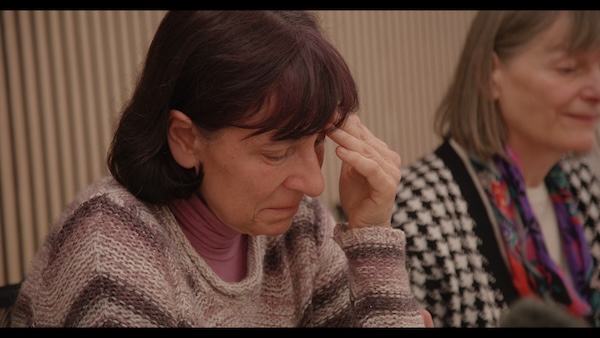
Gloria Branciani in a scene from Nuns vs. The Vatican. Photo: TIFF
The growing number of clerical abuse victims is not just a boys’ club.
A Jesuit priest subjected nuns to sexual abuse for years in Italy and Slovenia, according to a new documentary at TIFF, Nuns vs. The Vatican. The priest, Marko Rupnik, is an artist and is well known in elite Catholic circles. He is a former confidant of Pope John Paul II, a fellow East European, and was close to Pope Francis, a fellow Jesuit. Nuns have quietly reported his abuses for years. Rupnik, no longer a Jesuit, remains a Catholic priest.
Rupnik urged his principal accuser, Gloria Branciani, to abandon studies in medicine and join the Loyola Community in the late ’80s. A rare nun who is willing to discuss priest abuse publicly, Branciani says in the documentary that Rupnik forced her and others into sex. He stressed to her that their intimacy contributed to his work — which critics are calling “rape art.” She recalled that he and his staff threatened that Branciani would work in the kitchen for the rest of her religious life if she refused or if she spoke out.
Eventually, Branciani tried to kill herself and left the Loyola Community, a group of nuns over whom she said Rupnik wielded supreme authority.
Rupnik, now 72, had powerful friends. A prolific artist, he is known for his mosaics in a neo-Byzantine style that draws from Eastern and Western Christianity and has established a following among Church leaders that runs parallel to his notoriety among the nuns of his old community. Working with mosaics, his most important patron and exhibition venue has been the church. In Lorena Luciano’s film, his works are seen decorating the Redemptoris Mater Chapel of the Apostolic Palace in the Vatican. He also made mosaics for the facade of the Church of Our Lady of the Canadian Martyrs at Lourdes, for sites at Fatima (Portugal), for the St. John Paul II National Shrine in Washington DC, for Sacred Heart University in Fairfield, Connecticut, and for the Knights of Columbus in Washington and New Haven.
“I am an artist because I am a priest, and I am a priest because I am an artist,” Rupnik insists in the film, “If you want to caress God, you must give that love to a brother or sister, because that’s how you truly touch God.” This is the same man who reportedly told a young novice, “I have to f__k you to save you.”
One of Rupnik’s works was on view in an apartment used by Pope Francis. Hundreds more are at Catholic sites all over the world. These works include a giant mosaic that spans more than 43,000 square feet at the monumental National Shrine of Our Lady of Aparecida in Brazil, the world’s second largest church. Rupnik has also developed a lucrative side business, estimated in the millions of dollars, designing tombs.
At times Nuns vs. The Vatican, executive-produced by the Law & Order star Mariska Hargitay, feels like Spotlight 2.0 a l’italiana, given the church’s opaque structure, its glacial pace in addressing grievances, and suggestions that Rupnik’s superiors were aware of his abuse. The whispers of scandal were dismissed: this priest was a celebrity who spent a lot of his time in the public eye. The respected journalist Peter Steinfels of the New York Times wrote approvingly about Rupnik’s mosaics at Sacred Heart (CT) in 2009. Self-marketing fueled his career and status.
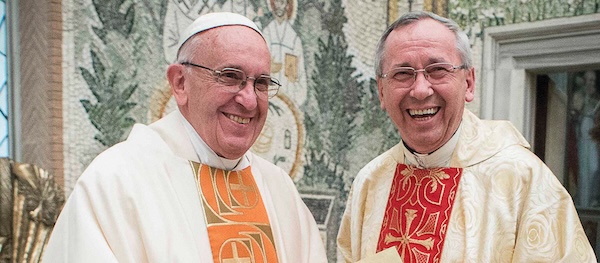
Pope Francis and Marko Rupnik in the Vatican in 2016. Photo: TIFF
It took the courage of one woman to testify publicly to transform the case against him. “Nuns don’t talk. They are ashamed. They don’t trust institutions,” the journalist and podcaster Federica Tourn told me, “obedience inside the Vatican isn’t just expected, it’s essential. The only way to break that silence was to have a face and a name, because fear and shame are the Vatican’s tools. There is a weapon that they have in their hands, which is silence.” The documentary follows the pursuit of Rupnik by journalists like Tourn, whose appropriately-named podcast, “La Confessione” (so far only available in Italian), goes into incriminating detail.
If Rupnik’s alleged patterns of abuse sound like those endured by male victims, his sexual adventures, along with his defense of them, are a mix of melodrama and cruelty say his victims. Sex, Branciani was informed, went hand-in-hand with the priest’s art. The young woman became a model for Rupnik’s mosaics, which the priest said required her sexual cooperation to be realized. Rupnik explained that threesomes with women or other men — that he recommended — were inspired by the Holy Trinity. He and Branciani also looked at pornography together – another formative element for his art? As Branciani describes those moments, often through tears, it’s hard not to find resonances of the Marquis de Sade in Rupnik’s self-dramatization.
Rupnik’s sexual gambits relied on the misery of others. Young women were made available to Rupnik from the Jesuit-connected Loyola Community. About half of the women there were raped, Branciani says. The documentary reveals patterns resembling those of Jeffrey Epstein, such as access to elite circles of power and the enforcement of a tough Mother Superior, Ivanka Hosta, who kept the other nuns in line – a Slovenian version of Ghislaine Maxwell.
In 2020, Rupnik was excommunicated from the church for absolving a young novice with whom he had sex. He granted that absolution from sin in the confessional – an act beyond chutzpah, to borrow a term from another religious tradition. But he repented, and the excommunication was withdrawn. In December 2022, the Jesuits confirmed that they had suspended Rupnik after charges of abuse, but later dismissed that punishment after the Vatican’s Dicastery for the Doctrine of Faith, an office in the Roman Curia enforcing discipline, cited statutes of limitations.
Rupnik was expelled from the Jesuits in June 2023 for violating restrictions imposed on him after allegations of the abuse over three decades from more than 20 women and one man came to light. Two months later, he was incardinated (admitted, as a priest) by the diocese of Koper in Slovenia.

Nuns vs. The Vatican director Lorena Luciano. Photo: courtesy of the artist
Ivanka Hosta, who parted with Rupnik in 1993, lives under the authority of the diocese of Braga in Portugal. A church commission ruled that she must journey regularly to Italy to pray for those who suffered under her regime in Slovenia. It’s penance, but not much. Branciani and other nuns from the Loyola Community note with chagrin that church law views the abuse of anyone but a minor as a sin, rather than a crime.
Rupnik’s art projects were administered out of the Centro Aletti, an art studio in Rome that he founded in the ’90s. Commissions kept coming in as those who reported the man’s abuses left religious life and sank into despair and isolation. If the vow of poverty taken by all nuns sounds severe, the poverty endured by those excluded for speaking out was far worse. Rupnik’s first expulsion from the Jesuits came after he violated his oath of obedience. So did his final and most lasting expulsion.
In Nuns vs. The Vatican, priests willing to talk to the press stress that Rupnik has not been found guilty, that his accusers are jealous of his fame, and that other unnamed priests are guilty of abuses that are far worse. Oh, really? Like what? (Those ‘other’ clerics and their abuses aren’t named.) Statutes of limitation have also worked in Rupnik’s favor. One Catholic writer, troubled by Rupnik’s lax treatment, tried to set the record straight in an article entitled “When It Comes to Comparisons With Father Rupnik, Think Cosby, not Caravaggio.”
Now a panel formed by the Vatican’s Dicastery for the Doctrine of the Faith (formerly known as the Congregation for Doctrine of the Faith) will review charges and pass judgment on Rupnik, but he won’t necessarily be subjected to prison or fines. Massive money damages, like those imposed on priests and dioceses in the US, are rare in Europe.
As that body deliberates – the investigation of nuns’ charges continues to move slowly – there are calls to destroy Rupnik’s works, to remove them, or at least to cover them, as has already been done at Lourdes and at offices of the Knights of Columbus in Washington DC and New Haven. At Aparecida in Brazil and in Spain (where the greatest number of Rupnik mosaics can be found), his art remains on view. Cemeteries in Slovenia are filled with his tomb mosaics. Reports in Italian blogs say China is proving to be a new market.
The case against Rupnik has finally reached the public, thanks to more women testifying and media spurred on by Catholic journalists and a dogged Italian blogosphere. In the film, the TV journalist Roberta Rei finds Rupnik picking up his luggage at Fiumicino Airport in Rome; she bombards him with questions for ten minutes, none of which are answered. Instead, the priest’s assistant blocks her and her camera from filming. A shaky, hand-held clip of that one-sided encounter has been taken off the internet, supposedly because of a rights issue, but some of the footage can be seen in the documentary.
So far, the abused women of the Loyola Community can take comfort in the renewed bonds they have made with each other. Meanwhile, their lawyer, Laura Sgro, is still pressing the Vatican for accountability.
Americans who see this troubling film or read about the Rupnik scandals will want to know more about clergy abuse of nuns closer to home. Nuns vs.The Vatican focuses on the US to revisit two cases. A study done in the mid-’90s at the University of St. Louis, a Jesuit institution, found that a third of female clergy responded that they had been abused by priests. A faculty member involved in conducting the study says he sent the report to church hierarchy in St. Louis and received no answer. The archdiocese of St. Louis now faces multiple abuse lawsuits.
The film also contains testimony from an American nun, raped by a priest, who became pregnant and underwent an improvised abortion that went awry and almost killed her. A doctor — summoned to keep her alive — added some abusive behavior of his own.
Nuns vs. The Vatican prepares its audience for an ongoing story that is expanding each time one more victim agrees to talk publicly. Do not doubt that there will be a sequel.
David D’Arcy lives in New York. For years, he was a programmer for the Haifa International Film Festival in Israel. He writes about art for many publications, including the Art Newspaper. He produced and co-wrote the documentary Portrait of Wally (2012), about the fight over a Nazi-looted painting found at the Museum of Modern Art in Manhattan.