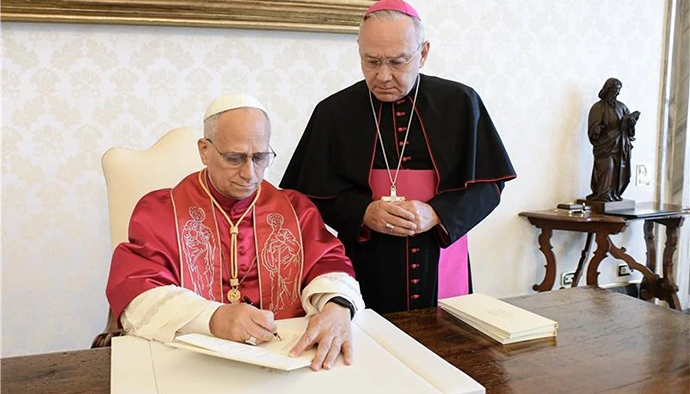
Pope Leo XIV signs his first apostolic exhortation, ‘Dilexi te’, at the Vatican, Saturday, Oct. 4, 2025 (Credit: Vatican Media)
Pope Leo XIV’s first magisterial document of his papacy, Dilexi Te (“I have loved you”), has understandably generated a lot of interest. An apostolic exhortation is a fairly low-level document in terms of the classical criteria for adjudicating the authority of magisterial texts. Pope Leo has played his cards close to the vest during these first months of his papacy, doing and saying little that would generate much controversy, and so the level of interest in this—the first of his documents—is running almost at a fever pitch. And so it is not surprising that many Catholics from all sides of the ecclesial spectrum have submitted the new text to a detailed analysis to glean any hints of where Pope Leo intends to take the Church.
I think that has led many to overthink the text and to see in it more than it intends or portends. All in all, for reasons I will elucidate below, I think Dilexi Te, though a fine document that is at points both profound and beautiful, says very little that is new in the sense of a theological novelty, says hardly anything even mildly controversial, and is at pains to position itself as in total continuity with the Tradition. I liked the text, but I think those seeking a deeper insight into the mind of Pope Leo will come away empty-handed.
No new insights into the thought of Pope Leo
For starters, this is a text that was largely already written by Pope Francis. And it is difficult, if not impossible, to know which bits of it are from him and which are from Leo. One can say that such things do not matter since Pope Leo put his signature to its final iteration, but such things do matter. It may be that, as with the first encyclical from Pope Francis (Lumen Fidei), which was mostly written by Benedict, publishing the mostly finished final writings of a recently deceased (or retired) pope is more an act of papal homage to their predecessor than a completely programmatic expression of the new pope’s deepest convictions. It might just be a magisterial gesture in the direction of continuity with one’s predecessor than a robust statement of where the new pope plans to go with his thought and pontificate.
By contrast, St. Pope John Paul II’s first encyclical, Redemptor Hominis, was a Christocentric theological anthropology very near and dear to his heart. And as his full papacy made clear, it was indeed a definite programmatic statement from the new Pope about the main themes of his papacy. However, Lumen Fidei was not that, nor, I suspect, is Dilexi Te.
I am not saying that this habit of publishing unfinished papal texts from one’s immediate predecessor is little more than an empty encomium in the form of a eulogy, signifying little. It obviously means something, and that could be nothing more than the obvious. To wit, Pope Leo really does have a love for the poor and desires that the Church take the matter seriously. Nevertheless, there is a definite sense in which Dilexi Te is not yet a full-orbed expression of what the main themes of Leo’s papacy will be.
In other words, the Pope, who has so far played his cards close to the vest, continues to do so.
The second reason this new document may not provide the tea leaves some desire for reading the future direction of this papacy is that it deals with relatively uncontroversial topics. And, once again, that may be by design. Poverty of body and soul, economic injustice, greed, the spirit of acquisition, the libido dominandi as it gets expressed in the typical dominance of the wealthy over the poor and weak, the commands of our Lord regarding to wealth and poverty, are hardly the stuff of deep disagreement and sharpened controversy. There are precious few in the Church who would disagree with what the pope says on those topics.
Immigration and free markets
The closest Dilexi Te comes to controversy is its treatment of the issue of immigration. Nevertheless, even here it touches upon the topic in ways so generic that no particular political policy recommendation can be discerned from it with clarity. As one might expect from a pope who spent many years as a missionary in Peru, Leo is certainly not a populist nationalist who seeks to promote a neo-isolationist nativism that turns its back on immigrants who are seeking asylum. Nevertheless, neither does he come across as an advocate for globalist removal of all national borders and a total “open door” policy of unrestricted access to any nation an immigrant may choose to enter.
Instead, the document swims in the safe waters of rather anodyne comments about the full dignity of all human beings, native or migrant, and the need to treat everyone with respect and with a deep charitable impulse to help everyone achieve a fully human integral development as persons. Who can disagree with that?
Therefore, critics of this document who view it as expressive of some kind of George Soros-style globalist agenda in league with the “Davos elites” are engaging in unvarnished alarmist nonsense. It is nothing of the sort, as can be easily seen in the fact that a good 60% of the text is dominated by a thick retelling of the lives of the many saints in the Church’s history who have championed the cause of the poor, the sick, the immigrant, the socially marginalized, and the imprisoned. Pope Leo could not be clearer that the bonds of Christian charity are not reducible to mere philanthropy and that the Church is not just another humanitarian aid agency.
Similarly, there is too much overthinking about the text regarding the topic of free markets. Nowhere in the text does the Pope advocate for a socialist answer to economic inequality. It is true that he criticizes “free markets”, but it is also abundantly clear that when read charitably and in full context, those remarks are aimed at a particular kind of free market capitalism. It is targeted at those forms of free market economics that view the invisible hand of the market as existing in a zone of amoral indifference to human need, the universal destination of goods, or the higher moral purposes that must accompany wealth accumulation lest it devolve into a bestial social Darwinism.
One may say that this is a fiction of the pope’s imagination and that no such robber baron capitalism exists anymore, but they would be wrong. Gone are the economic oligarchs of oil, coal, railroads, and shipping, and in their place we have the oligarchs of our new digital paradigm of computer tech, military weaponry, and financial and commodity speculation.
Seen in this light, everything that Pope Leo says in the text about the shortcomings of specific kinds of free market economies is completely in line with all previous papal social teachings, stretching from Leo XIII and on down through Francis. Absolutely nothing in Delexi Te is out of step with previous papal teaching on the potential pitfalls of unbridled free market economies.
The Christological concentration and defining “the poor”
My point, once again, is that Dilexi Te says very little that is new, controversial, or unsettling. It is in places beautifully written, even moving, and when it deals with the “poverty” of Christ (section 18 and following) it reaches levels of lyrical theological beauty that are truly the key to the whole document. The section begins with this:
The Old Testament history of God’s preferential love for the poor and his readiness to hear their cry — to which I have briefly alluded — comes to fulfillment in Jesus of Nazareth. By his Incarnation, he “emptied himself, taking the form of a slave, being born in human likeness” (Phil 2:7), and in that form he brought us salvation. His was a radical poverty, grounded in his mission to reveal fully God’s love for us (cf. Jn 1:18; 1 Jn 4:9). As Saint Paul puts it in his customarily brief but striking manner: “You know well the grace of our Lord Jesus Christ, that though he was rich, yet for your sakes he became poor, so that by his poverty you might become rich” (2 Cor 8:9).
So there is a Christological concentration that breathes fire into the equations of what would otherwise be merely human stratagems. On this point, Pope Leo could not be clearer, and insofar as this Christocentrism is the hermeneutical key to the whole, it places him in firm continuity with every pope of the 20th century and before.
Some critics say the text is characterized (some would even say “marred”) by a breezy set of generalizations about “the poor” and “migrants” and the different “kinds of poverty” to the point of a kind of romanticized idealization. The poor in this text, so the criticism goes, are never the conniving liars and manipulators that many of them are in reality. And migrants are never portrayed as sex trafficking coyotes or drug runners for murderous cartels. They are instead portrayed by Pope Leo as purely innocent victims of economic and political oppression in our unjust system.
However, in my opinion, the pope is instead rightly deriding the classical distinction between the “worthy and the unworthy poor” as a mere tool of the rich and powerful to dismiss the moral claim laid upon them. As he states in section 14:
The poor are not there by chance or by blind and cruel fate. Nor, for most of them, Is poverty a choice. Yet, there are those who still presume to make this claim, thus revealing their own blindness and cruelty. Of course, among the poor there are also those who do not want to work … However, there are so many others – men and women – who nevertheless work from dawn to dusk, perhaps collecting scraps or the like, even though they know that their hard work will only help them to scrape by, but never really improve their lives. Nor can it be said that the poor are such because they do not ‘deserve’ otherwise, as maintained by the specious view of meritocracy that sees only the successful as ‘deserving’.
In this quote, we see no romanticization. What we see is the clear-eyed expression of the full reality of poverty from a man who has seen it up close and personal in Peru and elsewhere. In our country, much of the poverty we see is caused by drug addiction and/or untreated mental illness. And if I had one wish, it is that the pope had addressed those realities as real causes of much of the poverty in economically affluent societies. However, he is entirely correct to note that around the world, in nations that have huge swaths of impoverished persons, this poverty is not caused by laziness or rank stupidity but is instead the product of unjust economic and political structures.
This statement from the Pope also exposes the critics of the Church’s preferential option for the poor as the actual perpetrators of vague abstractions in the service of an ideology. For example, there are American critics of this text who can cite every single crime and act of violence by immigrants to Europe and America as evidence of why mass deportations are justified without making distinctions between the criminal element and those who are here without harm. An illegal is an illegal, some insist, and no such distinctions are necessary; they are an abstraction insofar as they are all, by statutory definition, “criminals”.
Yet those same critics ignore our own history as a nation that allowed tens of millions of Irish and Italian immigrants to enter this country, and who promptly formed some of the most violent and evil criminal organizations in the world. And today, such immigrants are now lionized and praised as the great addition to our society that they were, despite the nativist backlash they experienced at the time and despite the very real criminal element within their ranks.
This historical amnesia, combined with constant references to the unique evils of modern immigration, is itself a subtle lie that Pope Leo is rightly calling out. He is not advocating open borders. But he is obviously also opposed to strictly closed borders, as we all should be in the run of Christian charity.
The Pope is well aware that poverty and immigration often go hand in hand and that it can create awful social conditions. And nobody is claiming, including Pope Leo, that nations do not have the right to control and regulate borders. But he is reminding us that borders are not absolute and that the rise of the modern concept of the “sovereign nation state” is itself open to an idolatrous apotheosis of one’s own country. In this regard, one aspect of Dilexi Te that needs emphasizing is the Pope’s focus upon the traditional Catholic doctrine of the universal destination of all goods. Private property is not absolute and is instead a function of the universal destination of goods when properly understood in its full social context (see section 86).
But beyond social context, the entire tone and tenor of Dilexi Te is Christological. The universal destination of all goods, irrespective of its grounding in natural law, is first and foremost grounded in the common origin and destiny of all things in Christ. Drawing copiously from the writings of Paul VI, John Paul II, Benedict XVI, and Francis, Pope Leo underscores the deep Christological continuity of the Church’s teaching on our obligation to see the face of Christ in the poor.
Monasticism and true inclusion
Finally, I would like to note the pope’s analysis of the Church’s monastic tradition and the relationship between the monasteries and the poor as yet another example of his Christological focus. Pope Leo states:
In the West, Saint Benedict of Norcia formulated a Rule that would become the backbone of European monastic spirituality. Welcoming the poor and pilgrims occupies a prominent place in the document: “The poor and pilgrims are to be received with all care and hospitality, for it is in them that Christ is received.” These were not just words: for centuries Benedictine monasteries were places of refuge for widows, abandoned children, pilgrims and beggars.
Over time, Benedictine monasteries became places for overcoming the culture of exclusion. Monks and nuns cultivated the land, produced food, prepared medicines and offered them, with simplicity, to those most in need. Their silent work was the leaven of a new civilization, where the poor were not a problem to be solved, but brothers and sisters to be welcomed. The rule of sharing, working together and helping the vulnerable established an economy of solidarity, in contrast to the logic of accumulation. (55-56)
I think it is significant that Pope Leo begins this section by recalling the Christological grounding of Benedictine hospitality, but then links it at the beginning of the next section to “overcoming the culture of exclusion.” I think this might be one of the most important and (so far) most neglected statements in the text. I think it is no accident that the pope is grounding a properly Catholic notion of “inclusion”—a term much used and abused today in the breaking down of barriers initiated by Christ, who alone grounds the solidarity of the human race in himself.
Therefore, it is more than a mere statement of sociological significance. The Pope is affirming that all notions of “inclusion” must ultimately be Christological and rooted in the Gospel and not in any secular ideology.
All in all, as I said at the beginning, Dilexi Te is actually a strikingly unremarkable text in terms of any novelty we might be seeking. It is instead a rather typical amalgam, so characteristic of modern popes, of tradition and a concern for modern social conditions. In that regard, Pope Leo XIV might just be not so different from Leo XIII and should be read through that lens.
Finally, and I say this with some relief, the text is in many ways a simple recapitulation of long-standing Catholic teaching, stated without saying anything really controversial or unusual. And perhaps that is the best thing about it.
If you value the news and views Catholic World Report provides, please consider donating to support our efforts. Your contribution will help us continue to make CWR available to all readers worldwide for free, without a subscription. Thank you for your generosity!
Click here for more information on donating to CWR. Click here to sign up for our newsletter.