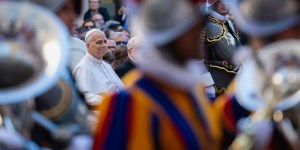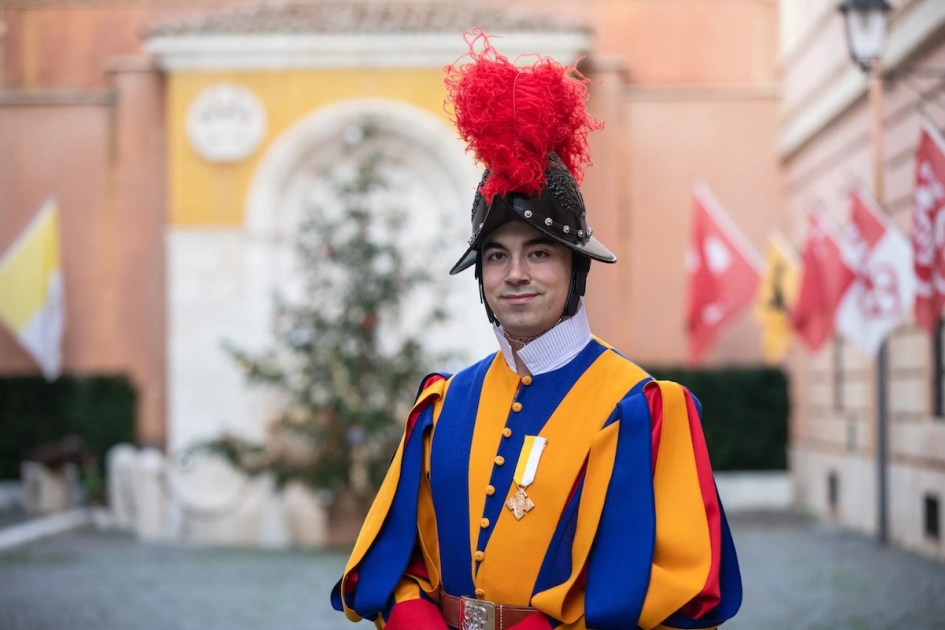
With the Jubilee, the death of Pope Francis, the conclave, and the first steps of Pope Leo XIV, the Swiss Guard is experiencing a historic year in 2025. Corporal Eliah Cinotti, spokesperson for the Swiss Guard, looks back on how the world’s smallest army accompanied Pope Francis to the end and ensured the protection of the conclave.
With the advent of Pope Leo XIV, he also recounts how the world’s smallest army must adapt to a new style and new challenges.
The last days of Pope Francis
How did the Swiss Guard experience Pope Francis’ hospitalization?
Corporal Eliah Cinotti: First of all, I must say that we were all praying for him. At the barracks, we were convinced that he would return to the Vatican even stronger. This had been the case during his previous hospitalizations.
When he returned after 38 days at Gemelli Hospital, we still felt the same. He was weakened, of course, but he was lucid and affable, always with kind words on hand for certain guards. We imagined he’d need a few weeks of convalescence, followed by a 200% return to form. In fact, his presence on Easter Sunday in St. Peter’s Square seemed to confirm this. But he died the next morning. To depart on Easter Monday after greeting his people … What a magnificent image!
For you, was it all hands on deck?
Corporal Cinotti: For my part, I was on leave in Assisi when I heard of the Pope’s death. I couldn’t believe it. Then I was immediately called back to Rome. We had a mission: to accompany the Holy Father to his final resting place.
I’ve never seen the Swiss Guard as focused and determined as they were during those historic days. The services followed one after another to such an extent that, for me and many other guards, the mourning for our pope took place later, during the summer.
For some, Pope Francis was like a grandfather, a role model. He also left his mark on the Swiss Guard by increasing the number of guards from 110 to 135, allowing guards to marry after five years of service, and increasing the Guard’s presence during apostolic journeys.
Clear protocols for the funeral and conclave
Was the Guard preparing for such an event?
Corporal Cinotti: Not particularly. In fact, everything is recorded in a protocol that we had in the archives from 2005. We followed the procedure to the letter. Things ran smoothly because our daily expertise enabled us to respond to such a mobilization. The gestures, attitudes, and steps don’t change. The pace was undoubtedly a little slower when we accompanied the coffin.
After the death of Pope Francis, the Seat of Peter was vacant. Was your mission then to protect the cardinals?
Corporal Cinotti: That is one of our missions. Before the conclave, the cardinals are free to move about as they please. They can sleep outside the Vatican. But on the eve of the conclave, they arrive at the Santa Marta residence.
We watch over them as we would a pope. It’s not the most complicated task because they’re cloistered, have no contact with the outside world, and it doesn’t last very long. Our mission is not to disturb them, to maintain an atmosphere cut off from the world and connected to the Holy Spirit.
For the conclave, the commander of the Guard and the major take an oath. The commander is stationed in front of the door to the Sistine Chapel. When the election is over, he is the first military officer to greet the new pope and accompany him to the balcony for the blessing.
Welcoming Pope Leo XIV
Can you describe the atmosphere in the barracks when the white smoke appeared?
Corporal Cinotti: It was a moment of great excitement. But it was perhaps the first time I saw the Guard ready in three minutes. I was part of the picket line on the steps of St. Peter’s Basilica, under the Loggia where the new pope was to appear. When I heard the words “habemus papam,” I thought I’d lost my hearing because the crowd was screaming with joy. Then the name was announced.
Obviously, it was impossible to discuss the news with the person next to you. It was also impossible to look up to see the new pope in the Loggia. In fact, we were among the last to see Cardinal Prevost in his Leo XIV robes with our own eyes.
How did the Guard experience the arrival of Leo XIV?
Corporal Cinotti: It’s exciting because everything’s new. We’re fortunate because Cardinal Prevost knew us well. He’d come to see a film about the Swiss Guard and had also attended the last two swearing-in ceremonies. He knows what our mission is.
In the early days, Pope Leo XIV had to get used to being pope. We can now see that he really enjoys human contact. He doesn’t hesitate to spend time with the crowd before and especially after general audiences. He is very calm, which is very valuable for a security service. Our mission is to ensure that he remains so. This requires constant vigilance.
Adapting to the new pope
Does he have more protection?
Corporal Cinotti: The pope is always a very exposed person. Leo XIV was elected at the age of 69. He was therefore 19 years younger than Pope Francis at the time of his death. We’re adapting to his youth and greater mobility.
But I must say that we’re facing a new problem: objects being thrown during large events in St. Peter’s Square. The Pope once caught a tennis ball in mid-air, and since then, it has become fashionable to throw stuffed animals, flags, and other objects. This is a real challenge for the security services.
In addition, many parents hold out their children for the Pope to bless them. As we are in the digital age, they immediately take out their phones to film the scene, so that when we turn around to return the child, we no longer know who the child belongs to …
You also had to deploy to the Palace of the Holy Office, where the Pope lives, and then to Castel Gandolfo …
Corporal Cinotti: We did indeed leave the Santa Marta residence where Pope Francis lived to provide security for the Palace of the Holy Office. As for Castel Gandolfo, it was a rediscovery, since Pope Francis had never slept there in 12 years of pontificate. The know-how had almost been lost.
Very quickly, the Guard adapted to secure Villa Barberini, the papal residence that the Pope visits almost every Tuesday.