
Growing up as the only Jewish student in her school in Germany, Hanna Veiler, 27, had to figure out what her Jewish identity meant to her at a young age.
“My family moved from Belarus when I was seven, and our family wasn’t allowed to practice religion or develop any sort of positive Jewish identity for decades,” Veiler, the newly elected president of the European Union of Jewish Students (EUJS), told The Times of Israel. “Like many people of my generation growing up in Eastern Europe, I had to struggle to relearn what this means and form it into a positive identity.”
With antisemitism spiking on university campuses across Europe and the world, Veiler will have to put those lessons to good use quickly. A recent report by B’nai B’rith International, in cooperation with EUJS and Berlin’s democracy watchdog democ, described a growing climate of anxiety and exclusion among Jews across the academic world, with university administrations enabling violent protests instead of working to quell them.
Another recent survey by the Anti-Defamation League (ADL) and the World Union of Jewish Students (WUJS) found that more than three-quarters of Jewish students around the world are afraid to share their identities publicly. “The situation is nothing short of dire,” that report concluded.
EUJS is a 47-year-old umbrella organization for students and young professionals in 36 countries across Europe. During her two-year term, Veiler will be charged with leading a movement working to help an estimated 160,000 young adults ages 18-35 stand up for their rights as European Jews.
“It’s going to be a top priority to help young Jews reclaim their own narratives,” said Veiler, who previously served as president of the German Union of Jewish Students. “Since the October 7 attack, we’ve been living in a reality where Jewish students have been pushed against the wall and forced to defend ourselves, but not be able to address the things that are important to us. It’s time for us to raise our voices.”

EUJS president Hanna Veiler in an undated picture (Courtesy)
Students throughout the continent face increasing intimidation, threats of violence and an endless flood of antisemitic attacks: At the University of Strasbourg in France, students were beaten by attackers shouting “Zionist fascists”; a Jewish student at the Free University of Berlin hospitalized with facial fractures after a violent assault; a co-president of Belgium’s Jewish student union attacked while retrieving his car beside a protest encampment; an “Intifada” encampment at the University of Vienna threatening Jewish students on Holocaust Remembrance Day.
Veiler and her seven-person board have no illusions that this reality is going to change in the near future as they continue to work with European policymakers and local leaders.
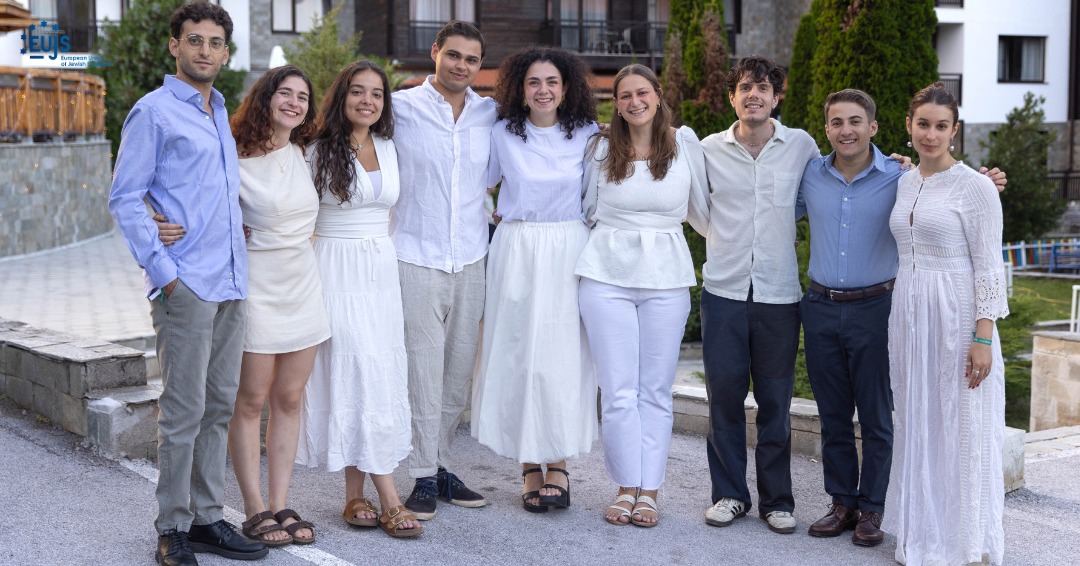
The new EUJS board, August 2025. (EUJS)
“We’ll have to continue defending ourselves, because antisemitism isn’t going away, but we have to start speaking up for our place in European society, for equality and justice, for peace in the Middle East. We need to start telling our stories so the world sees what it means to be a young Jew in Europe at this moment,” she said.
A model for Jewish student life
To understand what life looks like for Jewish students in Europe, it is important to understand how it is different from the American college experience, said Dalia Grinfeld, associate director and program manager in Europe for the Anti-Defamation League (ADL).

Dalia Grinfeld, the ADL’s associate director of European Affairs (Courtesy)
While many US colleges tend to operate within clearly defined campuses that keep dormitories, academic buildings, and other facilities close together, most European universities are spread throughout their cities, with classrooms and student apartments scattered across different neighborhoods, Grinfeld explained.
That makes Jewish student life less centralized and more exposed to the city’s broader urban Jewish community, Grinfeld said.
“That means campus antisemitism shows up differently in the data,” Grinfeld explained. “When we talk about an assault or incident, it might refer to something that happened on public transport or on the way to class, and not on an actual campus.”
Organizations like Hillel and Moishe House exist in some countries, but they tend to cater to all young Jews, not just students, and rarely have a physical presence on campus itself, Grinfeld added.

Students at the entrance of the Sciences Po in Paris, France, on March 13, 2024. (Emmanuel Dunand/AFP)
In Europe, most Jewish programming, events, and advocacy are organized by students for their peers, with little help from institutions or organizations, Grinfeld said. Financial support for Jewish students typically comes from national Jewish umbrella organizations or the city’s Jewish community, rather than from the university itself. That can make becoming a student leader very engaging and empowering, but also limits how much they can actually accomplish.
People who take on Jewish student leadership roles mark themselves publicly as Jews, potentially marking themselves as targets for antisemitic activities, Grinfeld noted.
“There are a lot of people who are very proud of their ethnic heritage, but aren’t comfortable speaking about Israel with their peers or wearing Zionist symbols,” Grinfeld said. “That makes it much harder.”
According to the B’nai B’rith International report, hostility toward Jewish students is only growing, with anti-Israel organizations dialing up intimidation tactics under the guise of pro-Palestinian activism.
Most university administrations have been reluctant to take strong stances against antisemitism, contributing to an environment where calls for intifada, glorification of Hamas, Holocaust distortion, and other rhetoric have become the norm, the report found.

People walk by banners hanging inside a window of an encampment set up by pro-Palestinian and anti-Israel students and activists at Ghent University, as students occupy parts of the campus in Ghent, Belgium, May 16, 2024. (AP Photo/Virginia Mayo)
“Students tell us they do not feel that their peers on campus are acting as allies to them as Jews, and that the progressive movements in these spaces do not stand up for Jews any longer,” Grinfeld said. “The institution of universities as a place of learning and identity building is now a place of threat and unsafety, and this is a long-term problem for the Jewish community.”
Learning to respond
To help students learn to adjust to the new reality, Grinfeld heads the ADL’s “Words to Action” project, a training program designed to teach students the history and current manifestations of antisemitism and provide practical tools to respond.
Some 4,500 students in 25 countries have participated in the one-day seminar since it was launched in 2022, Grinfeld said.
“We start by focusing on helping people understand the history of antisemitic myths and stereotypes, so they know that the tropes they see on campus are old, even if they seem current,” Grinfeld said. “We show them photos from current demonstrations, and then we look at textbook depictions of old-time antisemitism, from the Spanish Inquisition or the last century, and they have to find the common denominator.”

An example from the ADL’s “Words to Action” training manual (ADL)
“This is really difficult for many people, but this is an important building block to help them put things into context before they take it further,” Grinfeld added.
“For many, this is the first time in their lives they experience what it is like to actually speak out and stand up for themselves as a Jew,” Grinfeld said.
Veiler, the new EUJS president, agreed. “Many Jews today see themselves only as victims,” she said. “But historically, we’ve always taken responsibility, not only for our own communities, but for societies as a whole.”
Grinfeld claimed data collected by the ADL shows that this training gives students an average boost of 25% in confidence to respond. Students then learn strategies for comebacks to different attacks, along with role-playing different scenarios.
“For many of the people doing this training, this is the first time they have ever talked about antisemitism with their own Jewish peers, and it’s the first time they’re being asked about what it means to them, how they view Israel, and how their experiences are similar to their peers. From that standpoint, this is something that is so valuable to them,” she said.

European students learn about antisemitism in Czechia in May, 2024 (ADL)
To Veiler, getting comfortable standing up and pushing back as a Jew is one of the biggest challenges for European students today.
“Since October 7, most young Jews have felt like they had their backs against the wall, with very little room to feel safe,” she said. “But they are also realizing that being a Jew at this time means to be aware of the incredible resilience that our culture and community give us.”
“We have to keep living a confident Jewish life as much as we can, celebrating our Jewishness, learning together, fostering community, and asking ourselves how we can make this world better for everyone,” Veiler said. “Being a Jew means not giving up.”