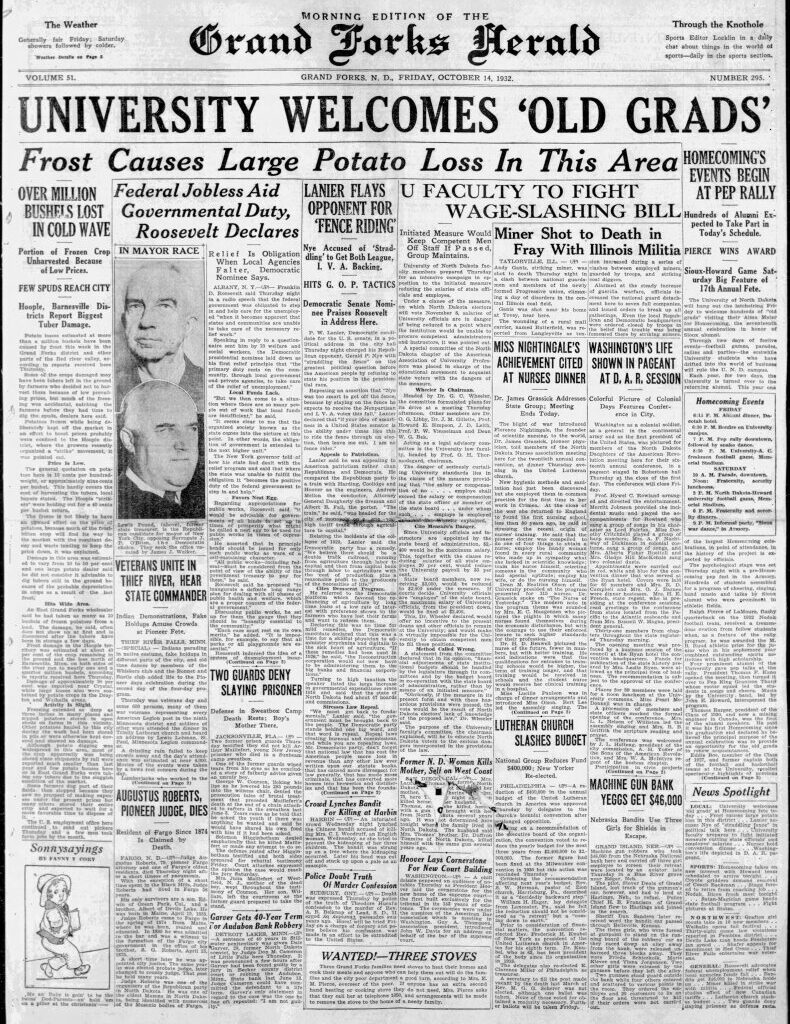
Today in History revisits the Friday, October 14, 1932 edition of the Grand Forks Herald and highlights a story on the U.S. studying the effect of new Canadian tariffs. Experts like Dr. Julius Klein believed American ingenuity would overcome the duties. The story mentions how U.S. companies adapted to Australian and South American tariffs by shipping components instead of finished goods, suggesting a similar strategy would maintain U.S. access to Canadian markets.
FEDERAL EXPERTS STUDY EFFECT OF CANADIAN TARIFFS
Britain Expects Trade Boost of 70 Millions; Hits U. S. Goods
WASHINGTON. — (AP story as published by the Grand Forks Herald in 1932) The extent to which United States exports will be affected by the changes in Canadian tariffs was said Thursday, Oct. 13, 1932, by Dr. Julius Klein, assistant secretary of commerce, to be indeterminate until it is seen how far American ingenuity will be able to circum- vent disadvantages in the new schedules. He said Canadian industry is largely “Americanized,” both in habits and capitalization, leading to a natural disposition to favor products of this country, which might surmount to a considerable extent adverse price factors brought about by the tariffs.”
Klein mentioned use by Canada of machinery, structural steel and many products of the American type rather than the British. Also, he said, the question of delivery time and service on American products would do much to hold the market for materials not specifically prohibited.
Beyond these direct factors, the commerce official emphasized dexterity of American industry for substituting new products for those blocked by tariff or other barriers. He said it was entirely possible that through this means domestic manufacturers would keep command of markets which, on paper might appear to have been diverted to Great Britain.
He cited as examples the reac- tion which followed an Australian tariff on American automobile tires. The original market was closed, he added, but the manufacturers quickly turned to shipment of fab- rics and tire components not pen- alized, and built up a larger busi- ness than the original. When Argentine and other South American countries imposed spe- cial tariffs on cotton textiles, he said, materials for the manufacture of cloth were shipped instead, to a greater value than the finished product. Klein expressed a belief that none of the new duties imposed by Canada would prove prohibitive. However, experts of the depart- ment were hard at work analyzing each change made by the neighbor nation.

Our newsroom occasionally reports stories under a byline of “staff.” Often, the “staff” byline is used when rewriting basic news briefs that originate from official sources, such as a city press release about a road closure, and which require little or no reporting. At times, this byline is used when a news story includes numerous authors or when the story is formed by aggregating previously reported news from various sources. If outside sources are used, it is noted within the story.