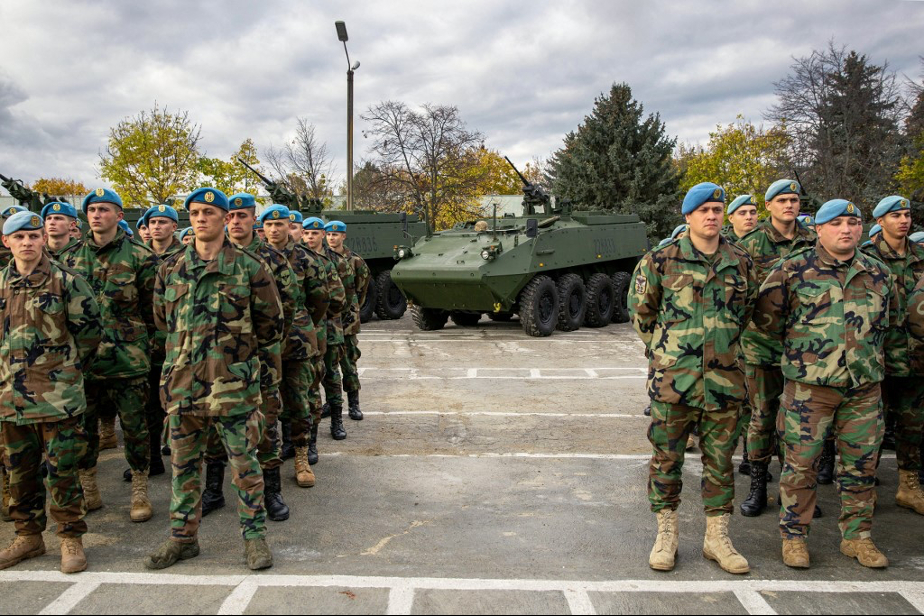
Moldova’s government approved the country’s military strategy document for 2025-2035 on Wednesday, which would raise defense spending to 1% of GDP.
It spelled out plans to both increase the size of its armed forces, to a modest 8,500, and to transform them “into a modern, professional, well-equipped, and trained military institution capable of defending the sovereignty, independence, and territorial integrity of the Republic of Moldova, contributing to national resilience, and actively participating in international missions in support of peace and security.”
Follow our coverage of the war on the @Kyivpost_official.
It said the basis of the strategy was Moldova’s commitment to becoming “a European, democratic, and prosperous country where citizens live in safety and peace.”
The strategy sought to prioritize:
Intelligence, surveillance for target detection, identification, and location Special operations forces Command, control, communications, and computers Cyber defense Electronic warfare Force protection Sustainability Training Strategic communication
Defense Minister Anatolie Nosatîi said a key element of the new strategy was to bring Moldova closer to the EU defense standards and to participate in international peacekeeping missions under the UN, OSCE, and EU.
Despite not directly mentioning the threat from Russia or NATO, no one was left in any doubt that one of the main drivers was the war being waged on its eastern neighbor, which Prime Minster Dorin Recean’s comments left in no doubt.
He said whenever decisions on national defense are made, “hysterical voices” appear that have kept this sphere “in poverty and disorder,” an attitude that “benefits the aggressor state.”
Other Topics of Interest
‘Push Putin, Pressure Allies’ – Trump Reportedly Ties Tomahawk Deal to German Missile Transfer
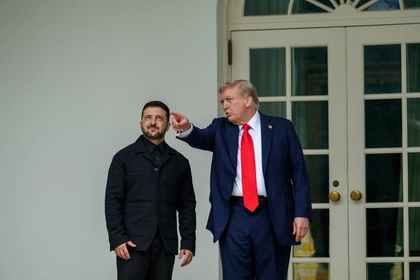
The US President is nearing a decision on Tomahawk missiles, a move sources tell Kyiv Post is calculated to compel Moscow and end allied hesitation. Zelensky’s visit will seal defense cooperation.
Recean added that opposition voices in Moldova “Glorify the Kremlin… that spends a third of its budget… on the killing of children, young people and civilians in Ukraine. Therefore, we will continue to develop the National Army, defend our homeland, and contribute to peace and global security.”
Russia claims bewilderment by Chișinău’s “unfounded” fear of Moscow
On hearing the announcement, a Kremlin spokesman told TASS that Moldova’s plans had raised concerns among the authorities of the unrecognized breakaway Transnistria and Gagauz Autonomous Regions. Meanwhile, Moldova’s pro-Russian opposition immediately criticized the increase in spending, amid the country’s severe economic crisis.
By Friday, the Russian view on the strategy coalesced around its standard assessment that the motives behind it were linked to Moscow’s so-called “special military operation” in Ukraine
Russian Deputy Foreign Minister Mikhail Galuzin told Izvestia that Moscow saw it: “As another step aimed at militarizing the country, bringing it closer to NATO, and turning it into a supply base for the criminal regime in Kiev [sic]… under the guise of European integration.”
He then added that this obvious anti-Russian alignment was obvious but totally misplaced, saying: “Despite our country’s consistent demonstration of a desire to develop a pragmatic, mutually respectful dialogue with Moldova based on equality and non-interference in internal affairs, this strategy is anti-Russian.”
“Year upon year, NATO increases its arms supplies to the country and its servicemen regularly take part in military exercises alongside alliance troops both inside and outside the country,” he said. “In 2024 alone, there were more than 30 such drills… It is no coincidence that a key element of the new military strategy is the provision that the military training of Moldovan servicemen will be carried out ‘in accordance with NATO standards’.”