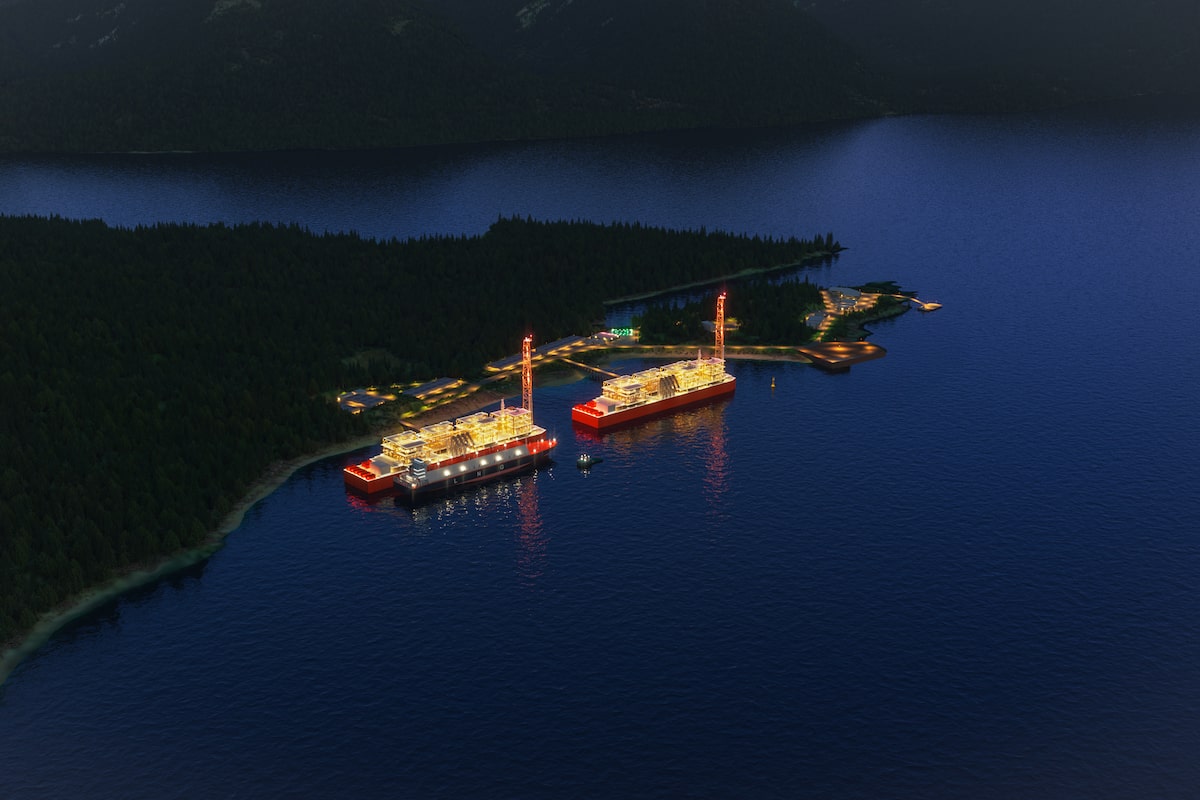
An artist’s rendition of floating LNG facilities planned for the Ksi Lisims project, which hopes to export liquefied natural gas from Pearse Island, B.C.Ksi Lisims LNG/Ksi Lisims LNG
The developer of a project seeking to export liquefied natural gas from British Columbia says he is encouraged by a shift in political attitudes in Canada toward supporting his industry.
Davis Thames said he is grateful for the political backing, though it has taken much hard work by Nisga’a Nation leaders and industry officials to reach the point where Ksi Lisims LNG is being taken seriously.
“There’s a political climate in Canada right now that’s very supportive of this kind of business,” said Mr. Thames, founder and chief executive officer of Houston-based energy development company Western LNG.
His company is partnering with the Nisga’a and a group of natural gas producers named Rockies LNG on the Ksi Lisims project near Gitlaxt’aamiks, which is home to the elected Nisga’a Lisims government.
“Our partnership – the three of us coming together – has added a unique element of capability to this,” Mr. Thames said in an interview from Houston.
Since founding Western in 2017, he has witnessed the United States gradually become the world’s largest LNG exporter, and he is optimistic that Canada will be able to play a larger role in the global LNG market.
Tony Keller: Does Canada need a new oil pipeline? Maybe. More LNG? Definitely
Mr. Thames said recent pro-LNG comments from B.C. Premier David Eby and federal Energy Minister Tim Hodgson are helpful for Ksi Lisims.
In recent weeks, Mr. Eby has characterized LNG exports to Asia as a crucial way for Canada to diversify its economy and reduce reliance on the U.S.
Shell PLC-led LNG Canada became the country’s first export terminal for natural gas in liquid form when it started shipments to Asia from Kitimat, B.C., in June.
Western began talks in 2019 to collaborate with the Nisga’a and natural gas producers. In 2021, the partners applied for environmental approvals for Ksi Lisims.
Mr. Hodgson expressed optimism about expanding LNG shipments from B.C., after Ksi Lisims received environmental approvals last month from the B.C. and federal governments. Ksi Lisims is “a project that grows our economy, advances reconciliation and ensures global energy security,” he said in a statement.
The backers of Ksi Lisims plan to make a final investment decision by the end of this year, in hopes of starting LNG exports to Asia in 2029.
B.C. Premier David Eby shakes hands with Nisga’a Nation President Eva Clayton at a September announcement about the first phase of the LNG project.ETHAN CAIRNS/The Canadian Press
Two floating production platforms are to be constructed in South Korea for Ksi Lisims, which would build various other LNG infrastructure on Nisga’a lands on Pearse Island.
The future facility is forecast to have an export capacity of 12 million tonnes a year, which would make it the country’s second-largest LNG export terminal, after LNG Canada.
Mr. Eby, Mr. Hodgson and B.C. Energy Minister Adrian Dix delivered congratulatory remarks at a recent event in Vancouver to celebrate LNG Canada’s first phase.
LNG Canada’s co-owners are expected to make a final investment decision in 2026 on a Phase 2 expansion, which would double the plant’s total capacity to 28 million tonnes a year.
The U.S., Australia and Qatar were by far the world’s largest LNG exporters last year. Russia ranked fourth, followed by Malaysia.
Russia plans to expand its LNG exports, but with higher carbon emissions than Ksi Lisims, Mr. Thames said.
“If we don’t do it in Canada the right way, it’s going to be done somewhere else a different way. So, for example, if we didn’t build Ksi Lisims but another LNG facility was built in Russia, what do you think the aggregate climate impact of that would be? It would be horrible,” he said.
Two B.C. projects are currently under construction: Woodfibre LNG near Squamish, and Cedar LNG in Kitimat.
Mr. Thames is a former senior vice-president at Houston-based Cheniere Energy Inc., which has LNG export terminals at Sabine Pass in Louisiana and Corpus Christi in Texas.
Along the U.S. Gulf Coast, American politicians at the federal, state and local levels have backed LNG exports, especially after Russia’s 2022 invasion of Ukraine led some countries to seek other sources of energy.
Artist’s rendition of plans for the Ksi Lisims floating LNG facilities.Supplied
The construction costs alone for Ksi Lisims are expected to reach $10-billion, plus another $12-billion for the Prince Rupert Gas Transmission pipeline project, which would transport natural gas 750 kilometres from Northeastern B.C. to Pearse Island.
The contentious Coastal GasLink pipeline across Northern B.C., operated by TC Energy Corp., is supplying natural gas to the LNG Canada export terminal in Kitimat.
PRGT, which is co-owned by Western and the Nisga’a, is striving to become the second major pipeline carrying natural gas from Northeastern B.C. to the West Coast for exporting purposes.
Nisga’a leaders say Ksi Lisims and PRGT are prime examples of economic reconciliation.
Critics, however, question claims by Ksi Lisims that the project will be able to comply with what the B.C. government calls credible plans to reach net-zero emissions of greenhouse gases.
Indigenous representatives in Northwestern B.C. who oppose LNG include Gitanyow hereditary chiefs and members of the Lax Kw’alaams Band.
Environmental groups and climate activists say the focus should be on renewable energy instead of pouring more money into fossil fuels such as LNG.
PRGT is facing two separate legal challenges in B.C.’s Supreme Court, as the petitioners seek judicial reviews to quash a ruling in June by Alex MacLennan, head of the B.C. Environmental Assessment Office, that the project has been substantially started. That decision by Mr. MacLennan paved the way for further construction on the pipeline project.
Charlie Wright of the Gitxsan Nation is the petitioner in one case, while PRGT, Mr. MacLennan and B.C. Environment Minister Tamara Davidson are among the respondents.
The Skeena Watershed Conservation Coalition, Kispiox Valley Community Centre Association and Kispiox Valley resident Kathleen Larson are the petitioners in the other case, while the respondents are Ms. Davidson and PRGT.
With only minimal construction completed along the pipeline route, that activity falls well short of the definition of substantial, according to lawyers representing the petitioners.