 Screenshot
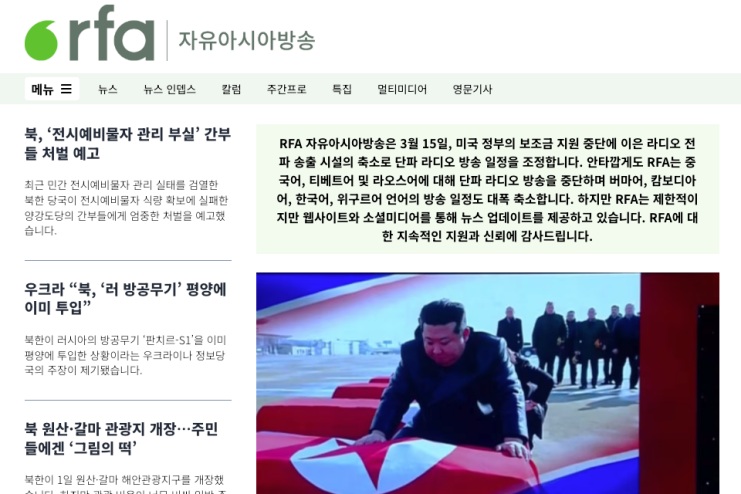
Two North Korean individuals who secretly listened to Radio Free Asia for years expressed profound loss after the U.S.-funded broadcaster ceased transmissions in early July due to changes in government policy, telling Daily NK the shutdown closed off a vital “window for communicating with the outside world.”
Daily NK interviewed individuals living in Hoeryong, North Hamgyong province (in their 40s) and Sinuiju, North Pyongan province (in their 50s), who described how RFA broadcasts had fundamentally altered their understanding of their country and the wider world.
A, an individual in Hoeryong, said he had been listening to RFA radio broadcasts since 2018. “I would turn on the radio after midnight or at dawn and tune the frequency to listen,” he said. “I could hear news about ‘the lower village’ (South Korea) and world affairs that are unknowable here (in North Korea), and it became a ‘yardstick’ for gauging the flawed political reality.”
A added, “Here everyone lives thinking the world is all like this, but listening to the broadcasts, I could realize how difficult it is to live here and that another society exists. I even developed a desire to live in the lower village.”
Meanwhile, B, an individual in Sinuiju, said, “I listened (to RFA radio broadcasts) starting in early 2003. I mainly tuned the frequency during dawn hours, and it was very helpful for learning about world affairs.”
B also said, “Before listening to the broadcasts, I didn’t know how the world worked, but listening to the broadcasts made the world look different and gave me new hope. Through the broadcasts, I had a reassuring feeling of communicating with the outside world.”
Radio offered comparison to regime propaganda
These remarks from A and B show that RFA and other radio broadcasts to North Korea have served not merely as news channels but as a “window” changing North Korean people’s thinking and emotions. The fact alone that they tuned frequencies to listen to outside broadcasts during secretive times like night or dawn shows that individuals approached prohibited information on their own.
What they commonly describe is that “their eyes for seeing the world changed.” Through radio broadcasts to North Korea, they learned about South Korea and world affairs and situations, realizing that the society they live in is not absolute. Radio broadcasts to North Korea served as a “yardstick of comparison” that created cracks in regime propaganda.
These individuals also candidly shared their feelings of emptiness and regret over the suspension of RFA radio broadcasts. A said, “At first I couldn’t believe it. I can’t understand why this situation occurred.” B said, “I was disappointed to the point that life lost its flavor. I don’t know why this happened.”
After RFA radio broadcasts were cut off, they are finding other ways, such as listening to Japanese and Chinese broadcasts or hearing outside news through Chinese ethnic contacts, but they expressed frustration, saying “more comparable information is needed.”
Both individuals agreed that “the broadcasts must resume.”
A expressed hope for the broadcasts’ resumption, saying, “It’s truly regrettable because listening to news about the lower village and overseas gave me new hope.” B revealed his earnest feelings, saying, “Here we can only learn about the outside world through broadcasts. I’m waiting for the communication window to reopen.”
Meanwhile, according to a report published last year by the Unification Media Group, demand for portable radio devices in North Korea appears to remain high.
While North Korean authorities continue to emphasize fixed frequencies and strengthen control through the law on rejecting reactionary ideology and culture, 19% of the 100 North Korean people who participated in the survey at that time said they listen to radio. Additionally, listening frequency was found to be “almost every day” at 5.6% and “more than once a month” at 44.4%, indicating relatively high numbers of active listeners.