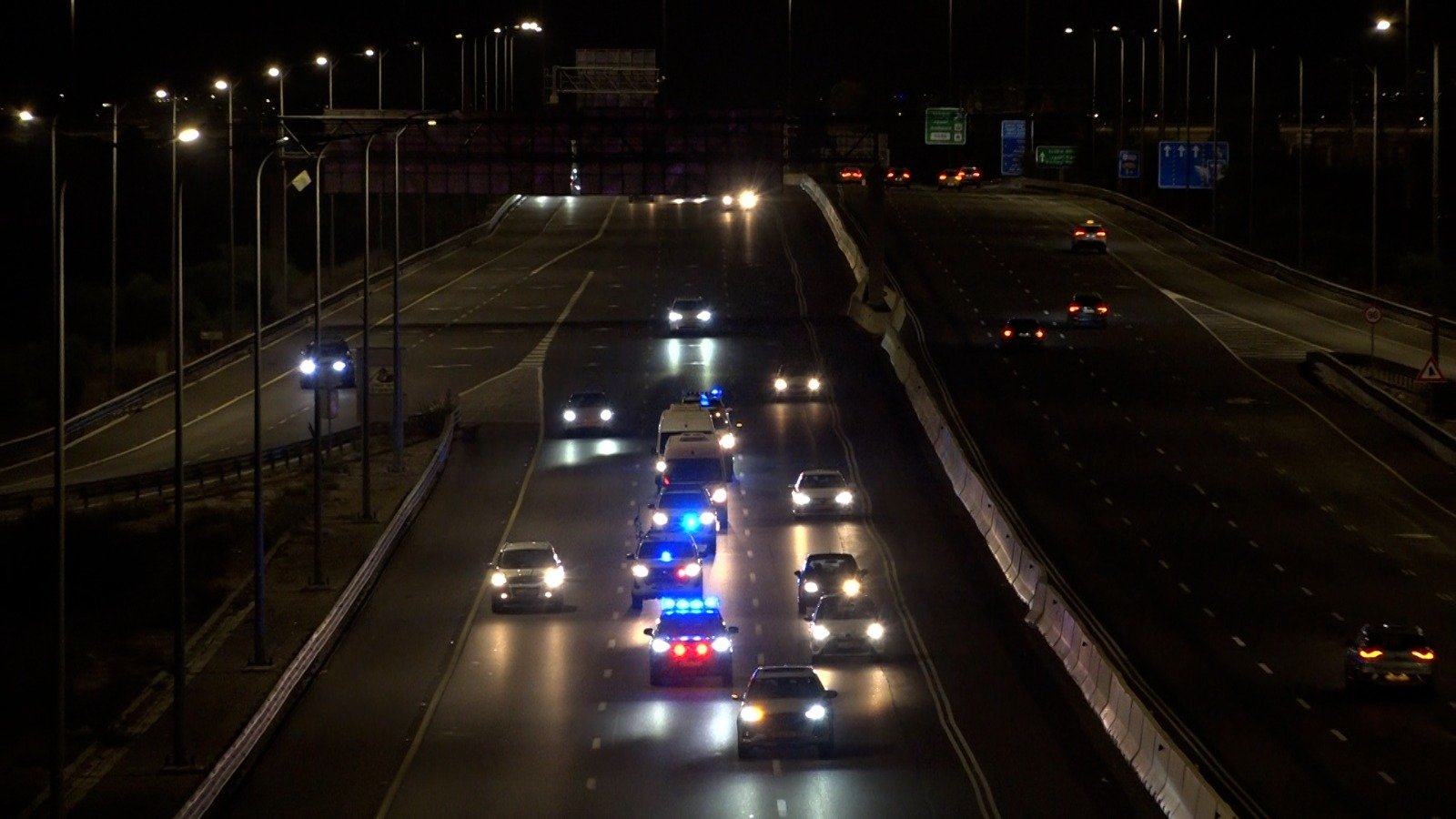
IDF troops brought four caskets that were said to hold the bodies of dead hostages back to Israel on Tuesday night, after the government accused Hamas of breaking the ceasefire agreement and threatened to withhold aid from Gaza.
The bodies, which Hamas gave to the Red Cross earlier on Tuesday before they were transferred to the military, have not been identified by Hamas. They were taken to the Abu Kabir forensic institute in Tel Aviv for identification, a process that officials say could take up to two days.
The handover happened after Israel accused Hamas of violating the recently implemented ceasefire by withholding the bodies of deceased hostages. Hamas released the final 20 living hostages on Monday, as well as the bodies of four dead captives, but was still holding 24 deceased hostages.
If the bodies that were brought to Israel late on Tuesday are indeed identified as deceased hostages, it would mean that 20 bodies of captives remain in the Strip. Earlier this year, Hamas gave Israel a body that it said belonged to slain hostage Shiri Bibas, which was soon identified as a Palestinian from Gaza. Bibas’s remains were subsequently handed to Israel.
Hamas has informed the mediators that it will transfer four more bodies of deceased hostages to Israel on Wednesday, a Middle Eastern diplomat and a second source familiar with the matter told The Times of Israel.
Get The Times of Israel’s Daily Edition
by email and never miss our top stories
By signing up, you agree to the terms
The controversy surrounding the release of deceased hostages could threaten to derail the ceasefire, just over a day after celebrations erupted across Israel at the release of the remaining living hostages. US President Donald Trump, whose administration brokered the deal, lauded it in a landmark Knesset address, then flew to Egypt for a peace summit in the agreement’s wake.
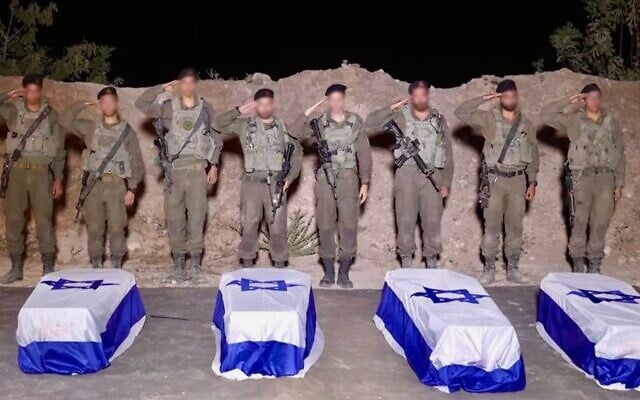
IDF troops salute over the caskets containing the bodies of slain hostages Guy Illouz, Bipin Joshi, Yossi Sharabi and Cpt. Daniel Perez in the Gaza Strip, late October 13, 2025. (Israel Defense Forces)
The agreement stipulated that Hamas return all 48 hostages, living and dead, within 72 hours of the deal taking effect, a period that began on Friday. But it also raised the possibility that there would be a delay in locating the dead hostages’ bodies in the war-torn Strip.
Now, disputes reminiscent of past ceasefires are resurfacing, as small groups of hostages are let out in phases amid fear that the agreement could collapse. Israel is claiming Hamas broke the deal by delaying the return of the dead captives. And families of those held in Gaza are fuming that celebrations are premature, given that the terrorists who perpetrated the October 7, 2023, attack that launched the war are still holding hostages.
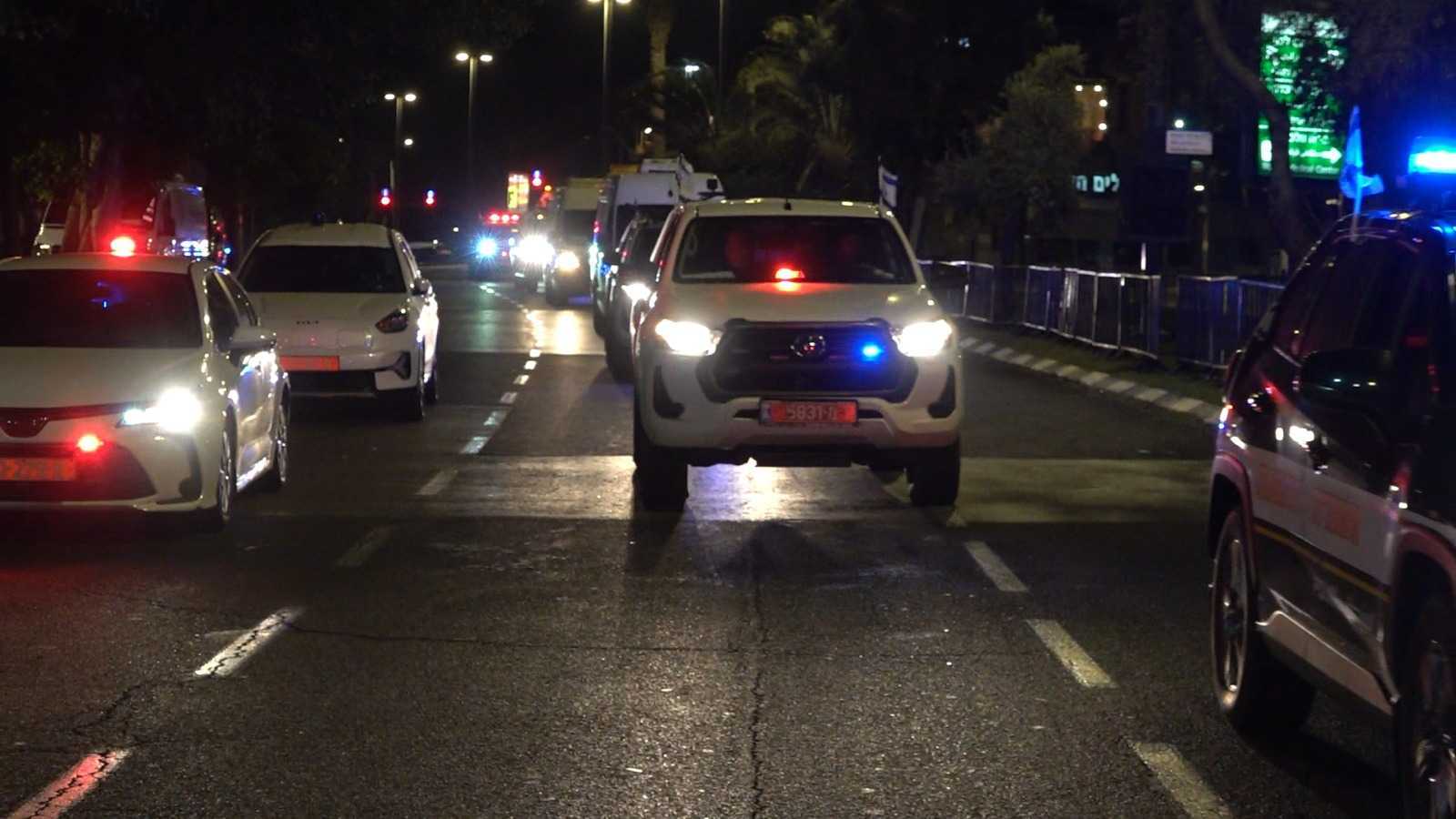
The bodies of four apparent slain hostages released from Gaza arrive at the entrance to the Abu Kabir forensic institute in Tel Aviv, early October 15, 2025. (Israel Police)
“What we feared is now happening before our eyes,” the Hostages and Missing Families Forum wrote in a letter to US envoy Steve Witkoff, a key broker of the ceasefire. “Only four deceased hostages are coming home today. Only four families will be able to bring their loved ones to the dignified burial they so deserve and begin to find closure. How is this possible? How can we accept that the others remain behind?”
“We must ensure that all remaining hostages come home. We cannot rest, and we know you will not rest, until every last hostage is returned,” the letter continued.
The forum also demanded a meeting with IDF Chief of Staff Lt. Gen. Eyal Zamir. And it urged the public to keep up its activism for the captives’ return, after multiple government officials reportedly ordered signs pressing for the hostages’ release taken down.
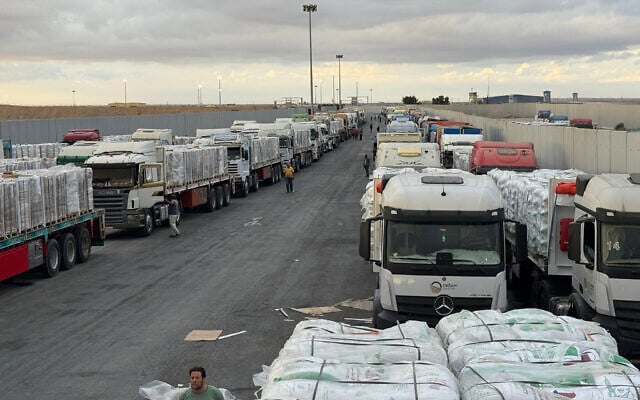
Trucks loaded with humanitarian aid are parked on the Egyptian side of the Rafah crossing, waiting to get access to the Gaza Strip, on October 12, 2025. (AFP)
In addition, on Tuesday, Israel decided not to reopen the Rafah border crossing between the Gaza Strip and Egypt the next day, as required by the ceasefire deal, citing the delay in the return of the deceased hostages. Israel said it would also reduce the amount of aid flowing into Gaza as part of the sanctions against the terror group.
Whether that decision was changing following Tuesday night’s handover was unclear. Following the caskets’ arrival in Israel, the IDF had been expected to inspect them before draping them in Israeli flags and holding a short ceremony led by a military rabbi.
“Hamas is required to abide by the agreement and make the necessary efforts to return all the bodies,” the military says.
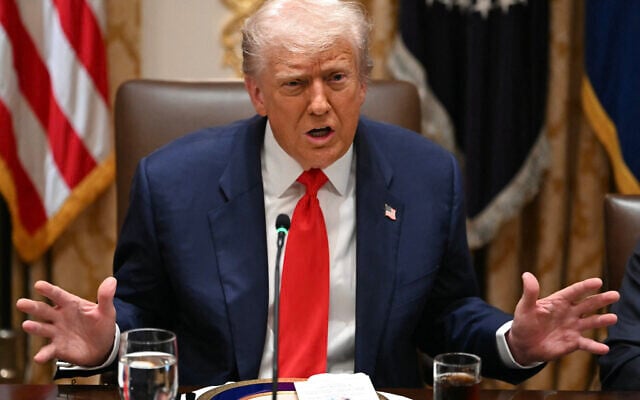
US President Donald Trump speaks at the White House in Washington, DC, on October 14, 2025. (ANDREW CABALLERO-REYNOLDS / AFP)
Trump, meanwhile, claimed that Hamas misrepresented the number of bodies of slain hostages it told mediators it would be able to produce.
“We were told they had 26, 24 dead hostages… and it seems as though they don’t have that, because we’re talking about a much lesser number,” Trump said on Tuesday.
“I want them back,” Trump reiterated to reporters in the White House during a meeting with visiting Argentine President Javier Milei.
The four deceased hostages returned on Monday were identified by forensic experts as Guy Illouz, 26, Bipin Joshi, 23, Yossi Sharabi, 53, and IDF officer Cpt. Daniel Perez, 22 — matching a list provided by Hamas ahead of that transfer.
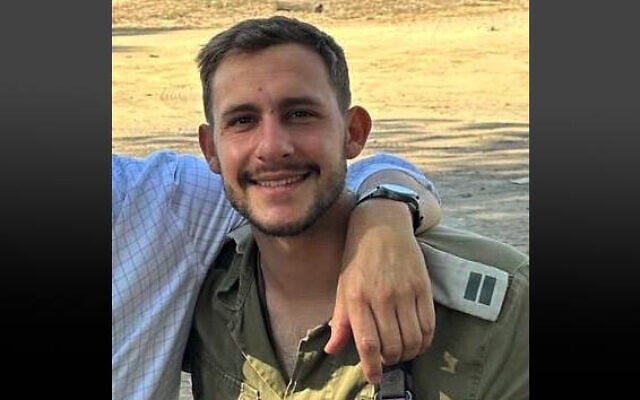
Cpt. Daniel Perez (IDF)
Perez’s family said it would hold a second funeral for him on Wednesday evening in Jerusalem.
Perez, an immigrant from South Africa who was a tank commander in the 7th Armored Brigade’s 77th Battalion, was killed battling Hamas fighters during the October 7 attack, and his body was taken captive.
His death was declared by the IDF in March 2024, and his family decided at the time to hold a funeral, burying his blood-soaked clothing at the Mount Herzl cemetery in Jerusalem. His remains are expected to be added to the casket during this evening’s proceedings.
Of the remaining captives in Gaza, Israel has confirmed the deaths of all except Tamir Nimrodi. They were killed either on or after the October 7, 2023, onslaught, except for Hadar Goldin, a soldier who was killed in Gaza in 2014.
You appreciate our journalism

You clearly find our careful reporting valuable, in a time when facts are often distorted and news coverage often lacks context.
Your support is essential to continue our work. We want to continue delivering the professional journalism you value, even as the demands on our newsroom have grown dramatically since October 7.
So today, please consider joining our reader support group, The Times of Israel Community. For as little as $6 a month you’ll become our partners while enjoying The Times of Israel AD-FREE, as well as accessing exclusive content available only to Times of Israel Community members.
Thank you,
David Horovitz, Founding Editor of The Times of Israel
Already a member? Sign in to stop seeing this