Are the biomass deaths caused more by pollution (burning) or falling logs and axe accidents? 🤔
What is the difference between coal and brown coal?
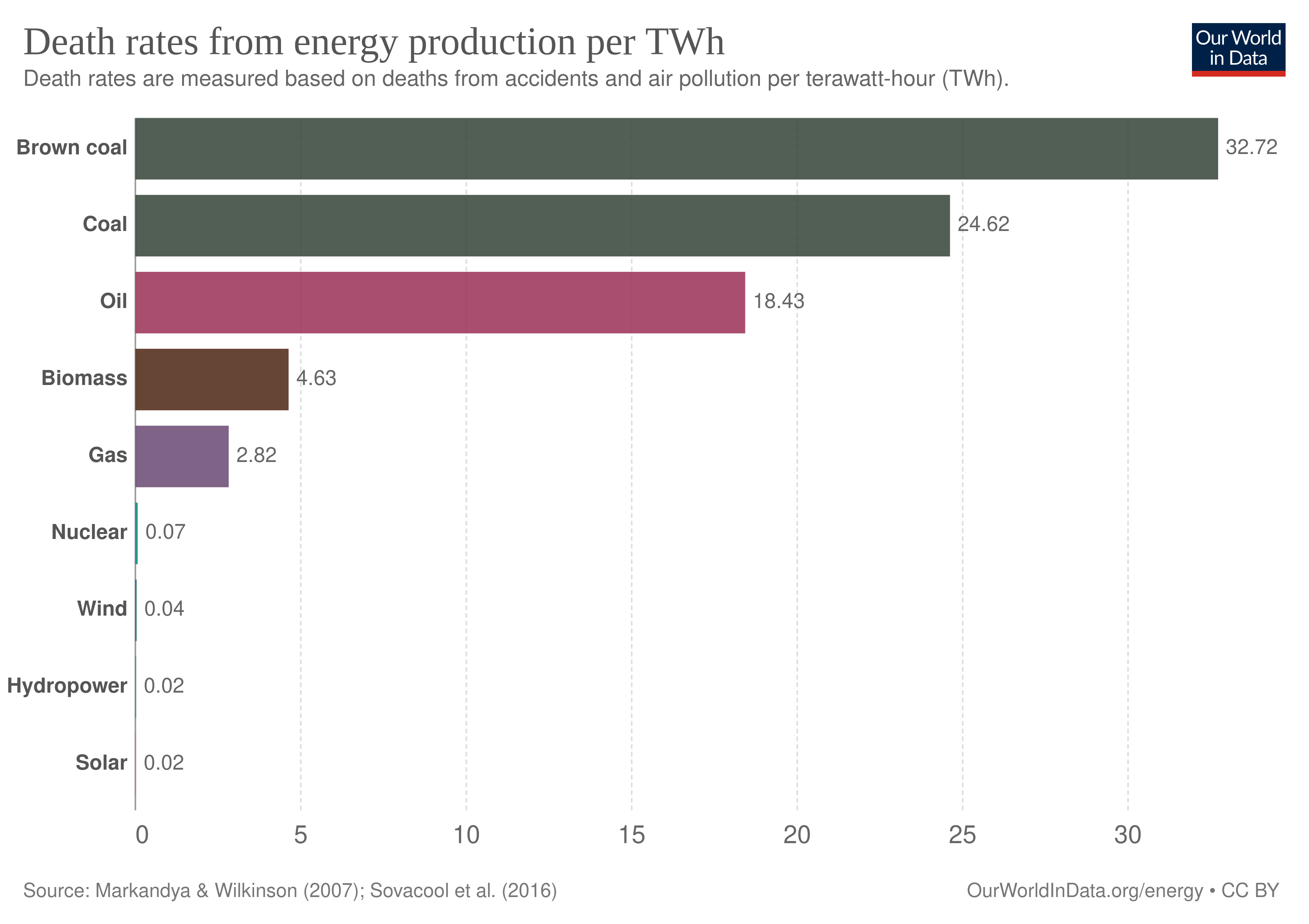
The number for nuclear should be taken with a grain of salt though. There are studies which suggest that Chernobyl caused up to 60.000 deaths as opposed to the 4000 which are taken into account for this post. Also, radioactive fallouts are very unlikely but cause a high number of deaths if they happen. These low-probability events are more difficult to estimate than more likely events like death by falling from a roof which is the kind of death that you have to include for renewables.
Lets ban nuclear, it’s obviously so harmful.
Is it fossil fuels/biomass with or without filtered emissions?
Deaths from nuclear disasters are a lot more mediagenic than deaths from coal.
If you judge dangers by degree of media coverage — as people seem to — you can wind up with some pretty distorted views of risks.
>The Summer of the Shark refers to the coverage of shark attacks by American news media in the summer of 2001. The sensationalist coverage of shark attacks began in early July following the Fourth of July weekend shark attack on 8-year-old Jessie Arbogast, and continued almost unabated—despite no evidence for an actual increase in attacks—until the September 11 terrorist attacks shifted the media’s attention away from beaches. The Summer of the Shark has since been remembered as an example of tabloid television perpetuating a story with no real merit beyond its ability to draw ratings.
>
>The media’s fixation with shark attacks began on July 6, when 8-year-old Mississippi boy Jessie Arbogast was bitten by a bull shark while standing in shallow water at Santa Rosa Island’s Langdon Beach. The shark, which measured approximately 7 feet (2.1 m) in length, bit off Arbogast’s arm in the attack; it was then caught and killed after being dragged by its tail onto shore by Arbogast’s uncle, Vance Flosenzier. Although Arbogast was immediately pulled out the water by an unidentified bystander, the severe blood loss he suffered caused damage to his organs and brain, complicating his recovery. Arbogast’s arm was later removed from the captured shark’s mouth and surgically reattached.
>
>Immediately after the near-fatal attack on Arbogast, another attack severed the leg of a New Yorker vacationing in The Bahamas, while a third attack on a surfer occurred about a week later on July 15, six miles from the spot where Arbogast was bitten. In the following weeks, Arbogast’s spectacular rescue and survival received extensive coverage in the 24-hour news cycle, which was renewed (and then redoubled) with each subsequent report of a shark incident. The media fixation continued with a cover story in the July 30th issue of *Time* magazine.
>
>In mid-August, many networks were showing footage captured by helicopters of hundreds of sharks coalescing off the southwest coast of Florida. Beach-goers were warned of the dangers of swimming, despite the fact that the swarm was probably part of an annual shark migration. The repeated broadcasts of the shark group has been criticized as blatant fear mongering, leading to the unwarranted belief of a so-called shark “epidemic”.
>
>Two additional shark attacks, both fatal, occurred during the first three days of September — one in Virginia and one in North Carolina. By early September, there were calls to pass legislation to help “control the problem.” The Summer of the Shark came to a quick end following the September 11 terrorist attacks, as the media had shifted attention to the destruction at the Pentagon, lower Manhattan and Shanksville, Pennsylvania.
>
>Investigative journalist John Stossel explains the media’s shark fixation in his book *Give Me a Break*, stating:
>
>>Instead of putting risks in proportion, we [reporters] hype *interesting* ones. Tom Brokaw, Katie Couric, and countless others called 2001 the “summer of the shark.” […] In truth, there wasn’t a remarkable surge in shark attacks in 2001. There were about as many in 1995 and 2000, but 1995 was the year of the O.J. Simpson trial, and 2000 was an election year. The summer of 2001 was a little dull, so reporters focused on sharks.
Let’s say the Hydropower data are all lies and deception.
Seriously. Really seriously.
Indirect deaths from nuclear?
OurWorldInData has been running also coronavirus vaccine propaganda, so, their credit is mixed. Palestine got 1000 sputniks, OurWorldInData has marked “10 million”, bloody liars.

11 comments
[Direct link](https://ourworldindata.org/grapher/death-rates-from-energy-production-per-twh)
Interesting for the “green taxonomy” ([EU taxonomy for sustainable activities](https://ec.europa.eu/info/business-economy-euro/banking-and-finance/sustainable-finance/eu-taxonomy-sustainable-activities_en))
I am not sure if I like this data.
The boiling frog
Are the biomass deaths caused more by pollution (burning) or falling logs and axe accidents? 🤔
What is the difference between coal and brown coal?
The number for nuclear should be taken with a grain of salt though. There are studies which suggest that Chernobyl caused up to 60.000 deaths as opposed to the 4000 which are taken into account for this post. Also, radioactive fallouts are very unlikely but cause a high number of deaths if they happen. These low-probability events are more difficult to estimate than more likely events like death by falling from a roof which is the kind of death that you have to include for renewables.
Lets ban nuclear, it’s obviously so harmful.
Is it fossil fuels/biomass with or without filtered emissions?
Deaths from nuclear disasters are a lot more mediagenic than deaths from coal.
If you judge dangers by degree of media coverage — as people seem to — you can wind up with some pretty distorted views of risks.
https://en.wikipedia.org/wiki/Summer_of_the_Shark
>The Summer of the Shark refers to the coverage of shark attacks by American news media in the summer of 2001. The sensationalist coverage of shark attacks began in early July following the Fourth of July weekend shark attack on 8-year-old Jessie Arbogast, and continued almost unabated—despite no evidence for an actual increase in attacks—until the September 11 terrorist attacks shifted the media’s attention away from beaches. The Summer of the Shark has since been remembered as an example of tabloid television perpetuating a story with no real merit beyond its ability to draw ratings.
>
>The media’s fixation with shark attacks began on July 6, when 8-year-old Mississippi boy Jessie Arbogast was bitten by a bull shark while standing in shallow water at Santa Rosa Island’s Langdon Beach. The shark, which measured approximately 7 feet (2.1 m) in length, bit off Arbogast’s arm in the attack; it was then caught and killed after being dragged by its tail onto shore by Arbogast’s uncle, Vance Flosenzier. Although Arbogast was immediately pulled out the water by an unidentified bystander, the severe blood loss he suffered caused damage to his organs and brain, complicating his recovery. Arbogast’s arm was later removed from the captured shark’s mouth and surgically reattached.
>
>Immediately after the near-fatal attack on Arbogast, another attack severed the leg of a New Yorker vacationing in The Bahamas, while a third attack on a surfer occurred about a week later on July 15, six miles from the spot where Arbogast was bitten. In the following weeks, Arbogast’s spectacular rescue and survival received extensive coverage in the 24-hour news cycle, which was renewed (and then redoubled) with each subsequent report of a shark incident. The media fixation continued with a cover story in the July 30th issue of *Time* magazine.
>
>In mid-August, many networks were showing footage captured by helicopters of hundreds of sharks coalescing off the southwest coast of Florida. Beach-goers were warned of the dangers of swimming, despite the fact that the swarm was probably part of an annual shark migration. The repeated broadcasts of the shark group has been criticized as blatant fear mongering, leading to the unwarranted belief of a so-called shark “epidemic”.
>
>Two additional shark attacks, both fatal, occurred during the first three days of September — one in Virginia and one in North Carolina. By early September, there were calls to pass legislation to help “control the problem.” The Summer of the Shark came to a quick end following the September 11 terrorist attacks, as the media had shifted attention to the destruction at the Pentagon, lower Manhattan and Shanksville, Pennsylvania.
>
>Investigative journalist John Stossel explains the media’s shark fixation in his book *Give Me a Break*, stating:
>
>>Instead of putting risks in proportion, we [reporters] hype *interesting* ones. Tom Brokaw, Katie Couric, and countless others called 2001 the “summer of the shark.” […] In truth, there wasn’t a remarkable surge in shark attacks in 2001. There were about as many in 1995 and 2000, but 1995 was the year of the O.J. Simpson trial, and 2000 was an election year. The summer of 2001 was a little dull, so reporters focused on sharks.
Very different from this [source](https://www.statista.com/statistics/494425/death-rate-worldwide-by-energy-source/) that I saw a while back in this [post](https://old.reddit.com/r/europe/comments/qgzl1r/nuclear_energy_is_too_dangerous_too_expensive_and/hi9fe2w/). There nuclear had a clear edge compared to anything else.
Let’s say the Hydropower data are all lies and deception.
Seriously. Really seriously.
Indirect deaths from nuclear?
OurWorldInData has been running also coronavirus vaccine propaganda, so, their credit is mixed. Palestine got 1000 sputniks, OurWorldInData has marked “10 million”, bloody liars.