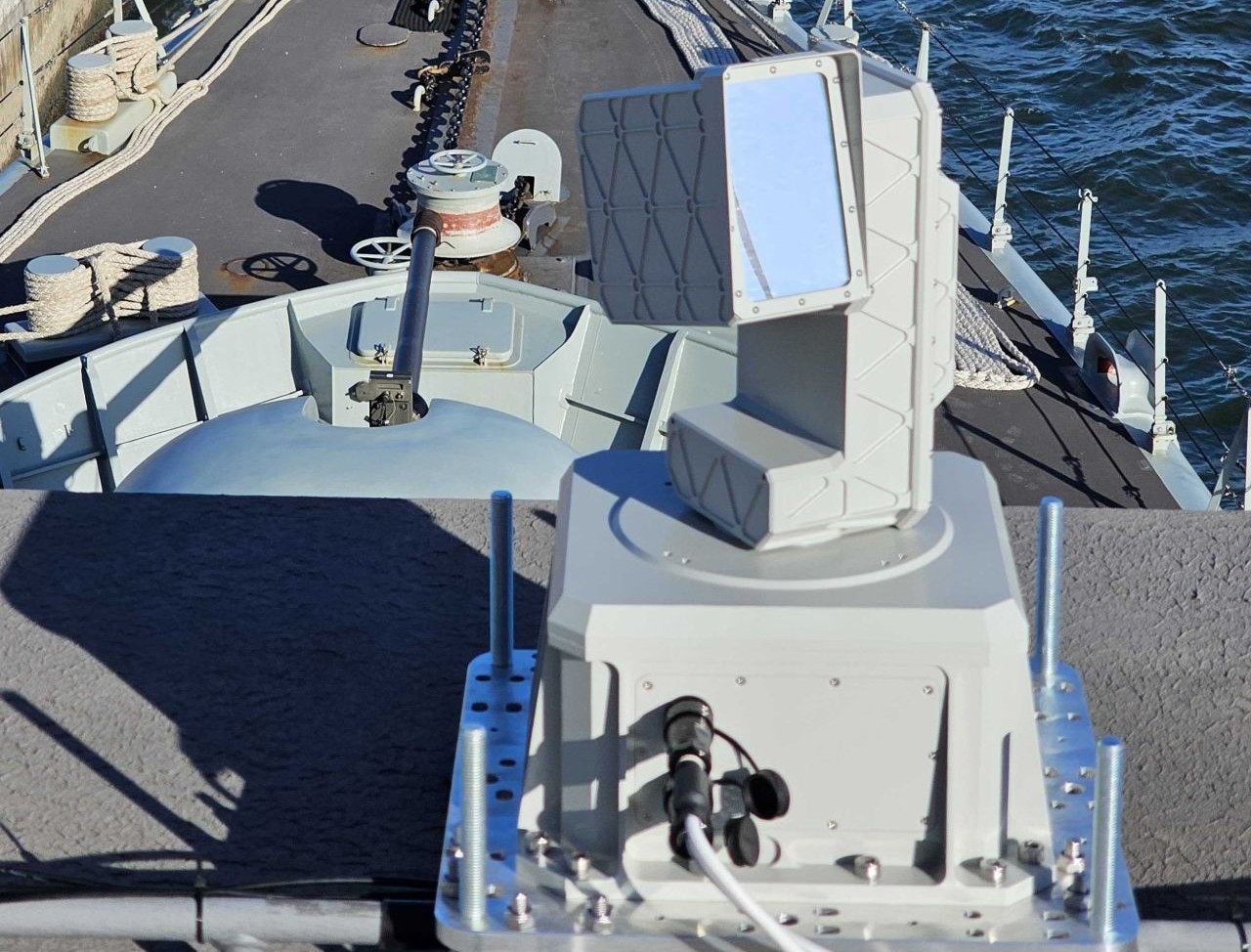
Polaris is a 16kg gimballed free space optical (FSO) communication terminal that uses high powered lasers to transmit data at sea. Designed for line-of-sight comms between naval vessels and unmanned surface vehicles (USVs), the system can transmit data at up to 1Gbps. More importantly, it can send this data silently, without detection, and in environments where other communication systems have been jammed.
Astrolight demoed the technology at NATO’s recent REPMUS (Robotic Experimentation and Prototyping using Maritime Uncrewed Systems)/Dynamic Messenger exercise, which was hosted by the Portuguese Navy. Polaris terminals maintained a stable, jam-proof horizon-limited laser-based link between two Portugeues naval vessels, with the link undetected by any other ships, drones or sensors deployed in the exercise.
“With persistent and rising GPS jamming attacks in NATO territories, we needed to test it in real-life conditions as soon as possible,” said Dalius Petrulionis, co-founder and CTO of Astrolight.
“Exercise results showed that our laser technology is a reliable and operable alternative to radio frequency-based communication – now it’s time to scale.”
Communication jamming at sea is a serious threat because it can distort satellite navigation, confuse radar and ship-tracking displays, and interrupt communications. When this happens, crews can be forced to switch to less secure backup methods like noisy radio or signal lamps, making their ships easier to detect.
Addressing the jamming threat has been one aspect of NATO’s DIANA (Defense Innovation Accelerator for the North Atlantic) programme, of which Astrolight is a member. The recent NATO demonstration of Polaris builds on prior tests with the Lithuanian Navy.
“Astrolight teams spent two weeks living and working with the Portuguese Navy aboard two of their ship fleets, installing their Polaris laser terminals,” NATO DIANA said in a statement on LinkedIn following the exercise.
“They established undetectable ship-to-ship laser communications, exceeding their initial targets by 200 per cent, and proving that first-time experiments can go better than planned when the technology is well-developed.”