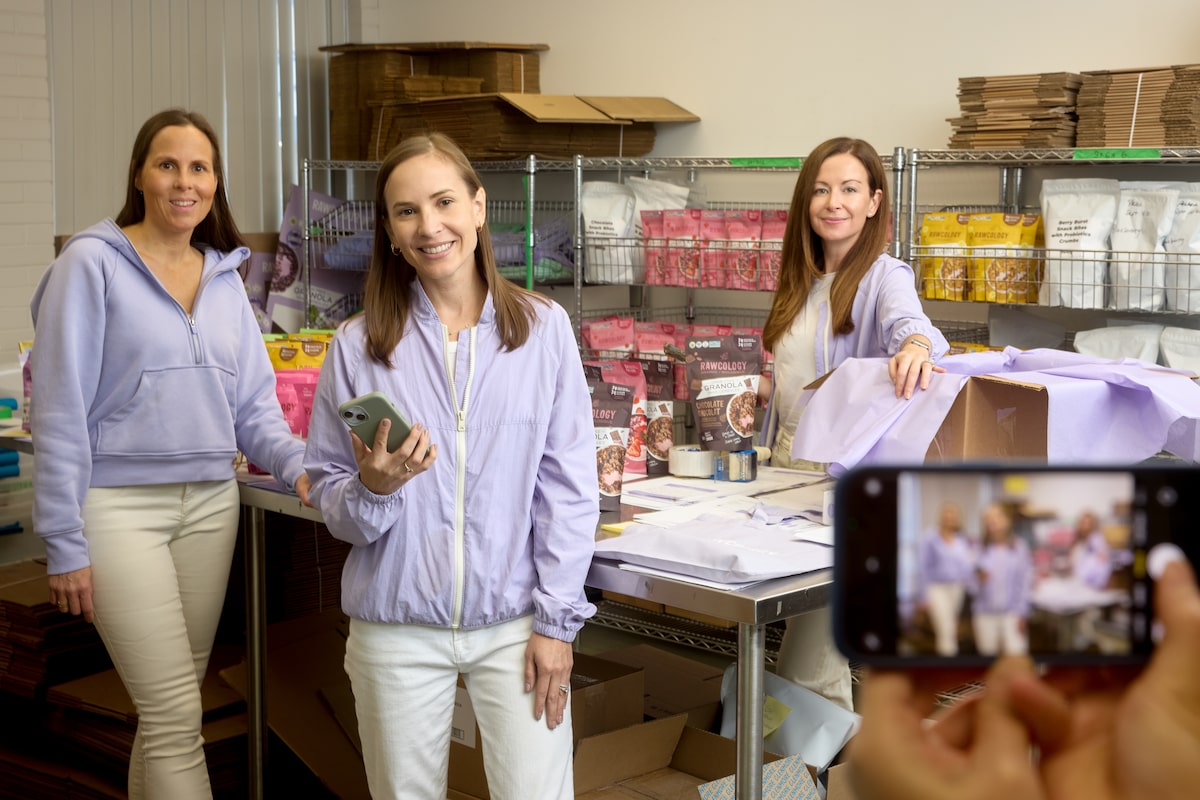
A founder-led approach to social media was the most natural fit for the co-founders of Toronto-based snack company Rawcology. (Left to right: Laura Powadiuk, Tara Tomulka and Megan Loach Tomulka)David Pike
A social-media presence for a small business is practically non-negotiable in our chronically online world. Less clear is whether founders should be front-and-centre on those accounts, or if a faceless brand is the better option for entrepreneurs who always have too much on their plates.
A founder-led approach was the most natural fit for Toronto-based snack company Rawcology: The brand launched after co-founder Tara Tomulka’s transition from corporate burnout to holistic nutritionist, and it featured Ms. Tomulka sharing her plant-based recipes from the early stages.
“Rawcology was started to share the message that nutrition can be powerful and life-changing,” Ms. Tomulka says. “Having that personal approach connected with the audience, and from the beginning we had such a great community of supporters.”
Her co-owner and sister-in-law Megan Loach Tomulka, also Rawcology’s chief marketing officer and head of sales, credits ‘vulnerability’ for part of that success. “I remember there were some posts in the early days where (Tara) had even shared on Mental Health Awareness Day that (she) suffered from anxiety, and this was how (she was) dealing with it.”
As the brand grew, its community has followed the journey from Ms. Tomulka’s kitchen to being stocked in Costco. “We got to a point where we were big enough that we could pull back and have a really stylized grid, have it be very product-focused or user-generated content. But I don’t think that speaks to our product story, our why,” Ms. Loach Tomulka says.
It comes down to a “storytelling mentality,’ she adds, that helps the company connect with its customers on a deeper level. “And as a small or medium-sized business, the only way to do that is to connect from a very human place.”
It’s also why their faces are on their product bags.
For other small businesses, the “faceless” approach works. Hamilton, Ont.-based Lootacris, which makes party loot bags, with clients that include rappers, reality stars and Justin Bieber’s half-sister.
“We wanted Lootacris to be about the products we provide for celebrations rather than on us as individuals. That said, our personalities still come through in the way we design, interact with clients and share behind-the-scenes moments,” founders Elissa Yeardsley and Stefania De Martino wrote by email. “It’s less about our faces and more about building a fun, creative brand.”
Hamilton, Ont.-based party loot bag company Lootacris has built up a client list that includes rappers and reality stars, without their founders stepping in front of the camera.Lootacris
Being “faceless” doesn’t necessarily mean sticking to static images. “Interestingly, our most popular post was a very short, four-second reel of a Simpsons-themed chip wrapper coming out of our printer,” the founders wrote. “We think it resonated because it was colorful, nostalgic and … kept people watching.”
The strategy works for Lootacris given the nature of its business: Content is more about the making of the loot bags – which are customized for each client using items sourced on Temu – and less about the people who make them. Ms. Yeardsley and Ms. De Martino, who run this as a side-hustle while parenting and working full-time, find social success with strategies such as trending audios and hashtags, and posting at times when they know more people are scrolling.
That’s not to say people don’t matter in a faceless brand, they add. “We reached out to Cheyenne from MTV’s Teen Mom to create favours for her son’s second birthday. After she tagged us in her post, we gained U.S. followers who placed orders,” they wrote. “We also used giveaways to grow our following and boost engagement. People love the chance to win something, and that was a big chunk for our following in the beginning.”
One thing is clear: Without social media, they wouldn’t have much of a business. “It is the only way our customers find us beyond word-of-mouth. It’s hard to promote our business locally through markets or craft shows because our products are customized, making it difficult to showcase everything in person. Our Instagram lets people see real-life examples through customer orders, inspiring them for their own upcoming events.”
“More and more people make their decisions based on that trust factor, and it’s hard to do that without having some sort of a social media presence,” says Sarah Francis, vice president of partnerships at influencer marketing firm Platform Media & Management. “It’s all about who that person is. Are they authentic? Trustworthy? Are they speaking from the heart?”
For Ms. Francis, being able to put a face to a brand will always be her first choice when advising a client. Knowing that many founders tend to be passionate about their businesses, she says being the face of social media marketing can be a natural way to let that show.
“That can really be used to the business owner’s advantage if they’re comfortable with putting themselves online,” she says. “And most of that is just practice, getting out there and doing it.”
She also points out that consumers are increasingly turned off by slick aesthetics and facades projecting perfection, offering another opportunity for the brave founder to break through with authenticity.
“When your customers can see you’re a real person behind a product, we’re more likely to purchase because we don’t just like the product but we like what it stands for,” she says. With the advent of AI, Ms. Francis adds, this will likely become increasingly important as we all wade through a mire of digital slop.
There also doesn’t have to be such a binary between founder-led versus faceless, she says. There’s a third option, which is getting other faces and personalities – whether that’s someone else on your team, an influencer or even user generated content created by customers for you – to lend that crucial human touch to your feeds.
“Maybe it’s the people who are creating the product, or you are proud to be made in Canada, and you want to show the behind-the-scenes,” she suggests. “It’s important for people to see, ‘is there authenticity from a 360-degree, holistic approach to your DNA as a brand?’
“As a founder, I think it’s really important to show who you are and what you believe in.”
As CMO, it’s part of Ms. Loach Tomulka’s job to wrangle Rawcology’s other co-founders to hop in front of the camera, which can be tough when there are so many competing priorities for time and attention. “We all wear so many different hats and it’s a very fast paced world,” she says, adding the company is constantly looking to finesse the process. Sometimes that involves getting better at editing or exploring how AI tools could help make work easier.
There’s also the practical fact that the company does not have a large marketing budget, and getting influencers or paid actors to tell its story is not where it wants to spend money. “And no one sells or tells your story like you do,” adds Ms. Loach Tomulka.
“We get the most likes when it’s our faces in the posts or it’s us speaking. That’s when we get the most traction and comments.”