On the eastern fringes of the European Union (EU) – the arena of an intense influence battle between pro-European and pro-Russian forces – good news is all the more appreciated because it is so rare. Sandwiched between war-torn Ukraine and Romania, which has just emerged from a presidential election marked by a powerful far-right surge, Moldova reaffirmed its willingness to undertake the lengthy EU accession process during the September 28 legislative elections.
In Chisinau, anticipation surrounded the event. The pro-European camp, embodied by President Maia Sandu, feared a protest vote over the country’s economic hardships. These difficulties can be traced in particular to rising energy prices after the Russian giant Gazprom cut off gas supplies to the separatist region of Transnistria in the heart of winter. Most of Moldova’s electricity came from Transnistria before authorities gained some leeway by connecting to the European grid. Sandu’s determination to take sole ownership of the EU accession project also fueled frustration among officials who shared her goal but wanted to retain their independence.
The outcome of the elections was so uncertain that in September, French President Emmanuel Macron, German Chancellor Friedrich Merz and Polish Prime Minister Donald Tusk all traveled to Chisinau for the country’s independence commemorations. Without a clear majority in Parliament, the pro-European Party of Action and Solidarity (PAS) would have been forced to form an unstable coalition with opposition parties. Such instability could have led to fresh snap elections, making it impossible for the country to pass the dozens of legislative measures needed for EU accession – notably the overhaul of its judicial system.
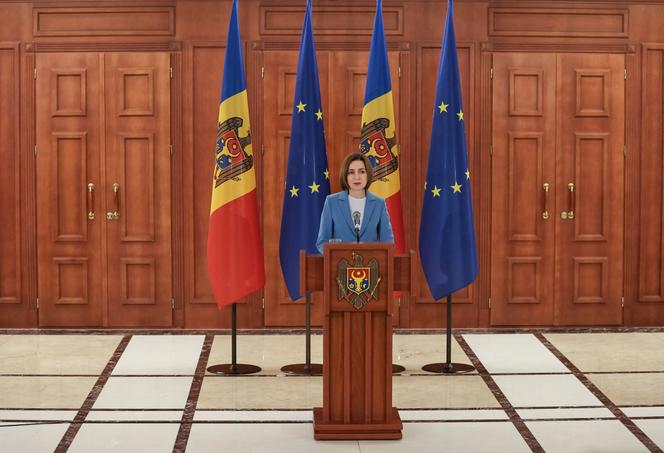 Moldovan President Maia Sandu after the announcement of the legislative election results in Chisinau on September 29, 2025. VLADISLAV CULIOMZA / REUTERS
Despite Russian denials, Moldova was targeted by a massive campaign of disinformation and lies, in which Romania’s far right also took part. At the same time, independent media and pro-democracy organizations have been hit hard by the abrupt halting of US aid under the Trump administration. Moldovan authorities, drawing lessons from the previous European choice referendum and the 2024 presidential election, also feared widespread vote-buying instigated by Kremlin allies. A close result would also have increased the risk of street protests over the outcome.
The pro-Russian opposition did indeed cry electoral fraud as soon as the results were announced, but its calls for demonstrations have gone unanswered for the moment. Although the pro-European camp did lose ground compared to the 2021 elections, it nevertheless remains firmly in control in Chisinau. However, this pleasant surprise could be quickly overshadowed by the results of the legislative elections on October 3 and 4 in the Czech Republic. The favorite, populist billionaire Andrej Babis, who was prime minister from 2017 to 2021 and now is a proponent of aggressive sovereigntism, opposes any military aid to Ukraine.
Translation of an original article published in French on lemonde.fr; the publisher may only be liable for the French version.