Sign up for the Slatest to get the most insightful analysis, criticism, and advice out there, delivered to your inbox daily.
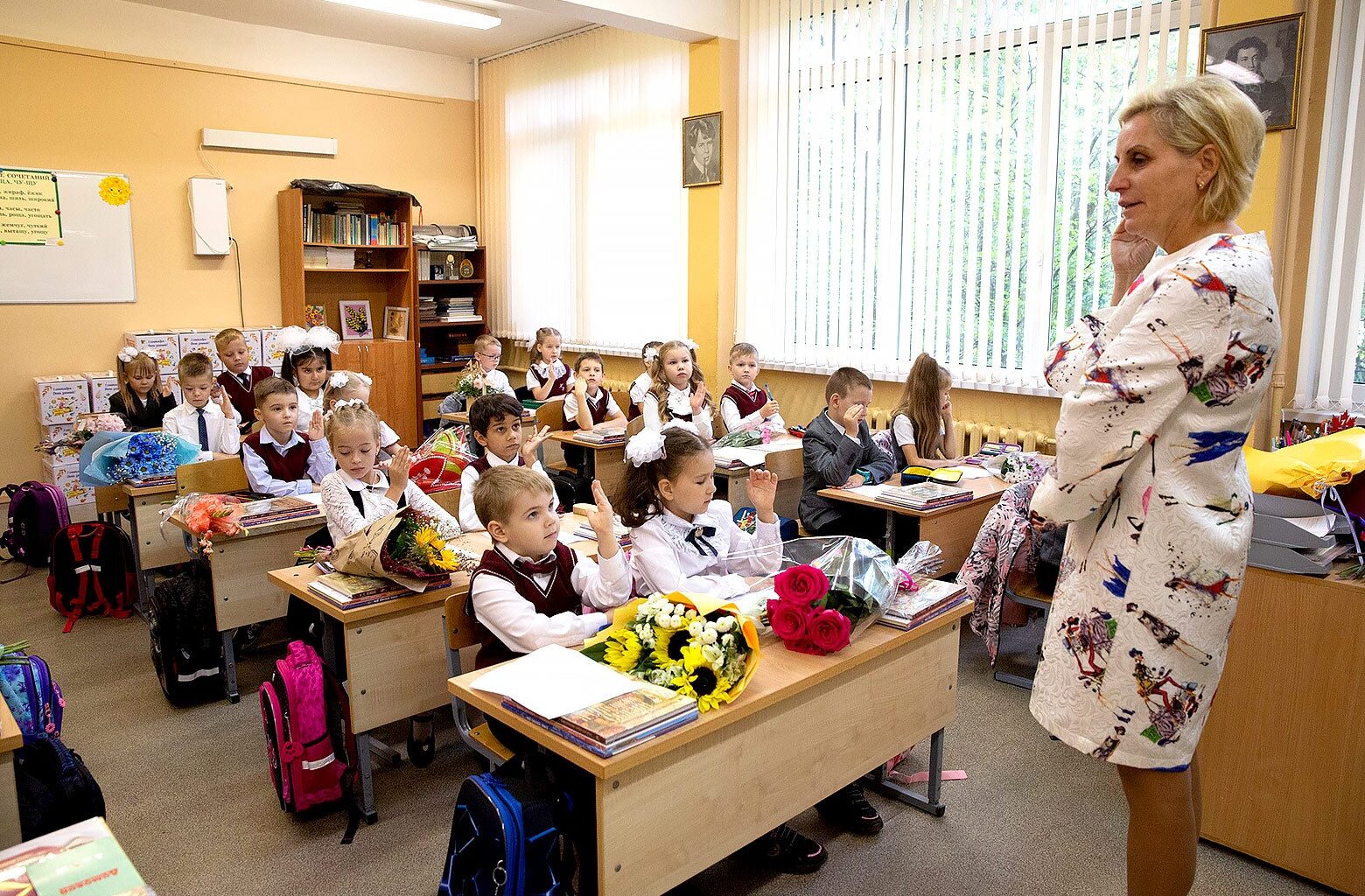
On Feb. 24, 2022, Russian tanks crossed the Ukrainian border. Six months later, on Sept. 5, 18 million Russian schoolchildren heard about “conversations about important matters” for the first time—a new weekly lesson that became mandatory for all schools in the country, from first to 11th grade.
Every Monday, first period, children aged 6 to 18 sit at their desks to learn about “serving the motherland,” “restoring historical justice” in Crimea, and why modern Russian soldiers are real heroes, unlike “fictional” Western superheroes. Since 2022, Russian schoolchildren have attended 102 such lessons.
“Conversations about important matters” isn’t just a new subject in the school curriculum. It’s a pro-regime indoctrination session masquerading as education—a systematic attempt by the state to reshape an entire generation’s consciousness, using the school system as an instrument of military propaganda.
I’m a Russian emigrant journalist and former political activist. I gained access to these materials through someone currently enrolled in a Russian school, who was able to send me the textbooks and lesson plans necessary for this analysis. Vladimir Putin’s war in Ukraine, and its implications for our planet’s future, deeply alarm me. I’m also concerned for the future of my country’s children: I’m witnessing the most ruthless propaganda machine to emerge since Goebbels—and it’s unfolding in real time.
“Conversations About Important Matters”
“Conversations about important matters” operates like a well-oiled propaganda system. Every week, thousands of Russian schools receive ready-made guides from the program’s official website. Teachers don’t need to think up anything—everything is already written in Moscow, including precise question formulations and “correct” answers. The program’s official goal sounds noble: “To develop in children the need for self-cultivation of such moral qualities as honor, conscientiousness, responsibility.”
But the actual content of the lessons demonstrates entirely different priorities: to train young minds to obediently follow Putin’s preferred version of recent history.
Take the lesson for 10th and 11th graders on the 80th anniversary of Victory, Russia’s victory over invading Nazis during World War II. The guide instructs teachers to begin with an emotional description: “The forties. In the morning, villages smelled of fresh bread, children ran to school, laughing and jostling, graduates prepared documents for university admission. … But this world shattered into fragments, blazing in the fire of war.”
After such a setup, teachers must ask schoolchildren the key question: “What qualities are needed today by Russian fighters battling for the Motherland against Ukrainian neo-Nazis in the Special Military Operation zone?” Note the formulation: Ukrainians are labeled “neo-Nazis” a priori, while Russian aggression becomes “battling for the Motherland.”
The guide then directly instructs: “Our servicemen participating today in the ‘special military operation’ continue the great traditions of their grandfathers and great-grandfathers, fighting for justice with honor and courage. And just as 80 years ago, with hope in their hearts and love for their loved ones, who remain a reliable rear in all times, they bring closer the final destruction of Nazi ideology.”
Rewriting Recent History in Real Time
The program goes to great lengths to legitimize Russia’s 2014 invasion and annexation of the Crimean Peninsula, a part of Ukraine. The lesson “Day of Crimea and Sevastopol’s Reunification with Russia” for high school students represents a textbook example of how history gets rewritten.
The guide requires teachers to explain that “Russia’s history is inextricably linked with Crimea and Sevastopol—this is our common history, common Russian language, common culture.” The 2014 annexation of the region is called nothing other than “restoration of historical justice” and “return to the family home.”
Teachers must quote Putin: “In Crimea, literally everything is permeated with our common history and pride. Here is ancient Chersonesos, where Saint Prince Vladimir was baptized. … Crimea is Sevastopol, a city of legend, a city of great destiny, a fortress city and birthplace of the Russian Black Sea Fleet.”
The rewriting of history continues with a distortion of what happened in the invasion’s aftermath, claiming Crimea’s citizenry embraced Russia’s takeover via popular vote. Children are told that a 2014 “referendum” was an act of free will: “Residents of Crimea and Sevastopol voted for reunification with Russia.” The fact that the “referendum” took place at gunpoint by Russian soldiers who had seized the peninsula goes unmentioned in the guides.
Hero Factory and Newspeak
The program actively creates new mythology and new language. In lessons about Russia’s military operations in Ukraine, Ukrainian forces are invariably called “neo-Nazis,” Russian aggression becomes a “special military operation,” and territorial seizure becomes “liberation.”
“Z-war correspondent” (a term for embedded propagandists) Evgeny Poddubny, who records video addresses for schoolchildren, explains to children: “A hero is someone ready to sacrifice himself for others.” Director Nikita Mikhalkov, in a video clip for high schoolers, sits against a backdrop of icons and tells them that the West “invents fictional heroes”—while footage from The Avengers and Iron Man plays. “Unlike other countries, Russia doesn’t need to invent heroes. We have them, real ones. These aren’t Bruce Lee, not transformers, not Schwarzeneggers. These are different people. But they are people. And the blood there isn’t ketchup, but real. And the death is real.”
Simultaneously, the guides shape children’s perception of a hostile environment. Schoolchildren learn the concept of a “multipolar world,” where Russia confronts an aggressive West. “Victory in the Great Patriotic War remains an important component of our country’s status on the world stage and creates conditions for a multipolar and safe world,” reads material for high schoolers.
The curriculum is part of a broader, and expanding, effort to fuse militarism and education. Russian military personnel have begun massively joining teaching ranks thanks to special government programs. The “Defenders of the Fatherland” state fund, created by Putin’s decree in April 2023, helps “special operation veterans” obtain pedagogical education. Essentially, people with post-traumatic disorders and killing experience are becoming children’s educators.
Psychological Manipulation
Classic propaganda techniques are on display in Russian classrooms. First, emotional impact precedes rational thinking. Lessons begin with vivid, sensory images—the smell of bread in peaceful 1940s villages, children’s laughter, family warmth. Only after this emotional “capture” is ideological content delivered.
Second, false dichotomy is actively employed. Children are offered a choice between “us” (Russia, good, justice) and “them” (the West, evil, aggression). No third option exists.
Third, “emotional anchoring” techniques are applied. Positive emotions—pride, family love, admiration for heroism—are tied to images of war and state power. The guides directly instruct teachers to evoke in children “feelings of pride for their Motherland” and “understanding of the necessity to defend the peace and sovereignty of their Motherland.”
Age gradation plays a special role. Elementary students receive a simplified worldview through fairy-tale images of good and evil. Teenagers get more complex concepts of “geopolitics” and “historical justice.” High schoolers, who will receive draft notices in a year or two, learn about the “necessity” of the current war and their “duty to defend the Motherland.”

Sam Adams
A Gripping New Movie Has a Terrifying—and Inspiring—Message About the Fight for America Ahead
Read More
Resistance and Coercion
Not all teachers are willing to participate in children’s ideological processing. Reports of teacher resistance and dismissals come from various Russian regions. However, this resistance isn’t systematic—the guides come down from above as mandatory, and refusing to implement them threatens job loss.
Moreover, the program operates even in occupied Ukrainian territories, where Russian authorities forcibly implement “conversations about important matters” in captured schools. Ukrainian children are compelled to study “correct” history and “correct” values.
Parents are also drawn into the control system. The guides assume children will discuss lessons at home, and parental disagreement can become grounds for “preventive conversations”—a euphemism for “informant reports.”
A Crime Against Childhood
Prolonged exposure to fear narratives—“enemies all around,” “the country is under attack”—restructures children’s worldviews. In elementary school, critical mechanisms for evaluating such claims barely exist; lessons are absorbed as truth. Teachers recite formulas about “NATO encirclement” long before children learn to read maps.
This Content is Available for Slate Plus members only
Democrats Have One Brutal Path to Survival if the Supreme Court Kills the Voting Rights Act
This Content is Available for Slate Plus members only
Why Couldn’t Biden Get the Results Trump Just Did in the Middle East?
This Content is Available for Slate Plus members only
Trump Is Exploiting the Shutdown to Set Up Something Truly Terrifying
Think You’re Smarter Than a Slate Staff Writer? Find Out With This Week’s News Quiz.
Using the school system for military propaganda constitutes a gross violation of international law and child protection principles. Article 29 of the U.N. Convention on the Rights of the Child states that education should aim at “developing respect for human rights and fundamental freedoms,” not preparation for war.
Russia has transformed its schools into factories for producing future soldiers and compliant citizens. Children receive not education, but ideological processing. They’re not given tools for critical thinking, but force-fed ready-made schemes for perceiving the world. Western countries accepting Russian refugees should consider the scale of ideological processing to which Russian children have been subjected. Special programs for de-ideologization and critical thinking education will be needed to help these children adapt to free society.
“Conversations about important matters” is a crime against childhood, systematic poisoning of young minds with the venom of militarism and xenophobia. And the longer it continues, the harder it will be for Russia to return to peaceful existence.
Sign up for Slate’s evening newsletter.