
Oct 18, 2025
IndexBox has just published a new report: Africa – Crude Sunflower-Seed And Safflower Oil – Market Analysis, Forecast, Size, Trends And Insights.
The African market for crude sunflower-seed and safflower oil is projected to grow, with consumption volume reaching 2.2 million tons by 2035 at a CAGR of +1.7%, while market value is forecast to reach $3.1 billion at a CAGR of +2.6%. In 2024, consumption was 1.8 million tons, valued at $2.4 billion, with Egypt, South Africa, and Tanzania as the top consumers. Africa’s production was approximately 816,000 tons, led by Tanzania, South Africa, and Uganda. Imports surged to 1.1 million tons, dominated by Egypt, while exports were 58,000 tons, primarily from Egypt and Uganda. Price trends showed declines in both import and export prices in 2024.
Key Findings
Market volume is forecast to reach 2.2M tons by 2035, growing at a CAGR of +1.7%Market value is projected to hit $3.1B by 2035, with a CAGR of +2.6%Egypt, South Africa, and Tanzania are the top three consuming countries, accounting for 79% of volumeAfrica is a net importer, with imports (1.1M tons) far exceeding exports (58K tons) in 2024Zambia recorded the most significant growth rates in both consumption and production over the past decadeMarket Forecast
Driven by increasing demand for crude sunflower-seed and safflower oil in Africa, the market is expected to continue an upward consumption trend over the next decade. Market performance is forecast to decelerate, expanding with an anticipated CAGR of +1.7% for the period from 2024 to 2035, which is projected to bring the market volume to 2.2M tons by the end of 2035.
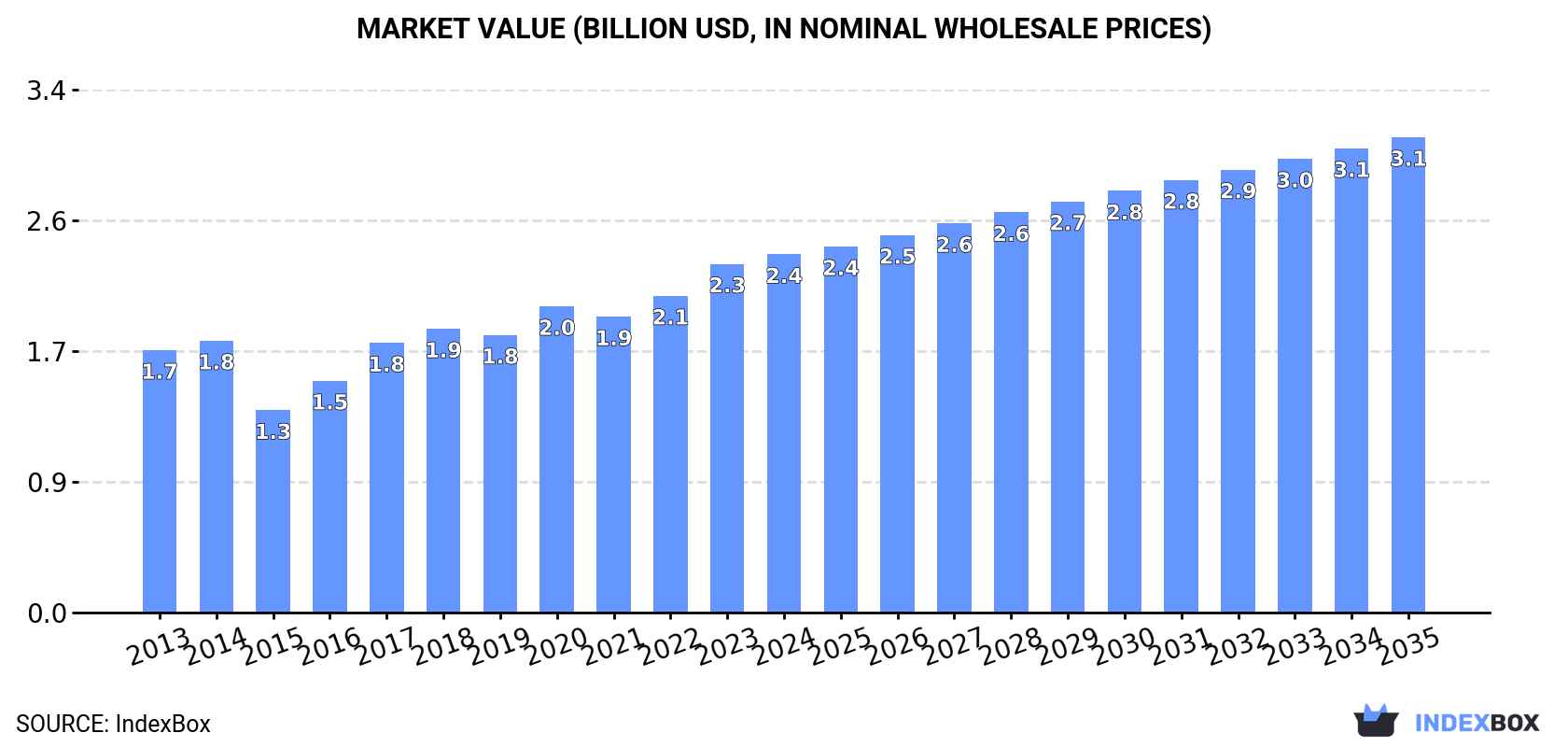
In value terms, the market is forecast to increase with an anticipated CAGR of +2.6% for the period from 2024 to 2035, which is projected to bring the market value to $3.1B (in nominal wholesale prices) by the end of 2035.
 ConsumptionAfrica’s Consumption of Crude Sunflower-Seed And Safflower Oil
In 2024, consumption of crude sunflower-seed and safflower oil increased by 13% to 1.8M tons, rising for the second year in a row after two years of decline. The total consumption volume increased at an average annual rate of +3.0% over the period from 2013 to 2024; however, the trend pattern indicated some noticeable fluctuations being recorded in certain years. Over the period under review, consumption reached the peak volume in 2024 and is likely to see gradual growth in years to come.
The value of the market for crude sunflower-seed and safflower oil in Africa amounted to $2.4B in 2024, growing by 2.7% against the previous year. This figure reflects the total revenues of producers and importers (excluding logistics costs, retail marketing costs, and retailers’ margins, which will be included in the final consumer price). The market value increased at an average annual rate of +2.9% over the period from 2013 to 2024; however, the trend pattern indicated some noticeable fluctuations being recorded throughout the analyzed period. The level of consumption peaked in 2024 and is expected to retain growth in the immediate term.
Consumption By Country
The countries with the highest volumes of consumption in 2024 were Egypt (687K tons), South Africa (448K tons) and Tanzania (311K tons), together accounting for 79% of total consumption. Morocco, Uganda, Sudan and Zambia lagged somewhat behind, together accounting for a further 14%.
From 2013 to 2024, the biggest increases were recorded for Zambia (with a CAGR of +11.2%), while consumption for the other leaders experienced more modest paces of growth.
In value terms, Egypt ($756M), South Africa ($548M) and Tanzania ($496M) were the countries with the highest levels of market value in 2024, with a combined 76% share of the total market. Uganda, Morocco, Sudan and Zambia lagged somewhat behind, together comprising a further 16%.
Zambia, with a CAGR of +11.6%, saw the highest rates of growth with regard to market size in terms of the main consuming countries over the period under review, while market for the other leaders experienced more modest paces of growth.
The countries with the highest levels of crude sunflower-seed and safflower oil per capita consumption in 2024 were South Africa (7.2 kg per person), Egypt (6.2 kg per person) and Tanzania (4.6 kg per person).
From 2013 to 2024, the biggest increases were recorded for Zambia (with a CAGR of +8.0%), while consumption for the other leaders experienced more modest paces of growth.
ProductionAfrica’s Production of Crude Sunflower-Seed And Safflower Oil
In 2024, approx. 816K tons of crude sunflower-seed and safflower oil were produced in Africa; leveling off at the previous year. The total output volume increased at an average annual rate of +2.1% from 2013 to 2024; the trend pattern remained consistent, with only minor fluctuations being recorded throughout the analyzed period. The most prominent rate of growth was recorded in 2017 when the production volume increased by 11% against the previous year. Over the period under review, production hit record highs at 821K tons in 2021; however, from 2022 to 2024, production remained at a lower figure.
In value terms, crude sunflower-seed and safflower oil production fell to $1.2B in 2024 estimated in export price. The total production indicated a noticeable increase from 2013 to 2024: its value increased at an average annual rate of +3.5% over the last eleven years. The trend pattern, however, indicated some noticeable fluctuations being recorded throughout the analyzed period. Based on 2024 figures, production decreased by -20.1% against 2022 indices. The growth pace was the most rapid in 2021 when the production volume increased by 20% against the previous year. Over the period under review, production hit record highs at $1.5B in 2022; however, from 2023 to 2024, production stood at a somewhat lower figure.
Production By Country
The countries with the highest volumes of production in 2024 were Tanzania (312K tons), South Africa (281K tons) and Uganda (89K tons), together accounting for 84% of total production. Sudan, Zambia and Morocco lagged somewhat behind, together accounting for a further 9.9%.
From 2013 to 2024, the most notable rate of growth in terms of production, amongst the leading producing countries, was attained by Zambia (with a CAGR of +11.4%), while production for the other leaders experienced more modest paces of growth.
ImportsAfrica’s Imports of Crude Sunflower-Seed And Safflower Oil
In 2024, purchases abroad of crude sunflower-seed and safflower oil increased by 27% to 1.1M tons, rising for the second consecutive year after two years of decline. In general, imports enjoyed a tangible increase. The growth pace was the most rapid in 2023 when imports increased by 77% against the previous year. Over the period under review, imports reached the peak figure in 2024 and are expected to retain growth in the immediate term.
In value terms, crude sunflower-seed and safflower oil imports stood at $1.1B in 2024. Overall, imports showed a mild expansion. The pace of growth was the most pronounced in 2016 with an increase of 34%. Over the period under review, imports attained the peak figure in 2024 and are likely to continue growth in the near future.
Imports By Country
Egypt represented the main importing country with an import of about 718K tons, which resulted at 67% of total imports. South Africa (174K tons) took a 16% share (based on physical terms) of total imports, which put it in second place, followed by Morocco (7.5%). The following importers – Tunisia (22K tons) and Sudan (18K tons) – each amounted to a 3.8% share of total imports.
Imports into Egypt increased at an average annual rate of +4.4% from 2013 to 2024. At the same time, Tunisia (+14.4%), Morocco (+9.4%), Sudan (+6.8%) and South Africa (+3.2%) displayed positive paces of growth. Moreover, Tunisia emerged as the fastest-growing importer imported in Africa, with a CAGR of +14.4% from 2013-2024. From 2013 to 2024, the share of Egypt and Morocco increased by +4.4 and +3.3 percentage points, while the shares of the other countries remained relatively stable throughout the analyzed period.
In value terms, Egypt ($727M) constitutes the largest market for imported crude sunflower-seed and safflower oil in Africa, comprising 66% of total imports. The second position in the ranking was taken by South Africa ($176M), with a 16% share of total imports. It was followed by Morocco, with a 7% share.
In Egypt, crude sunflower-seed and safflower oil imports increased at an average annual rate of +1.2% over the period from 2013-2024. In the other countries, the average annual rates were as follows: South Africa (+2.2% per year) and Morocco (+7.3% per year).
Import Prices By Country
In 2024, the import price in Africa amounted to $1,033 per ton, dropping by -14.4% against the previous year. Overall, the import price showed a noticeable shrinkage. The pace of growth was the most pronounced in 2021 when the import price increased by 66% against the previous year. Over the period under review, import prices hit record highs at $1,626 per ton in 2022; however, from 2023 to 2024, import prices stood at a somewhat lower figure.
Average prices varied noticeably amongst the major importing countries. In 2024, major importing countries recorded the following prices: in Sudan ($1,165 per ton) and Tunisia ($1,116 per ton), while Morocco ($965 per ton) and South Africa ($1,009 per ton) were amongst the lowest.
From 2013 to 2024, the most notable rate of growth in terms of prices was attained by Tunisia (+1.0%), while the other leaders experienced mixed trends in the import price figures.
ExportsAfrica’s Exports of Crude Sunflower-Seed And Safflower Oil
In 2024, the amount of crude sunflower-seed and safflower oil exported in Africa skyrocketed to 58K tons, jumping by 39% on 2023. In general, exports enjoyed a pronounced increase. The pace of growth was the most pronounced in 2017 with an increase of 124%. The volume of export peaked at 70K tons in 2019; however, from 2020 to 2024, the exports remained at a lower figure.
In value terms, crude sunflower-seed and safflower oil exports surged to $64M in 2024. Overall, exports continue to indicate a temperate expansion. The pace of growth appeared the most rapid in 2022 when exports increased by 163%. As a result, the exports reached the peak of $110M. From 2023 to 2024, the growth of the exports failed to regain momentum.
Exports By Country
Egypt represented the main exporter of crude sunflower-seed and safflower oil in Africa, with the volume of exports recording 40K tons, which was approx. 69% of total exports in 2024. South Africa (7K tons) ranks second in terms of the total exports with a 12% share, followed by Uganda (12%) and Tanzania (5.6%).
Egypt was also the fastest-growing in terms of the crude sunflower-seed and safflower oil exports, with a CAGR of +8.4% from 2013 to 2024. At the same time, Uganda (+8.4%) displayed positive paces of growth. South Africa experienced a relatively flat trend pattern. By contrast, Tanzania (-3.9%) illustrated a downward trend over the same period. From 2013 to 2024, the share of Egypt and Uganda increased by +23 and +3.8 percentage points, respectively.
In value terms, Egypt ($35M) remains the largest crude sunflower-seed and safflower oil supplier in Africa, comprising 55% of total exports. The second position in the ranking was taken by Uganda ($16M), with a 25% share of total exports. It was followed by South Africa, with a 9.6% share.
In Egypt, crude sunflower-seed and safflower oil exports increased at an average annual rate of +3.9% over the period from 2013-2024. In the other countries, the average annual rates were as follows: Uganda (+13.2% per year) and South Africa (+2.4% per year).
Export Prices By Country
In 2024, the export price in Africa amounted to $1,106 per ton, falling by -16.8% against the previous year. Overall, the export price recorded a mild slump. The most prominent rate of growth was recorded in 2021 an increase of 62% against the previous year. The level of export peaked at $2,111 per ton in 2022; however, from 2023 to 2024, the export prices stood at a somewhat lower figure.
There were significant differences in the average prices amongst the major exporting countries. In 2024, amid the top suppliers, the country with the highest price was Uganda ($2,318 per ton), while South Africa ($877 per ton) was amongst the lowest.
From 2013 to 2024, the most notable rate of growth in terms of prices was attained by Uganda (+4.5%), while the other leaders experienced more modest paces of growth.