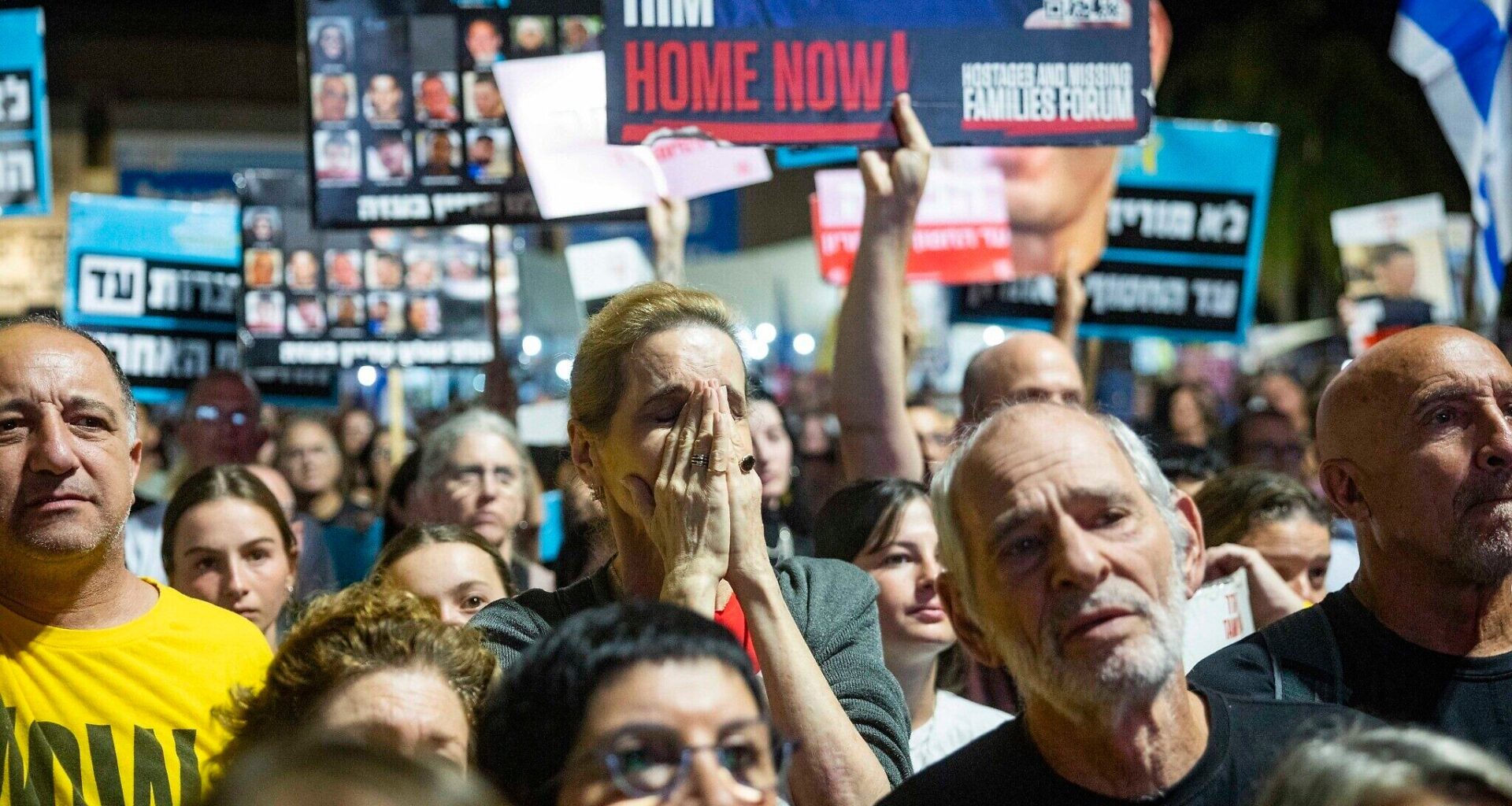
Periodically, throughout Saturday night’s rally in Tel Aviv’s Hostages Square, two dissonant sets of photos flashed alongside one another on a giant screen behind the stage.
One contained the images and videos Israelis have watched time and again over the past six days: scenes from Monday of 20 freed hostages embracing their loved ones, sobbing tears of happiness, holding signs thanking the people of Israel.
The other contained another group of photos the country has come to know well over the past two years: pictures of the 18 dead hostages not yet released — still shots of fathers, sons and brothers whose bodies were still held in Gaza. (Hours later, Hamas handed over what it said were the remains of two of the hostages).
The split screen on the stage mirrored a fraught ambivalence in the crowd — and across the country. The exuberance that came with the living hostages’ release, less than one week ago, had ceded space to uncertainty and disappointment.
Six days ago, joy and relief swept over Israel as the seemingly impossible happened — the rest of the living hostages coming home, all at once, all on their own two feet. But now, the country is confronting the reality that it will have to keep fighting for the deceased hostages who have yet to return for burial, even as Israel has no timeline for their release, and no guarantee that they’ll be returned.
Get The Times of Israel’s Daily Edition
by email and never miss our top stories
By signing up, you agree to the terms
The experience of the past few days — in which small groups of bodies are released to Israel with no identification — has induced whiplash, an unhappy reminder of the ceasefire earlier this year in which small groups of hostages came home week by week. Coupled with that is the fear, among relatives of the deceased hostages, that their fellow citizens will stop caring now that the living have returned.
“I came here very scared; I was scared the square would be empty,” said Ayelet Goldin, whose brother Hadar’s body has been held by Hamas for 11 years. “I came here scared, and emotional, and mainly ready for battle. On the one hand, I want to believe, and I have hope. And on the other hand, my eyes are open to reality.”

Signs reading, “Don’t stop until the last hostage,” are displayed at a rally at Tel Aviv’s Hostages Square on October 18, 2025. (Ben Sales/Times of Israel)
That same anxiety and determination pulsed through the crowd on Saturday night. Exactly one week prior, a gigantic audience in the very same spot erupted in jubilation as US envoy Steve Witkoff proclaimed that “miracles can happen,” that the captives were coming home. Some wondered if, after more than 100 weeks, it would be the final rally to free the hostages.
It was not. On Saturday night, as another crowd of thousands gathered in the square, the stalls selling T-shirts and pins were still open. The clock counting the days the hostages have been held in Gaza still ticked. Groups on either side of the plaza sang melancholic songs, or recited a psalm said in times of distress.
Claudia Rotem, who was at last week’s rally as well as the one on Saturday night, laughed when asked if any of the previous week’s excitement remained.
“I think last week there was a fair amount of euphoria, and even though we were skeptical, we expected that things would unfold as they should,” she said. “They clearly haven’t.”
She added: “It’s very sad. We’re very skeptical that this thing will end as it’s supposed to.”
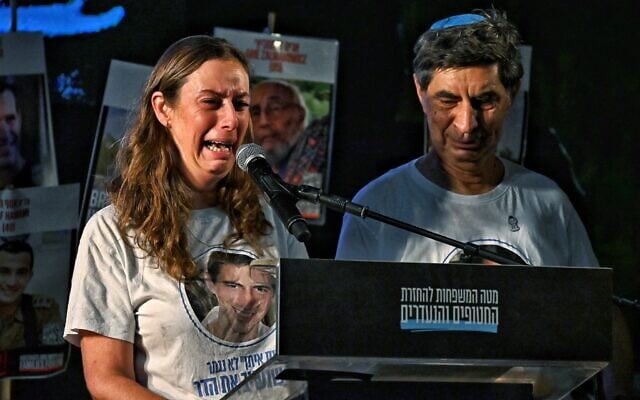
Ayelet and Simcha Goldin, sister and father of Hadar Goldin, whose body has been held by Hamas in Gaza for 11 years, speaking at Hostages Square in Tel Aviv, October 18, 2025. (Omer Yelin / Pro-Democracy Protest movement)
The goal of the rally, it appeared, was to harness the frustration coursing through the crowd and channel it toward a redoubled fight for the release of the deceased hostages. The tone wasn’t celebratory, let alone valedictory. It was a desperate plea to Israel to understand that the fight to bring the hostages home wasn’t over yet.
“Matan has come home alive,” Einav Zangauker, one of the most prominent faces of the struggle to free her son and the other hostages, said to cheers.
She continued: “But — and there’s a big ‘but’ that must be said — our fight isn’t over. The fight won’t be done until the last fallen hostage has come back to us.”
That theme extended throughout the rest of the rally. Gratitude for the 20 living hostages’ release, and the return of 10 deceased hostages, was present, but hardly the focus. Speaker after speaker celebrated the return of the captives, then spent most of their time calling for the release of those still held.
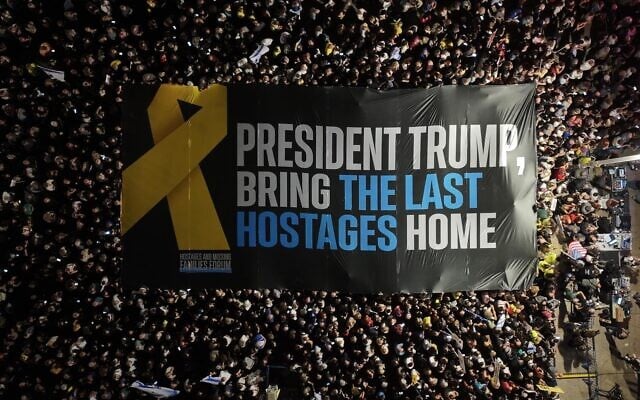
A banner in Hostages Square in Tel Aviv urges President Trump to “bring the last hostages home,” October 18, 2025. The bodies of 18 hostages are still held in Gaza. (Aviv Atlas / Pro-Democracy Protest Movement)
The trademark giant banner held above the crowd’s head read, in all-caps, “President Trump, bring the last hostages home.”
Even the announcement that more deceased hostages would be released later that night, made midway through the rally, received only a smattering of applause. The same questions remained: Who would they be? And when would everyone finally come home?
Relatives of hostages said they shared those questions. Goldin reminded the crowd that the terror group holding the fallen captives is the same Hamas that massacred southern Israel two years ago — and which cannot be trusted to return the rest of the hostages. There were calls — echoed by the Hostages and Missing Families Forum — for the government to halt the implementation of the ceasefire deal until the hostages returned.
Some of the strongest reactions were choruses of boos reserved for government officials who have signaled that the fight to free the hostages is over — such as Knesset Speaker Amir Ohana, who made a show of removing his yellow ribbon pin before Trump’s address to the Knesset on Monday.
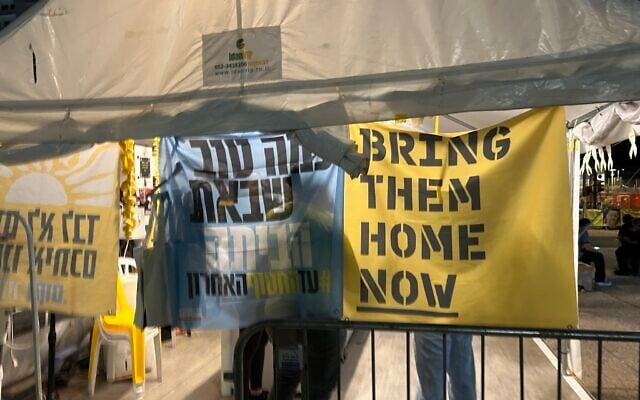
Two signs, one celebrating the return of hostages from Gaza and another calling for those still held captive to be released, hang side by side in Tel Aviv’s Hostages Square on October 18, 2025. (Ben Sales/Times of Israel)
There were reminders, amid the speeches, that things had in fact changed. Photos of hostages dangled from a nearby tree, and the faces included some who were back home and some still captive. The composites of the remaining hostages included far fewer photos than just a week ago.
But speakers urged the crowd not to give up — even if it means deferring their joy until all of the hostages’ families receive the closure of getting their loved ones back.
“Now we’re in a rare window of time,” said Ela Haimi, wife of slain hostage Tal Haimi. “We have wall-to-wall backing, and the public is with us. But the window could close… We will not give up. I will not give up.”