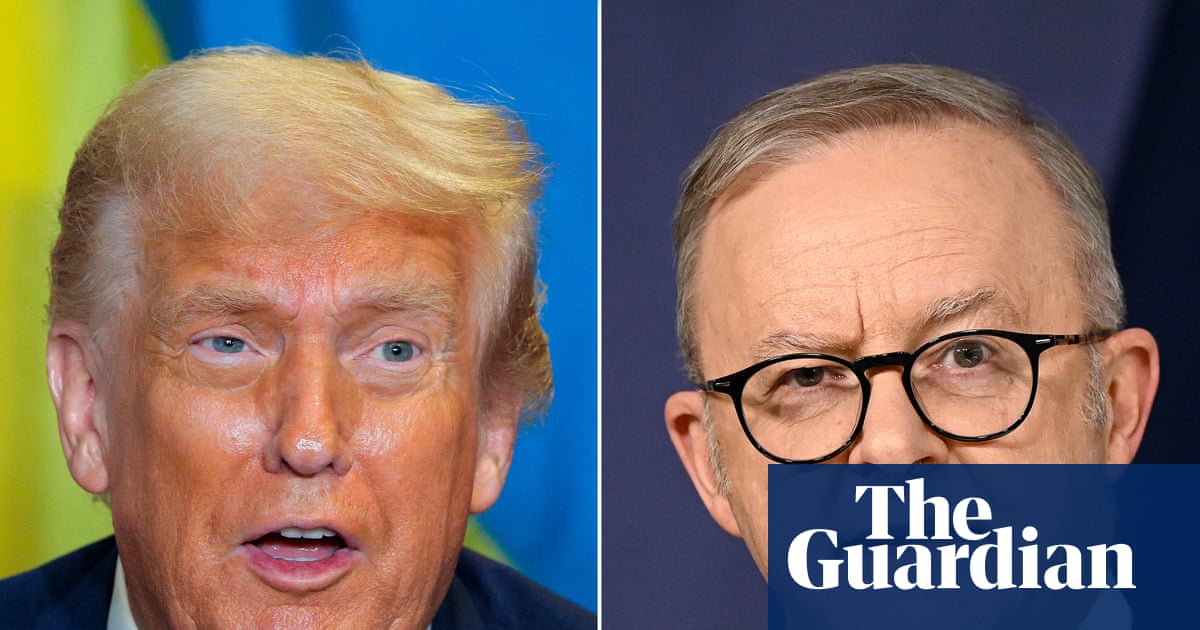
Labor government sources are confident Trump’s review of Aukus will rubber-stamp the agreement, by which Australia will be permitted to buy several American nuclear-powered submarines.
They note Australia’s showering of money on American shipyards, and an enthusiasm among congressional leaders that the defence industry minister, Pat Conroy, described as “evangelical” on Friday.
But the uncertainty over the review, including whether Trump could seek to strong-arm a better deal for America or make changes to the timeline, still hangs.
The Pentagon’s review of Aukus – signed by Trump’s predecessor, Joe Biden – remains ongoing, a Department of War spokesperson told Guardian Australia this week.
“The AUKUS initiative is still under review. We have no further AUKUS updates to announce at this time,” they said.
Hearing an explicit endorsement of Aukus from Trump’s lips – after he asked “What does that mean?” when it was mentioned in February – would be a relief for Albanese.
Sign up: AU Breaking News email
But the government is projecting major confidence about Aukus, with Australia having already contributed US$1bn to support American manufacturing, and another $1bn due by the end of the year.
It’s not beyond the realms of possibility that Albanese confirms that payment in his meeting with Trump. But sources downplayed prospects of the Pentagon review being released next week.
In Australia, though, there remains mixed opinions on Aukus: United States Studies Centre (USSC) polling found 17% support cancelling the agreement, 44% oppose cancelling, and 39% weren’t sure. Just 27% said Albanese’s government had properly explained why nuclear submarines were even needed.
2. Defence
Albanese could face more calls from Trump to boost Australia’s spending.
The war secretary, Pete Hegseth, in June said Australia should increase its defence spending to 3.5% of GDP “as soon as possible” – about a $40bn lift from the 2.4% of GDP projected by 2033-34 – as part of efforts to make allies “share the burden”.
Albanese and his government have resisted the idea of committing to a specific target, saying they will spend on defence as needed.
The defence minister, Richard Marles, said this week the government had a “good story to tell about building Australian defence capabilities”; the government points to billions spent on the new defence precinct at Henderson, which could be used by US military, and increased spending on missiles, drones and seacraft.
The USSC poll found only 42% of people thought the US alliance made Australia more secure, a 13% drop since 2024; just 54% think Australia should remain in the alliance.
3. Trade and tariffs
Australia is subject to 10% baseline tariffs, as well as sectoral tariffs on steel and aluminium. While government sources say they are constantly advocating for those tariffs to be dropped, citing the Australia-US free trade agreement, the government is not expecting any major changes in the near future.
Indeed, one argument is that Australia having the lowest tariff rate in the world may be creating sort of a competitive advantage in some sectors where our products are in competition with other exports into America from countries with higher tariff rates.
Changes to the steel and aluminium tariffs aren’t expected imminently, but the government is concerned about new ones; potentially on pharmaceutical products, or how the US government could respond to the news bargaining incentive, after similar policies on big tech were met with fury by Trump.
4. Critical minerals
While some parts of Albanese’s trip remain unknown, it is widely expected it will include something on critical minerals. Australia has vast deposits of rare minerals – including lithium and cobalt – that America and many nations want and need for advanced technology, as government ministers have been stressing in recent weeks.
Giving Trump a pipeline could help Albanese in other parts of the negotiations between the two nations.
The treasurer, Jim Chalmers, visiting Washington this week, told CNN that Australia could be “a reliable supplier of critical minerals”.
He noted that sometimes access to critical minerals could be “distorted” – potentially a not-subtle allusion to China’s plan for export controls on the material – and said Australia was keen to “work closely with the Americans” on supply.
Access to rare minerals could be Albanese’s ace in the hole.
5. Building rapport
In a way, simply having the meeting is a success – or a relief. Albanese has claimed “in the real world, no one cares” when he meets Trump; but Guardian Australia last month revealed the high-level behind-the-scenes diplomatic efforts to secure a meeting.
Albanese has come under intense criticism from the Coalition over the lack of a meeting so far, noting the conga line of world leaders who had made special trips to the White House.
The opposition leader, Sussan Ley, on the eve of his trip, wished Albanese well but yet again noted “this meeting could have, and should have, occurred sooner”.
Labor government sources are relaxed about the first meeting only coming in October, noting Australia had still gotten one of the best tariff deals in the world, that the Pentagon was speaking favourably about Aukus, and that Trump had rarely spoken unfavourably about Australian issues – indeed, that the leaders had held several productive phone calls, followed by Trump praising Albanese as “very good”.
Mindful of several explosive White House meetings with leaders from Ukraine or South Africa, some government sources thought an earlier Trump-Albanese sitdown could do more harm than good if it came amid tense negotiations.
That Albanese’s meeting comes amid Trump’s victory lap following a Middle East ceasefire, and renewed focus on the Russia-Ukraine war, could be good timing for a prime minister hoping a long-awaited meeting doesn’t cause too much fuss.