Aalten, a little town of 27,000 people tucked away in the farmland of the southeast Netherlands, is the unlikely home of the Australian rock legend Angus Young.
Just over a decade ago, the AC/DC guitarist and his Dutch wife, Ellen, bemused residents by building a large neo-renaissance villa there — complete with a sculpted head with devil’s horns and stained glass decorated with a lightning bolt.
This year, however, the people of Aalten learnt of a rather more controversial building project a couple of miles from Young’s mansion: a housing complex for 300 asylum seekers planned for a farmer’s field on the edge of town.
Many are not happy. Nathalie, 49, who has helped to organise a series of protests against the plans, said: “I understand that these asylum seekers must go somewhere, but 300 concentrated in one place is just too many for the local people.”

Nathalie, 49, standing next to a sign that reads: “Our own people first”
FONS SLUITER FOR THE TIMES
The council has now put its plans on hold, but authorities across the country are tackling resistance to a law that came into force in February last year, which aimed to spread asylum seekers more evenly across the Netherlands.
There have been widespread protests against plans to open asylum centres in more than a dozen towns ahead of the general election on October 29.
• Dutch government collapses over demands to stop asylum seekers
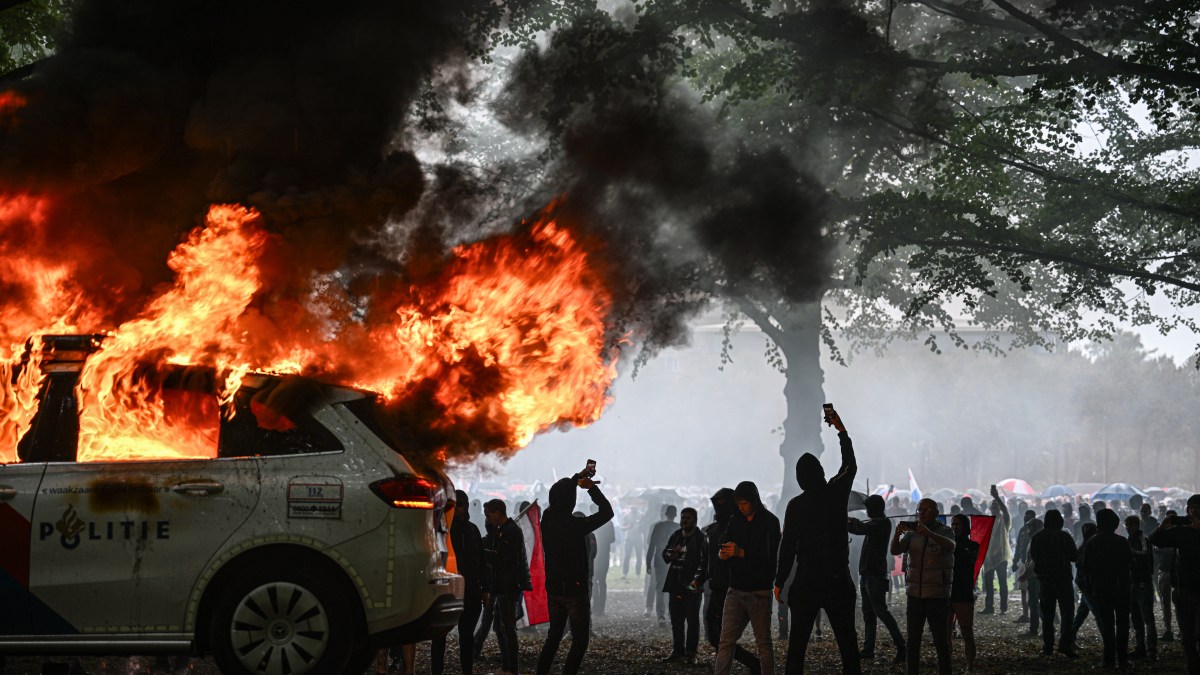
Police in The Hague used tear gas and water cannon to disperse a crowd of 1,500 people who blocked a main road, threw bottles and stones and set fire to a police car. Thirty people were arrested and two officers injured.

MOUNEB TAIM/ANADOLU VIA GETTY IMAGES
Geert Wilders, 62, whose Freedom Party (PVV) looks set to be the country’s single strongest political force for the second election running, with more than one in five of the votes, has seized upon the unrest. Immigration has dominated the conversation in the election run-up.
For the past two decades, the flamboyant right-wing leader has made the fight against immigration —and against Islam, in particular — the centrepiece of his political offer. His reward came in the last election in November 2023 when the PVV became the dominant force in a four-party coalition.
The coalition achieved little amid continued infighting and fell apart after Wilders pulled his party out in June in a dispute over immigration, precipitating this early poll.
Addressing a crowd protesting the opening of a centre in Zwolle, in the northeast Netherlands, Wilders said: “We absolutely don’t intend to turn the Netherlands into one giant asylum centre. What kind of lunatic would come up with the idea of putting such a large number of asylum seekers so close to houses, a school and a railway station?” Councillors later voted overwhelmingly to approve the scheme.

Geert Wilders
RUT / SPLASHNEWS.COM
Peter Kanne, a senior research adviser at pollsters Ipsos I&O, said: “The demonstrations against asylum centres help Wilders by keeping the subject alive. For him, the most important thing is that the campaign is about immigration and asylum.”
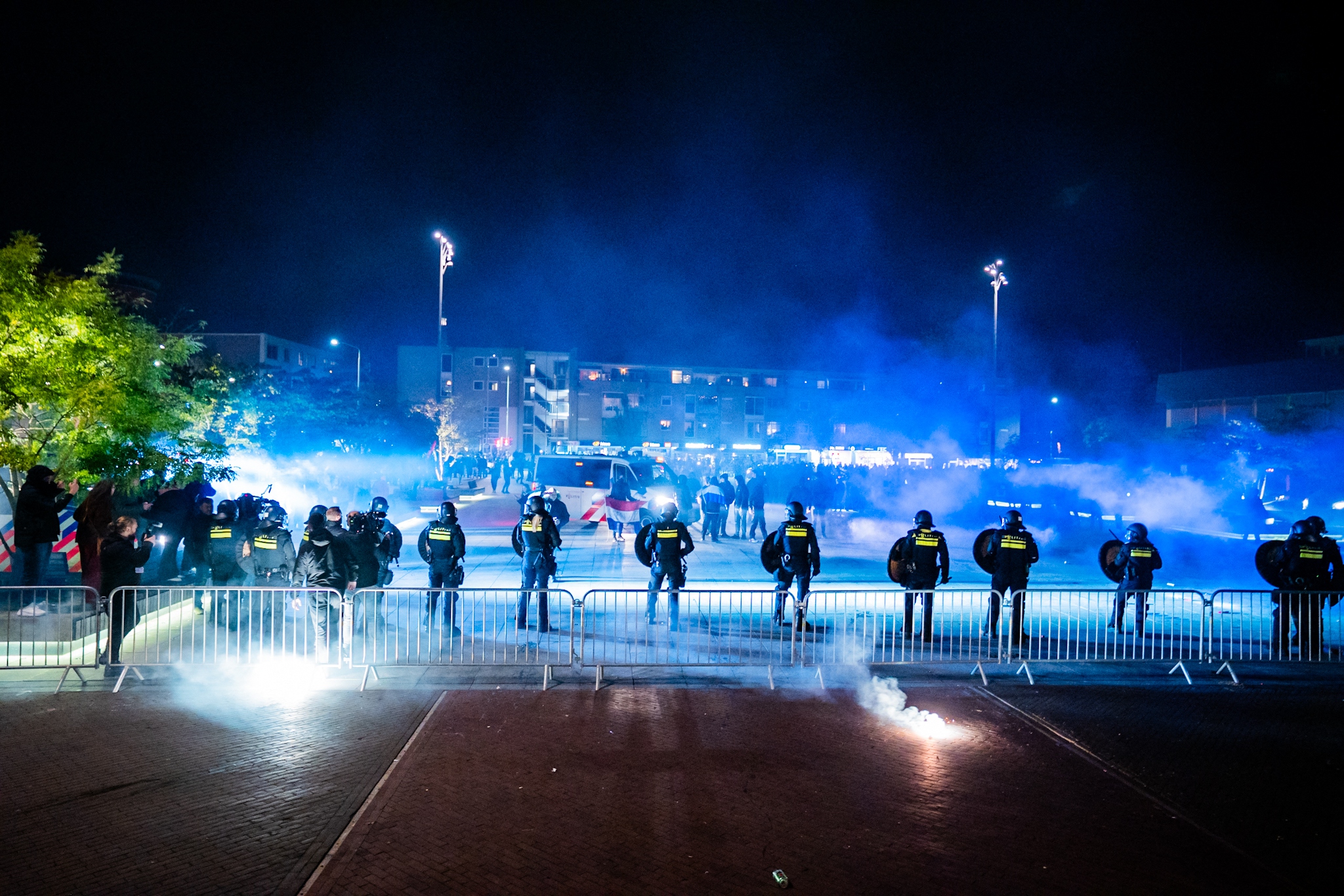
Violent protests broke out in Doetinchem, west of Aalten, last month over plans to open a centre for 100 migrants in a disused former office block. About 400 protesters armed with mortar fireworks descended on the town. Seven men were arrested, four of whom were jailed for three months.
Riot police in Doetinchem on September 25
ANP VIA AFP
Gerco Mons, a reporter for De Gelderlander, a regional paper, said: “At the beginning it was relaxed. The police were talking to the protesters, laughing and telling jokes. Then suddenly one guy started firing fireworks, others followed, and the riot police went in hard.
“It was really intense,” added Mons, who has covered the area for 25 years. “I have never seen anything like it before, especially not in this region, where everybody is most of the time very friendly and open and welcome.”
Mark Boumans, the mayor, said: “When people hear an asylum centre is coming, many are not happy, but we have to act according to the law, which, in our case, means we have to take about 330 people.
“What is important is that all local communities have to participate, not just a few.”

Mark Boumans, the mayor of Doetinchem
FONS SLUITER FOR THE TIMES
Safety is of great concern to residents. Rudolf, an elderly man who lives directly across the street from the planned centre, said: “I didn’t take part in the protest. It was ridiculous. But it’s the feeling in the neighbourhood. We are worried about our safety. There will be a lot of young men living in there.”
There are also fears that migrants will jump the queue for housing in a country suffering from a serious shortage.
Wilders has maintained an unrelenting focus on immigration. One of his most discussed — and complained about — postings on X juxtaposed half the face of a blue-eyed young woman with long blonde hair labelled PVV with half of an older woman in a headscarf marked PvdA, the initials of the rival Labour party. Underneath it read: “The choice is yours on 10/29.”

Yet Wilders’s gamble may not pay off: his main political partners vowed never to work with him after he collapsed the government. The PVV’s ratings also suffered when Wilders suspended all campaigning earlier this month after he was named as a potential target in an alleged plot by Islamists to kill Bart de Wever, the right-wing leader of neighbouring Belgium.
On Friday evening, Wilders returned to the fray, with an appearance on a popular television chat show. He was accused of being a “demagogue” and playing up the terror threat to avoid tough political debates — all of which he denied.
Polls show discontent over the level of immigration remains high, but some of Wilders’s supporters are defecting to other political parties.

Demonstrators at The Hague gathered to protest against plans for asylum centres on September 20
JAMES PETERMEIER/ZUMA PRESS WIRE
Among them is the BBB, the farmers’ party, which last week unveiled a plan against “Islamic extremism” that included a ban on burkas and groups praying in the street and a limit to amplified calls to prayer.
Kristof Jacobs, a political scientist at Radboud University, said: “There is a substantial distrust of politics in the Netherlands, and there are a lot of voters who are looking for a messiah who will save them from the ills of democracy. But they make bold promises that they cannot keep once they get into government, which means voters then abandon them.”
Jacobs predicted the next prime minister would be Henri Bontenbal, 42, the leader of the centre-right Christian Democratic Appeal, which, according to polls, is set to win 24 seats, up from just five in the outgoing parliament.
But there is still all to play for. “In 2023, roughly 40 per cent of voters only made up their mind in the last week before election day,” added Jacobs. “So a lot can change.”