by Ján Figeľ*
*A paper presented at the side event “Human Rights in Japan. Religious Cleansing in Japan: Eradication of an Entire Faith Community” 60th Session of the United Nations Human Rights Council, Geneva, 26 September 2025.
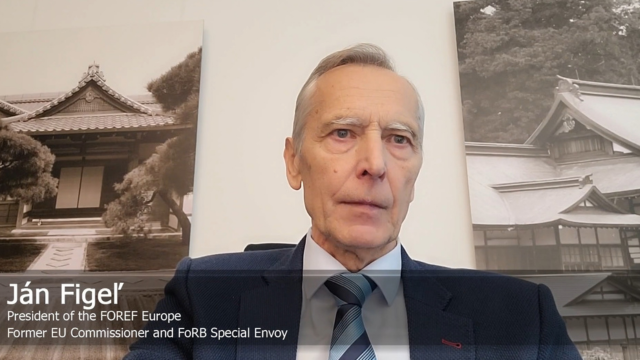 Ján Figel’ speaks (via video) at the Geneva side event.
In March 2025, the Tokyo District Court under the Civil Code ordered the dissolution of the Family Federation for World Peace and Unification (formerly the Unification Church).
I have been deeply concerned since this unprecedented decision. The order lacks a constitutional legal basis and violates Japan’s obligations under the International Covenant on Civil and Political Rights. Such measures endanger not only one minority faith but also others, because injustice against one community always threatens others. The ruling will have implications for religious freedom in Japan.
The decision is based on questionable evidence and accusations. It lacks a substantive foundation and appears driven more by political motives than law. What in particular troubles me about this ruling?
The court’s decision is arbitrary, unconstitutional, and unlawful. It violates basic principles of due process, such as the hearings being conducted behind closed doors.
Article 81 of the Religious Corporations Act allows dissolution only when an organization commits illegal acts that seriously harm public welfare. Yet, the Tokyo District Court expanded this to include thirty-two civil cases spanning forty years involving former members. The Ministry of Education, Culture, Sports, Science, and Technology even changed its interpretation of the law to request dissolution—something unprecedented.
Furthermore, missionary activity and donations were judged to violate “social norms” and “social fairness.” However, these concepts are far too vague, opening the door to the arbitrary use of state and judicial power.
The UN Human Rights Committee has already recommended that Japan refrain from restricting religious freedom based on “public welfare.” Article 18 of the International Covenant on Civil and Political Rights does not allow such restrictions. On the contrary, states are obliged to protect minority religions against hostility from dominant groups.
Instead, Japan tolerated forced deprogramming by Protestant pastors. Many plaintiffs in these cases were themselves subjected to coercion, confinement, and so-called “deprogramming.”
Even worse, the Tokyo District Court adopted the unscientific “mind control” theory, assuming victimhood without evidence. This is proof of bias and arbitrariness. Legitimate courts must not be swayed by political pressure or media campaigns.
The future of Japanese democracy depends on transparency, accountability, respect for human dignity, and the protection of fair justice for all.
Politically, I must say that the movement against the Family Federation has roots in the Japanese Communist Party’s activities decades ago. Marxist atheism lies at the root of this long-standing hostility. Such ideology often inspires radical attempts to exclude faith in God and suppress religion, because religion liberates people from the worship of secular values and authoritarian state power.
I know this from my experience. I lived half my life under a communist dictatorship in Czechoslovakia. The secret police killed my own uncle Ján. The regime sought to crush both historic and new religions through many forms of coercion. But it ultimately and peacefully collapsed in 1989. Slovakia’s main force behind the peaceful resistance and the fight for freedom was the Christian community, especially the Catholic Church, and dissent.
If the District Court decision is confirmed, it will damage Japan’s image and credibility as a democracy. It may endanger other minority religions, including smaller and newer groups such as the Jehovah’s Witnesses.
Japan should learn from the harm caused worldwide by state-imposed ideologies and religious oppression, which have often led to deep internal divisions. The state exists to serve all citizens, not just the majority or a favored group.
Religious freedom is a “litmus test” for all human rights. Why?
Freedom of religion is inseparable from freedom of thought and conscience. It belongs to everyone—believers, non-believers, and atheists alike. This “inner freedom” is guaranteed by Article 18 of the Universal Declaration of Human Rights and the International Covenant on Civil and Political Rights.
 An image of the side event during Figel’s speech.
If inner freedom is not respected, “outer freedoms”—speech, press, assembly, association—will also be endangered. It begins inside each person and is expressed outwardly through acts of faith, family, and community. Internal freedom is absolute and must be fully respected by the state and institutions. External expression can be regulated only if restrictions are legal, necessary, and proportionate.
I opposed the dissolution of the Family Federation from the beginning. I wrote personally to Japan’s Prime Minister and Foreign Minister but received no reply. However, opposition abroad is growing. Japan has long been respected as a moderate democracy, but its reputation is now at risk.
I hear worldwide concerns, shock, and even protests from governments and civil society. How a country treats minorities—not its majority—is the true measure of its democratic credibility.
The UN Special Rapporteur on Freedom of Religion or Belief, Nazila Ghanea, requested to visit Japan to investigate possible violations of minority rights. Unfortunately, the Japanese government has not allowed her to visit. Japan should engage in dialogue with her and the UN.
The U.S. has the most significant political and moral influence. I hope it will treat this issue seriously and initiate dialogue with Japan at a high level. Human dignity and fundamental rights are more important than business interests. If the U.S. acts responsibly, it can help bring about positive change.
The Family Federation appealed against the District Court verdict, and the case is now before the Tokyo High Court. There is still hope for a fair and favorable judicial resolution.
Even democratic countries are not entirely immune to ideologies or abuse of power. Therefore, society must remain vigilant in protecting human dignity and human rights for all.