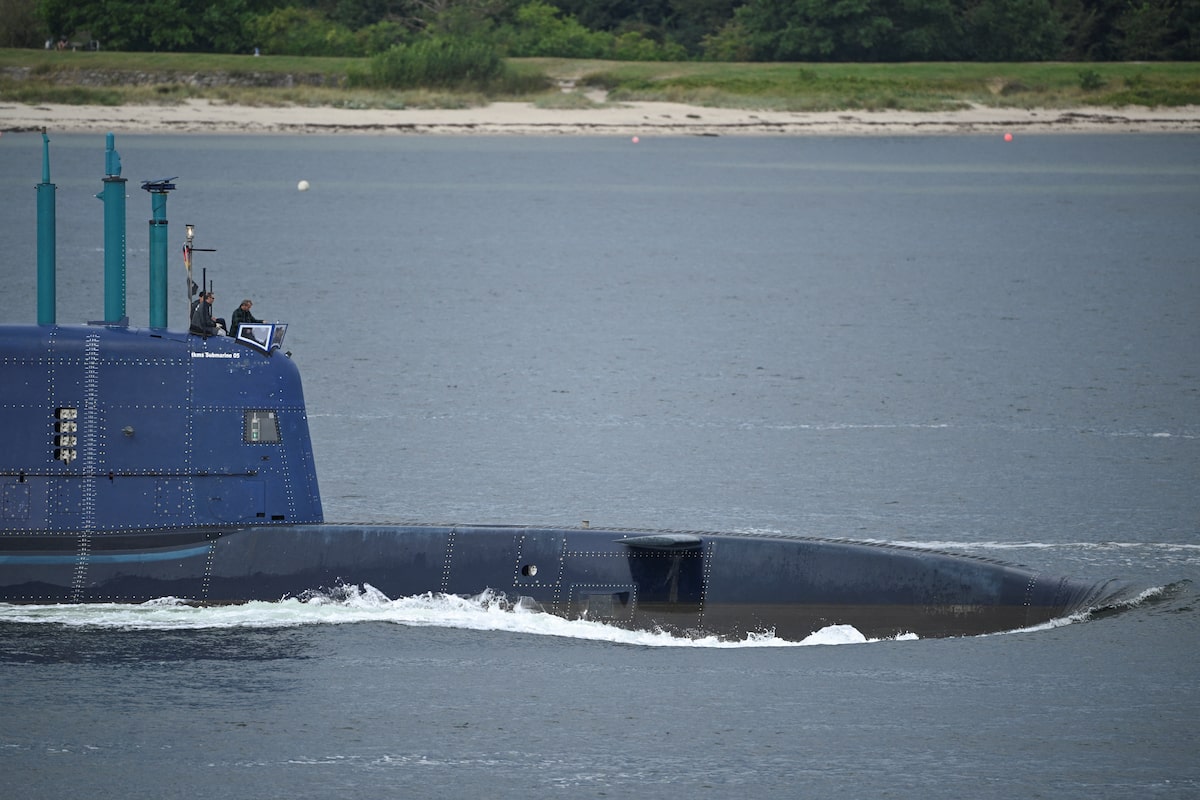
A submarine, built by Germany’s ThyssenKrupp Marine Systems (TKMS), moves through the Kiel Fjord, heading toward the Baltic Sea, off the coast of Kiel, Germany, on Sept. 1. TKMS is one of two companies shortlisted by Ottawa to compete on a multibillion-dollar contract to build up to 12 new submarines.Annegret Hilse/Reuters
Defence ministers from Germany and Norway urged Canadian officials in Ottawa to join their submarine partnership this week, just days before Prime Minister Mark Carney leaves on an Asian trip that will include a review of South Korea’s rival bid.
During a visit to Berlin in August, Mr. Carney announced that Canada had shortlisted two companies to compete on a multibillion-dollar contract to build up to 12 new submarines for the Royal Canadian Navy.
Just hours later, Mr. Carney took part in a hands-on tour of a 212A-class submarine, built by Germany’s ThyssenKrupp Marine Systems, or TKMS, one of the two shortlisted companies.
The second shortlisted company is Hanwha Ocean Co. Ltd. of South Korea. Mr. Carney has said he plans to visit their facilities in late October, when he will be in South Korea for meetings of the Asia-Pacific Economic Cooperation forum.
Norwegian Defence Minister Tore Sandvik, left, and German Defence Minister Boris Pistorius urged Canada to join their submarine partnership this week.PATRICK DOYLE/The Canadian Press
Norway is partnering with Germany to buy submarines from TKMS and Norwegian Defence Minister Tore Sandvik said Canadian participation makes sense among NATO allies with interests in protecting the North Atlantic.
“Norway is a proud partner and a happy customer buying German submarines,” Mr. Sandvik said.
He said the three countries could work together on maintenance and joint training if they were all using the same ships.
“With similar submarines, we will maintain them together. We will develop them together. We will train the crew together, and hopefully also we will sail together so we can share crew,” he said.
Canada’s submarine choice could break tradition, embrace South Korea in Indo-Pacific shift
German Defence Minister Boris Pistorius made similar comments during a joint news conference Tuesday in Ottawa and noted that TKMS has expressed openness to maintaining and possibly constructing the submarines in Canada.
“They are willing to do everything Canada is requiring. If Canada wants to produce, now or later, parts or totally, then TKMS will co-operate in a way which is appropriate to the project,” Mr. Pistorius said.
The two ministers spoke after meeting with Defence Minister David McGuinty and Industry Minister Mélanie Joly.
As for Germany’s South Korean competition, Mr. Pistorius said they build excellent submarines.
“We build better ones,” he said.
Seoul-based Hanwha builds the KSS-III Batch-II submarine. Hanwha has said it could deliver the first boat by 2032 and four subs by 2035, while TKMS has said it could deliver the first submarine well before 2035. Both vessels are diesel-electric submarines because Canada has ruled out nuclear-powered options, which are more expensive.
Mr. Pistorius dismissed claims that the South Korean option would be delivered more quickly. He also said Canada should prioritize working with NATO allies to counter Russia and China over saving a few dollars.
“One thing is, maybe the price is one dollar cheaper or two. And the other one is, what is the reliable partnership for the decades to come when it comes to northern Atlantic co-operation?”
Ottawa has not announced a budget for its submarines purchase, stating that doing so would compromise its negotiations with the two bidders.
Opinion: Canada’s new warships could be obsolete by delivery time
David Perry, president of the Canadian Global Affairs Institute, has estimated that the total acquisition cost over the lifecycle of the submarines would be $10-billion a boat, with as many as 12 on order, for a total price tag of as much as $120-billion.
Mr. Carney committed Canada in June to joining a NATO pledge to spend 5 per cent of GDP on defence-related spending, with 3.5 per cent on core military costs and 1.5 per cent on related infrastructure.
The target represents a dramatic increase for Canada, which has historically fallen short of NATO’s previous target of spending 2 per cent of GDP on defence.
During a committee appearance later in the day, Mr. McGuinty did not comment directly on the meeting with his German and Norwegian counterparts, but he told MPs that the decision to shortlist two companies will allow Canada to accelerate the process.
“It put us in a better position to be able to negotiate with two potential suppliers to maximize our benefits, to get the submarines that we need. And there is definitely a question of economies of scale here,” he said.