
Oct 22, 2025
IndexBox has just published a new report: Europe – Dates – Market Analysis, Forecast, Size, Trends and Insights.
The European date market is experiencing significant growth, with consumption reaching 221K tons in 2024 after two years of decline, valued at $605 million. Market performance is forecast to expand at a CAGR of +2.4% in volume and +3.1% in value through 2035, reaching 287K tons and $844 million respectively. France, the UK, and Germany are the largest consumers, accounting for 40% of total consumption, while Albania remains the dominant producer with 89% of European production. Import volumes surged to 270K tons ($811M) with the Netherlands showing the highest growth rate, while exports reached 65K tons ($266M) led by the Netherlands, France, and Germany. The Netherlands has emerged as a key trading hub with the highest import prices and export values in the region.
Key Findings
European date market projected to reach 287K tons by 2035 with 2.4% CAGR volume growthFrance, UK and Germany lead consumption with 40% market shareAlbania dominates European production with 89% share and highest per capita consumptionNetherlands emerges as key trading hub with highest import prices and fastest export value growthEuropean imports surged to 270K tons while exports reached 65K tons in 2024Market Forecast
Driven by increasing demand for dates in Europe, the market is expected to continue an upward consumption trend over the next decade. Market performance is forecast to decelerate, expanding with an anticipated CAGR of +2.4% for the period from 2024 to 2035, which is projected to bring the market volume to 287K tons by the end of 2035.
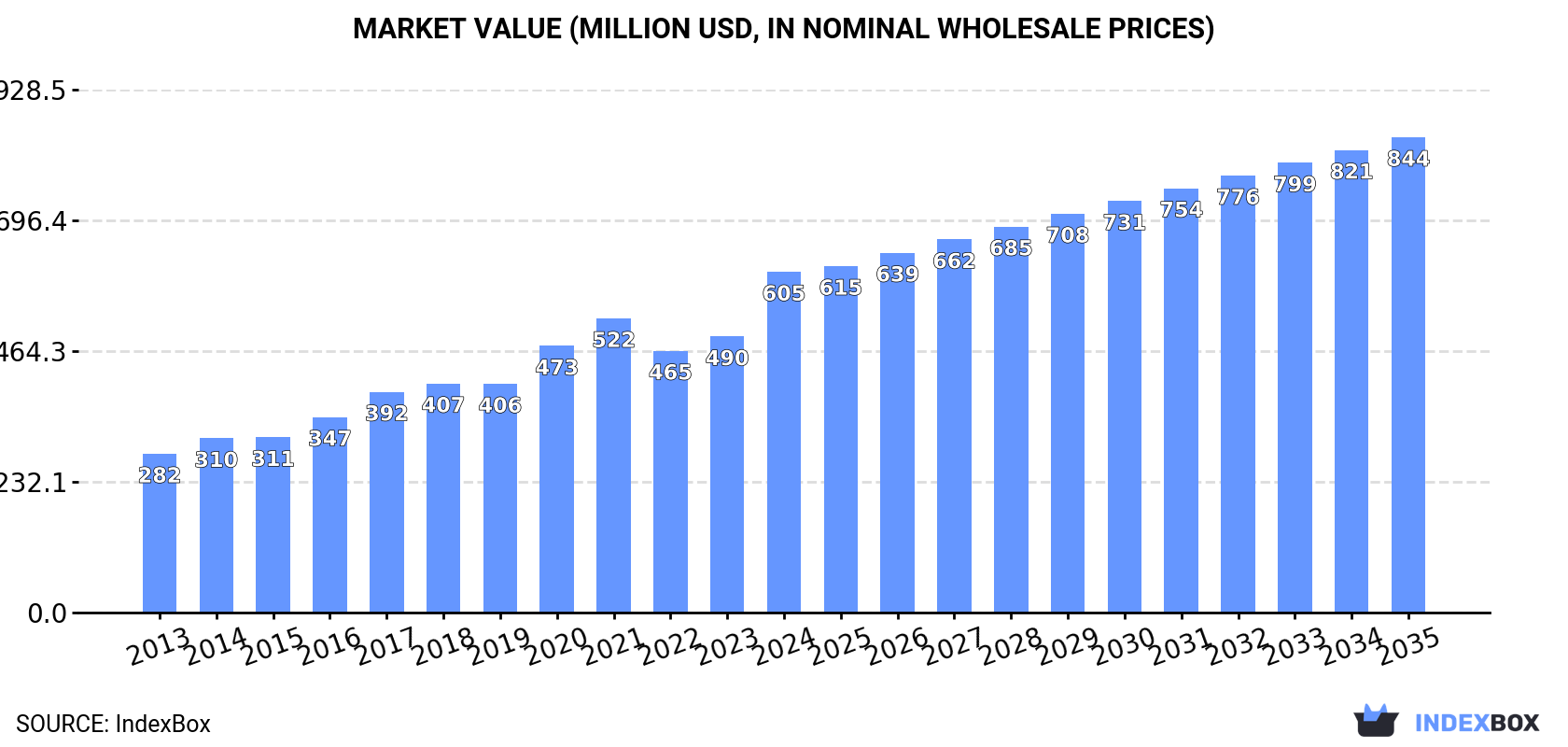
In value terms, the market is forecast to increase with an anticipated CAGR of +3.1% for the period from 2024 to 2035, which is projected to bring the market value to $844M (in nominal wholesale prices) by the end of 2035.
 ConsumptionEurope’s Consumption of Dates
In 2024, consumption of dates was finally on the rise to reach 221K tons after two years of decline. The total consumption indicated a remarkable increase from 2013 to 2024: its volume increased at an average annual rate of +5.5% over the last eleven years. The trend pattern, however, indicated some noticeable fluctuations being recorded throughout the analyzed period. As a result, consumption attained the peak volume and is likely to continue growth in the immediate term.
The value of the date market in Europe surged to $605M in 2024, rising by 23% against the previous year. This figure reflects the total revenues of producers and importers (excluding logistics costs, retail marketing costs, and retailers’ margins, which will be included in the final consumer price). The total consumption indicated a prominent increase from 2013 to 2024: its value increased at an average annual rate of +7.2% over the last eleven years. The trend pattern, however, indicated some noticeable fluctuations being recorded throughout the analyzed period. Based on 2024 figures, consumption increased by +30.2% against 2022 indices. As a result, consumption attained the peak level and is likely to continue growth in the immediate term.
Consumption By Country
The countries with the highest volumes of consumption in 2024 were France (36K tons), the UK (27K tons) and Germany (25K tons), with a combined 40% share of total consumption. Russia, Italy, Albania, Spain, Sweden, the Netherlands and Belgium lagged somewhat behind, together comprising a further 39%.
From 2013 to 2024, the most notable rate of growth in terms of consumption, amongst the main consuming countries, was attained by the Netherlands (with a CAGR of +14.0%), while consumption for the other leaders experienced more modest paces of growth.
In value terms, the UK ($94M), France ($87M) and Germany ($81M) appeared to be the countries with the highest levels of market value in 2024, together accounting for 43% of the total market. Spain, Italy, Russia, the Netherlands, Sweden, Albania and Belgium lagged somewhat behind, together accounting for a further 34%.
The Netherlands, with a CAGR of +16.2%, recorded the highest rates of growth with regard to market size in terms of the main consuming countries over the period under review, while market for the other leaders experienced more modest paces of growth.
In 2024, the highest levels of date per capita consumption was registered in Albania (5,375 kg per 1000 persons), followed by Sweden (578 kg per 1000 persons), France (528 kg per 1000 persons) and Belgium (499 kg per 1000 persons), while the world average per capita consumption of date was estimated at 298 kg per 1000 persons.
In Albania, date per capita consumption increased at an average annual rate of +2.2% over the period from 2013-2024. The remaining consuming countries recorded the following average annual rates of per capita consumption growth: Sweden (+9.6% per year) and France (+4.7% per year).
ProductionEurope’s Production of Dates
After two years of growth, production of dates decreased by -0.4% to 17K tons in 2024. Overall, production, however, showed a relatively flat trend pattern. The pace of growth was the most pronounced in 2014 when the production volume increased by 7% against the previous year. Over the period under review, production reached the maximum volume at 17K tons in 2023, and then shrank in the following year. The general positive trend in terms output was largely conditioned by a relatively flat trend pattern of the harvested area and a tangible increase in yield figures.
In value terms, date production stood at $22M in 2024 estimated in export price. Over the period under review, production continues to indicate a relatively flat trend pattern. The pace of growth appeared the most rapid in 2014 when the production volume increased by 39% against the previous year. Over the period under review, production attained the maximum level at $38M in 2015; however, from 2016 to 2024, production failed to regain momentum.
Production By Country
Albania (15K tons) remains the largest date producing country in Europe, comprising approx. 89% of total volume. Moreover, date production in Albania exceeded the figures recorded by the second-largest producer, Spain (1.2K tons), more than tenfold.
In Albania, date production increased at an average annual rate of +1.8% over the period from 2013-2024. The remaining producing countries recorded the following average annual rates of production growth: Spain (-8.0% per year) and Slovakia (-0.9% per year).
Yield
In 2024, the average yield of dates in Europe reached 23 tons per ha, leveling off at 2023 figures. The yield indicated a perceptible increase from 2013 to 2024: its figure increased at an average annual rate of +4.4% over the last eleven years. The trend pattern, however, indicated some noticeable fluctuations being recorded throughout the analyzed period. Based on 2024 figures, date yield increased by +52.8% against 2017 indices. The most prominent rate of growth was recorded in 2018 when the yield increased by 23% against the previous year. Over the period under review, the date yield reached the peak level in 2024 and is expected to retain growth in the near future.
Harvested Area
In 2024, the date harvested area in Europe shrank modestly to 714 ha, therefore, remained relatively stable against the previous year’s figure. In general, the harvested area recorded a noticeable shrinkage. The most prominent rate of growth was recorded in 2014 when the harvested area increased by 12%. As a result, the harvested area reached the peak level of 1.2K ha. From 2015 to 2024, the growth of the date harvested area failed to regain momentum.
ImportsEurope’s Imports of Dates
In 2024, purchases abroad of dates was finally on the rise to reach 270K tons for the first time since 2021, thus ending a two-year declining trend. Total imports indicated prominent growth from 2013 to 2024: its volume increased at an average annual rate of +6.6% over the last eleven years. The trend pattern, however, indicated some noticeable fluctuations being recorded throughout the analyzed period. As a result, imports reached the peak and are likely to continue growth in the immediate term.
In value terms, date imports soared to $811M in 2024. In general, imports saw buoyant growth. As a result, imports reached the peak and are likely to continue growth in the immediate term.
Imports By Country
In 2024, France (54K tons), distantly followed by Germany (32K tons), the UK (28K tons), the Netherlands (28K tons), Russia (21K tons), Italy (20K tons) and Spain (14K tons) were the largest importers of dates, together creating 73% of total imports. The following importers – Belgium (9.1K tons), Denmark (7.1K tons) and Sweden (7K tons) – each recorded an 8.6% share of total imports.
From 2013 to 2024, the most notable rate of growth in terms of purchases, amongst the main importing countries, was attained by the Netherlands (with a CAGR of +15.5%), while imports for the other leaders experienced more modest paces of growth.
In value terms, the largest date importing markets in Europe were France ($130M), the Netherlands ($124M) and Germany ($103M), with a combined 44% share of total imports.
The Netherlands, with a CAGR of +19.3%, saw the highest growth rate of the value of imports, in terms of the main importing countries over the period under review, while purchases for the other leaders experienced more modest paces of growth.
Import Prices By Country
In 2024, the import price in Europe amounted to $3,008 per ton, with an increase of 3.1% against the previous year. Over the last eleven years, it increased at an average annual rate of +2.0%. The most prominent rate of growth was recorded in 2014 when the import price increased by 15%. Over the period under review, import prices reached the maximum in 2024 and is expected to retain growth in years to come.
There were significant differences in the average prices amongst the major importing countries. In 2024, amid the top importers, the country with the highest price was the Netherlands ($4,505 per ton), while Russia ($2,017 per ton) was amongst the lowest.
From 2013 to 2024, the most notable rate of growth in terms of prices was attained by the UK (+3.5%), while the other leaders experienced more modest paces of growth.
ExportsEurope’s Exports of Dates
In 2024, shipments abroad of dates increased by 25% to 65K tons, rising for the second year in a row after two years of decline. Overall, exports continue to indicate a buoyant increase. The pace of growth was the most pronounced in 2019 with an increase of 28%. The volume of export peaked in 2024 and is expected to retain growth in years to come.
In value terms, date exports skyrocketed to $266M in 2024. Over the period under review, exports recorded a prominent expansion. The most prominent rate of growth was recorded in 2023 when exports increased by 28% against the previous year. Over the period under review, the exports reached the peak figure in 2024 and are likely to continue growth in the immediate term.
Exports By Country
The Netherlands (22K tons) and France (18K tons) represented the major exporters of dates in 2024, recording near 33% and 28% of total exports, respectively. Germany (6.7K tons) ranks next in terms of the total exports with a 10% share, followed by Belgium (5%). Denmark (2.3K tons), Slovakia (2.3K tons), Italy (1.8K tons), Spain (1.5K tons), Belarus (1.1K tons) and the UK (1K tons) followed a long way behind the leaders.
From 2013 to 2024, the most notable rate of growth in terms of shipments, amongst the main exporting countries, was attained by Denmark (with a CAGR of +16.7%), while the other leaders experienced more modest paces of growth.
In value terms, the Netherlands ($106M), France ($54M) and Germany ($29M) constituted the countries with the highest levels of exports in 2024, with a combined 71% share of total exports.
The Netherlands, with a CAGR of +16.7%, recorded the highest growth rate of the value of exports, in terms of the main exporting countries over the period under review, while shipments for the other leaders experienced more modest paces of growth.
Export Prices By Country
In 2024, the export price in Europe amounted to $4,085 per ton, which is down by -4.5% against the previous year. Over the last eleven years, it increased at an average annual rate of +1.5%. The pace of growth was the most pronounced in 2023 when the export price increased by 16% against the previous year. As a result, the export price reached the peak level of $4,275 per ton, and then reduced slightly in the following year.
Prices varied noticeably by country of origin: amid the top suppliers, the country with the highest price was Slovakia ($5,266 per ton), while Belarus ($386 per ton) was amongst the lowest.
From 2013 to 2024, the most notable rate of growth in terms of prices was attained by Slovakia (+4.1%), while the other leaders experienced more modest paces of growth.