
What’s the news?
The most influential think tanks operating in Brussels get a third of all of their money from U.S. companies and philanthropists.Experts warn that these think tanks are dependent on their funders, which makes them vulnerable to being influenced by corporate interests.This raises concerns about foreign influence on EU policy making.
Why does this matter?
U.S. influence and interference in EU affairs has risen to the top of the policy agenda in Brussels after Donald Trump’s return to the White House this year. With Washington taking an increasingly protectionist stance, experts warn that EU policymakers should be aware of ideas coming from think tanks that are skewed towards U.S. interests.
How was this investigated?
We set up a database with information on the most influential think tanks in Brussels, based on their lobbying efforts, budgets and media presence. We examined dozens of annual reports, reviewed think tanks’ mission statements and board structures, and analysed hundreds of documents obtained through Freedom of Information (FOI) requests. We also spoke to dozens of experts, think tank members and European Commission officials about the findings.
Read more
Fold in
The most influential think tanks operating in Brussels get a third of all of their money from U.S. companies and philanthropists, an analysis by Follow the Money found – raising concerns about foreign influence on EU policy making.
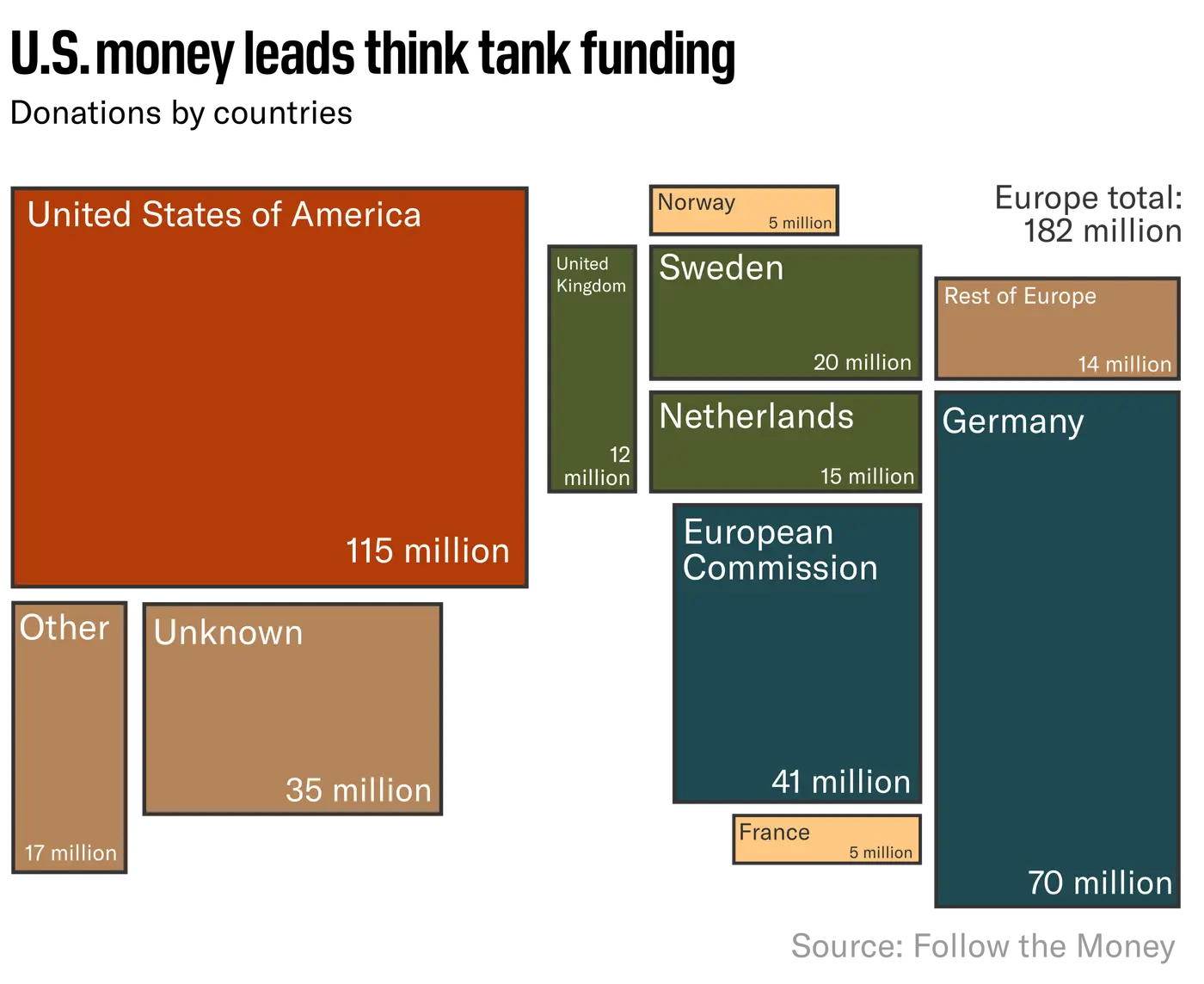
In 2023 alone, at least 115 million euros flowed from the U.S. to think tanks that influence the EU policy debate, the analysis shows. That’s out of a total of 350 million euros the think tanks received from both European and non-European funders – and by far the biggest chunk of money from a single country.
This data raises concerns about how vulnerable the EU is to U.S. corporate interests via think tanks, experts told FTM, and to what extent this is going under the radar.
The prospect of U.S. giants like Apple and Amazon having more sway over Brussels’ policies is particularly troubling at a time when the Trump administration is pushing hard to weaken EU digital and privacy rules in favour of American tech interests.
“[The amount of funds coming from the U.S.] is just politically shocking because basically its external interference in a structured way over many, many decades,” said political scientist Inderjeet Parmar, who has extensively researched think tanks.
Behind the funds are often private companies, such as Google, Microsoft, and Facebook parent company Meta – who have an interest in influencing EU policies. The three companies alone spent a total of more than 7 million euros in 2023 on Brussels’ most prominent think tanks, the analysis shows.
“The EU has a very prominent regulatory agenda and many policies that Brussels creates are also adopted by [other] countries,” said Dieter Plehwe, political scientist and researcher at the WZB Berlin Social Science Centre. “Since European-style regulation often interferes with U.S.-style capitalism, the U.S. tries to get involved as early as possible.”
For the investigation, FTM analysed the financial reports of 48 prominent think tanks in Europe and spoke to dozens of experts, Commission officials, and current and former employees of think tanks.
Of those, the most dependent on U.S. money were the World Resources Institute, the Brookings Institution, and the Atlantic Council – together, they raked almost half of the funds. Each of them got about half or more of their funding from the U.S.
Although these think tanks are headquartered in the U.S, they belong to one of the most influential in the EU in terms of meetings and events they organise with high-level policymakers.
From “independent” to “objective” to “non-partisan”: think tanks boost their credibility by portraying themselves as entities that don’t represent specific interests.
With that, they get access to EU institutions, which bounce policy ideas off them.
The European Commission often uses them as a “sounding board” to develop early-stage policy proposals, an EU official who was granted anonymity to speak freely, told Follow the Money.
“Sometimes the Commission wants to go in a certain direction but has not yet fully figured out how,” the official, who often interacts with think tanks during his work, said. “At that point, a think tank like Bruegel develops the idea further and publishes a report. We then shoot down ideas that we don’t like and build further on the proposals we think are good.”
That’s not a one-off: since 2019, think tanks have had more than 700 meetings with the Commission, an analysis of available data shows.
Seibert and SOTEU
One of the key figures in European Commission President Ursula von der Leyen’s cabinet is Björn Seibert, the chief of staff.
It’s in this capacity that he regularly consulted with think tanks weeks, and sometimes just days, before crucial events, documents obtained by Freedom of Information (FOI) show – including the State of the European Union (SOTEU) address, a much anticipated speech that lays out von der Leyen’s priorities for the year. He called meetings with think tanks ahead of three SOTEU speeches in von der Leyen’s first term: in 2020, 2022, and 2023.
Overall, he met with think tanks on 12 different occasions, the documents show.
These events seem to have had an impact: a 2020 meeting to “contribute their insights on the state of the Union” was “extremely useful and interesting” for the President’s cabinet, the documents show. “We are particularly grateful for the many concrete ideas put forward,” an e-mail sent by an European Commission official said.
The European Commission did not respond to specific questions by FTM but wrote in an email that “engagement with think tanks ahead of SOTEU is a usual practice”.
Read more
Fold in
Experts, however, warn that think tanks – like any other organisation – are dependent on their funders, and with that risk being influenced by corporate interests.
“Think tank publications are generally perceived as neutral but that’s simply not the case,” said Max Bank, researcher at LobbyControl.
Funding from Bill Gates
More than three quarters of the U.S. money comes from philanthropists or corporations. Behind the funds: billionaires like Bill Gates – through his Gates Foundation and his Breakthrough Energy organisation – and John Douglas Arnold, who became the U.S. youngest billionaire in 2007. The total amount of money coming from American philanthropy was 64 million euros.
The second largest donor category, the FTM analysis shows, are companies. They account for 25 million euros.
Think tanks, said Nicola Duvoux, head of the Geneva Centre for Philanthropy at the University of Geneva, were a core part of the funders’ strategy to shape Europe’s policy debate.
“With the Gates Foundation, it’s really interesting to see their degree of institutionalisation of philanthropy … You see that they are interested in shaping the views of European policymakers,” Duvoux said.
Read more
Fold in

That think tanks aren’t neutral becomes clear when looking at why companies fund them in the first place: companies heavily rely on think tanks to lobby Brussels, said Angela Wigger, a political economist at the Netherlands’ Radhoud University.
“Digital companies, including Google, Meta, Apple, Microsoft, and Amazon, develop deregulation narratives themselves while simultaneously sponsoring a sea of think tanks in the U.S. and EU,” she said.
This push for deregulation clashes with developments in the EU.
Over the last few years, the EU has introduced several major regulations aimed at governing the digital economy more tightly. Key ones include the Digital Markets Act (DMA) and the Digital Services Act (DSA). Together they aim to create a more equal level playing field in the digital markets economy and a safer online space for users.
In response, Trump has threatened tariffs and export restrictions on countries – including the EU as a whole – whose regulations negatively influence big tech companies such as Google and Meta.
“I will stand up to countries that attack our incredible American tech companies,” he said on Truth Social earlier this year.
In a similar vein, U.S. companies call for less regulation of the American tech sector in Europe.
For that, they spend a lot of money on think tanks. In 2023 alone, Google handed out some 2.7 million euros to 12 of Europe’s most influential think tanks. Both Microsoft and Meta each spent around 2 million euros on think tanks that year, the FTM analysis shows.

Google told FTM that they detailed their work in the EU’s transparency register, “like other companies who work with European institutions”, and that they had clear policies in place to protect the independence of the people and organisations they sponsor. Microsoft said they did not want to comment on questions sent by FTM. Meta did not respond to requests for comments.
Big-Tech-funded think tanks are actively trying to shape Europe’s policy, Corporate Europe Observatory and LobbyControl found in 2021. They do that by drafting opinions for public consultations, position papers they send to EU lawmakers and other policy-makers, and hosting debates that favoured the interests of those who gave money to them, according to the report.
Deregulation is on the top of many of the think tanks’ agenda.
For example, both the Atlantic Council and its funder Google are pushing for fewer rules in the digital economy.
This also plays out in its interactions with the Commission: the Atlantic Council had a meeting with a cabinet member of Commissioner Valdis Dombrovskis to discuss how to reduce the red tape.
That meeting was one of sixteen the Atlantic Council has had with the Commission this year alone. An Atlantic Council spokesperson wrote that the think tank accepts funds from “a broad range of sources – governments, corporations, foundations, and individuals – provided they align with our mission”.
Extensive connections
Connections between think tanks and their funders go far beyond money. Karan Bhatia, for example, is both a board member of the Atlantic Council and head of government affairs and public policy at Google. Colleague Teresa Carlson is a member of the think tank’s executive committee, while also being a corporate vice president at Microsoft – which gave hundreds of thousands of euros to the think tank.
At Brookings, Suzanne Nora Johnson is the co-chairman while also on the board of Brookings’ donor Pfizer Inc. Brookings did not respond to requests for comment.
Read more
Fold in
The findings come at a time when Europe is increasingly alarmed by political shifts in the U.S., where even the tech giants that U.S. President Donald Trump would threaten the bloc for are no longer shielded from government interference.
After entering the White House for the second time, Trump issued an order effectively trying to purge diversity, equity, and inclusion (DEI) efforts from the federal government.
And the new administration soon began also applying pressure on American companies, including big tech, to roll back their Diversity, Equity, and Inclusion (DEI) programs. In response to increased pressure, Google and Meta curtailed or dismantled their DEI efforts to align with these federal directives.
Trump’s administration reportedly also sent out letters to European organisations, demanding that the organisations they funded refrain from activities such as events on gender and diversity.
Fabian Zuleeg, chief executive of the European Policy Centre (EPC), said to FTM during an interview in his Brussels office that he also received such a letter.
“That’s a very direct way of influencing agendas, and it would have applied to many NGOs, but also think tanks,” he said. “We refused to sign it, so we won’t be receiving any U.S. funding for the foreseeable future – but others did sign it.”

Our journalism is only possible thanks to the trust of our paying members. Not a member yet? Sign up now
With much of the money having come from the U.S., this risks undermining the level-playing field in Europe and overrepresenting interests of a geopolitical superpower.
U.S. companies turn to think tanks disproportionately compared to other countries, the 2021 report by LobbyControl and Corporate Europe Observatory found; Chinese tech giant Huawei, for example, only declared connections to three think tanks – compared to 19 that Google funded.
“The dependence upon U.S. money is quite worrying. I don’t see Chinese corporations or the Chinese state attempting to have such an impact upon think tanks,” LobbyControl’s Max Bank, who co-authored the report, said.
Since publishing the report in 2021, Bank said, the U.S. government had become more aggressive in its policy to foster an anti-regulatory environment.
One organisation feeling the effect is European Digital Rights (EDRi), an association of civil and human rights organisations.
“We are worried,” Jan Penfrat, senior policy advisor at EDRi said. “And obviously as civil society, we cannot hope to match the number of meetings and the number of events that they organise or the number of reports that they publish.”
And yet, that influence largely remained under the radar in Europe, several experts told FTM.
That’s because, said WZB Berlin’s Plehwe, the attention was on countries that have traditionally been perceived as more adversarial and less aligned with EU values.

“We have a lot of attention now on disinformation campaigns from Russia, from China, from Iran in the EU,” he said. “[The EU] basically turned a blind eye to at least as big influence campaigns coming from various quarters from the United States now.”
And big tech profits.
Although it has become easier for Big Tech companies to influence the EU with the current Trump administration, it still makes sense for these companies to fund think tanks operating in the EU, Bank said. “If EU policymakers are on board, they are more likely to act in the interests of US companies.”
A former European Commission official rejected the argument.
“Hopefully, the people in the Commission are not naive and have some idea of whose interests are being promoted,” he said.
Whether or not EU officials are aware is ultimately irrelevant, according to WZB Berlin’s Plehwe.
“It doesn’t matter from which source [the money comes] if there are strategies to leverage financial power to gain knowledge, authority and buy influence this way,” he said. “Obviously, this is unacceptable.”