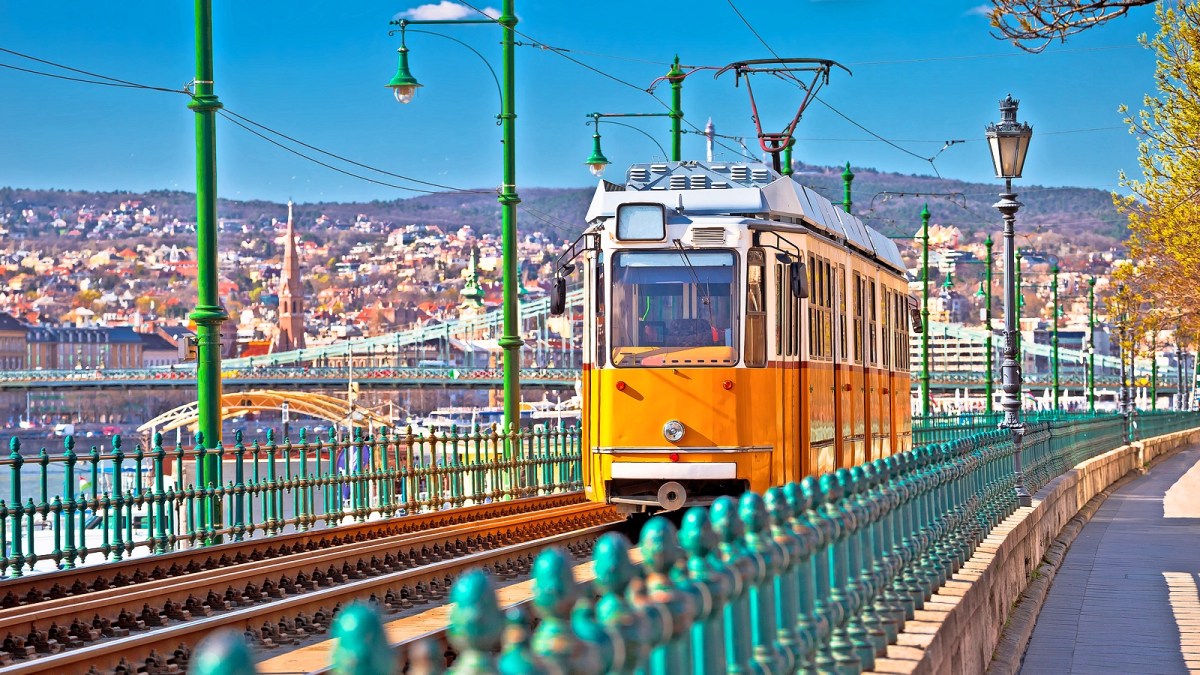
It started innocently enough as a family discussion in which we each suggested places for our summer hols. My daughter wanted Prague and Bran Castle in Romania, my son suggested Budapest and Istanbul, and Mrs 61 added that some beach time in southern Turkey would be lovely. I happily planned an itinerary linking each of these, thinking everyone would get what they wanted.
Except my daughter is a reluctant traveller who really only wanted a short break to Prague and Mrs 61 really only wanted a restful fortnight by a warm sea. Neither asked for a 5,000-mile train ride calling at all stations to Kusadasi on Turkey’s Aegean coast. Only as departure approached did it finally hit me. What had I done? Would I face a mutiny before we had even left? Would we ever get there? And if we got there, would they still be talking to me?
I’d bought four Interrail passes giving unlimited train travel around most of Europe on any five days over the course of a month (adults from £280; interrail.eu). The little brown Interrail booklet of my youth has given way to a digital pass that sits in an app on your phone. And it’s no longer just for the young: there are child, youth, adult and senior versions. It’s family friendly too. Our teenage kids qualified for the youth rate but had they been under 12 their passes would have been free. I’d supplemented the Interrail passes by buying regular tickets for a couple of the shorter hops and for travel east of Bucharest, where fares are cheap.
With mutiny temporarily averted — if only by my killer argument “well, I’ve booked it now” — we set off from our local station, Tring, after breakfast one Monday morning in late July. On the first and last days of a trip you can use your Interrail pass in your home country so travel from your home station to London is included, whether it’s Tring, Truro, Tywyn or Tyndrum.
On to the Eurostar and the holiday has begun
Interrail passes can be used on Eurostar if you book a special £32 Interrail passholder ticket and we were soon bound for Brussels on the 13.01 from St Pancras, sitting around a convivial table for four. The train manager, someone I knew from previous trips, stopped by to say hello. “Where are you off to this time, Mark?” “Kusadasi,” I replied, brightly. He rolled his eyes. “It’s never simple with you, is it?”
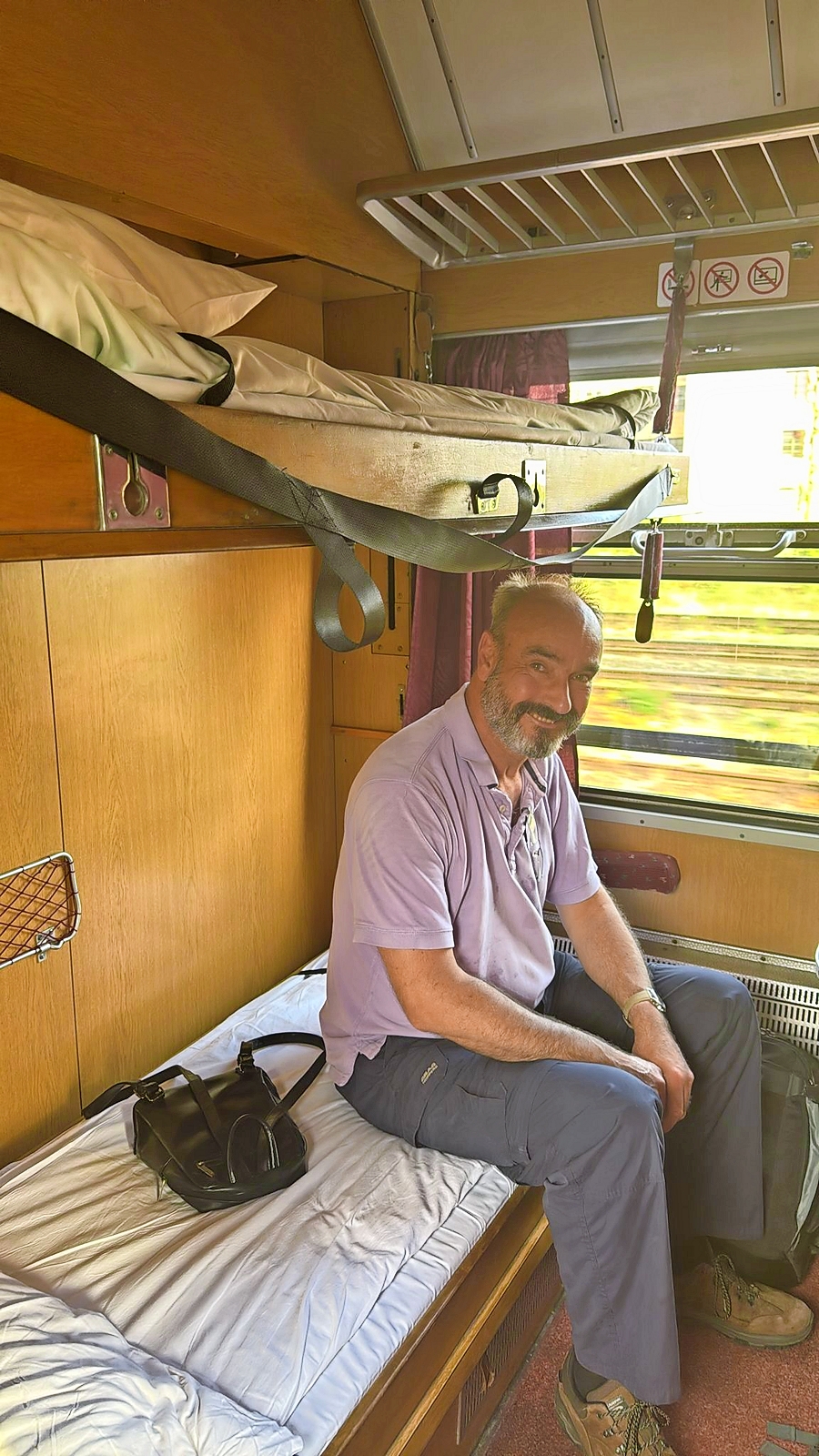
Mark Smith (AKA The Man in Seat 61) aboard a sleeper train
NOT KNOWN, CLEAR WITH PICTURE DESK
After a margarita or two in the bar at the Pullman Hotel (my waiting room of choice at Brussels Midi station) we boarded the 19.22 Brussels-Prague European Sleeper, started by two Dutch entrepreneurs and part of a modest renaissance of European sleeper trains. I’d booked a private couchette compartment but later upgraded us to two adjacent double sleepers, with armchairs convertible to comfy beds and a connecting door to make our two small rooms into a suite. No, I won’t tell you what those berths cost, even using an Interrail pass, only that Mrs 61 foolishly left me alone in a car park in High Wycombe with the European Sleeper website and a credit card.
Soon after departure Mrs 61 brought out her crocheting, a good sign. The next morning coffee and a breakfast box with rolls, jam, yoghurt and juice were delivered to our compartment as we snaked our way along the beautiful River Elbe under overcast skies — so much for the heatwave I’d been warned about. The European Sleeper rolled into the Czech capital on time at 11.24.
On our second day in Prague, standing before St Vitus cathedral, we learnt why Darling Daughter had brought us here: because of an album cover. I’ve travelled for less myself — I still want to see the marketplace in old Algiers for the sake of a line in a song. Two days in Budapest followed and I discovered, among other things, that amphibious tour buses give me the willies — tour buses just aren’t meant to drive into the water and paddle precariously up and down the Danube. While we were in Budapest our daughter went out for a wander on her own, not something I’d expected her to do. Later she turned to me and said, “I wish we could spend more time in Budapest.” I nodded sagely, inwardly delighted at this minor breakthrough.

Prague was one of the many cities visited by Mark and his family
GETTY IMAGES
• The Man in Seat 61: My decades-long love affair with Interrail
Sleeper train to Transylvania
Our sleeping car on the overnight train, the Corona, from Budapest to Brasov, was of Hungarian Railways’s oldest type, a communist-era car in remarkably good condition. We left our compartment with the window wide open to disperse the worst of its sauna-like qualities (we’d caught up with the 32C heatwave) and set off for the relative cool of the air-conditioned restaurant car. After a lovely dinner and a surprisingly decent night’s sleep we woke to a different world. We chatted over eggs and bacon in the restaurant car with the locomotive hooting and the wheels clickety-clacking beneath us, as the warm morning sun dispersed the early mist over the villages of rural Transylvania. My heart sang. Moments like this are why I don’t just take a flight.
Brasov is a delight and base camp for the lovely Bran Castle. Tourists come to see Dracula’s castle but Bran’s connection with Vlad the Impaler, on whom the fictional Dracula is thought to be based, is tenuous. The connection with Bram Stoker’s novel is stronger: Stoker had seen pictures of Bran and it fits his description of Dracula’s castle (but then so does Poenari Castle, 70 miles southwest). What few people expect is a link to a remarkable British princess. A granddaughter of Queen Victoria, Marie of Romania was brought up in Kent and married the Romanian king Ferdinand I. Marie persuaded her husband to enter the First World War on the side of the allies (no mean feat given he was German) and she was instrumental in the creation of modern Romania. Bran Castle became Marie and Ferdinand’s summer home.

Bran Castle is thought to be the inspiration for Dracula’s castle
GETTY IMAGES
From Brasov we travelled to Bucharest, a scenic two and a half hour train ride through the imposing Carpathian mountains. The following morning we raided the Carrefour at Bucharest’s Gara de Nord, emerging with sandwiches, Oreos, a bottle of wine “for Dad” and industrial quantities of peach flavour iced tea. Thus equipped for a 23-hour journey to the edge of Europe, we boarded the Turkish couchette car to Istanbul. It was clean and air-conditioned, in sharp contrast to the elderly, graffitied Bulgarian car to Sofia coupled next door. We squeezed ourselves into a compact but comfortable four-seat compartment with bunks that folded out from the wall.
• How I fell in love with ‘winterrailing’ through Sweden in the snow
Across the Danube and on to Turkey
We left Bucharest just after 10am and shortly afterwards the friendly Turkish car attendant brought us some tea. Three hours later the train crossed the Danube, rumbling noisily across the 1.5-mile Friendship Bridge. The leisurely ride through rural Bulgaria was mostly on a single track with clickety-clack from old-school jointed rail, and there was a chance to stretch our legs on the platforms at Ruse and Gorna Oryahovitsa while our couchette car was shunted from train to train. Minor panic ensued when Master 61 was left behind at Gorna, until we realised that our car was merely being shunted to another platform. At Dimitrovgrad at 11pm, our couchette car was attached to the Sofia-Istanbul Express.
It was not the most restful of nights. Bulgarian passport control came on board after midnight and that was followed by a long stop in the small hours at the Turkish border, where we got off to be stamped into Turkey. But we managed a little sleep as the sun rose over rolling Turkish farmland. The train stopped briefly at Cerkezkoy, where the Orient Express was stuck in snow for six days in 1929, inspiring Agatha Christie’s novel. We eventually arrived at Istanbul’s Halkali station just after 10am, some 20 minutes late. For reasons best known to Turkish Railways, the international train now terminates here, 16 miles short of downtown Istanbul. After persuading the yellow ticket machines to cough up four Istanbulkart public transport smartcards, we hopped on a Marmaray suburban train to Sirkeci station on the shores of the Bosphorus and hailed a taxi to the Pera Palace Hotel.

Istanbul, one of Mark’s favourite cities
GETTY IMAGES
The Pera Palace is an Istanbul institution, opened in 1895 by the Compagnie Internationale des Wagons-Lits for passengers arriving on the Orient Express (room-only doubles from £175; perapalace.com). Christie was a regular guest in room 411, while room 101 is a museum to the founder of modern Turkey, Mustafa Kemal Ataturk. Ernest Hemingway, Alfred Hitchcock, Greta Garbo, Edward VIII and Elizabeth II all stayed here, and I’ve stayed several times since 1995. Back then its faded grandeur could be enjoyed for a pittance but a major refurb in 2010 brought five-star standards and five-star prices. Even so, at under £200 a night it’s not beyond reach and, for me, it will always be special. It was in 2005, at the concierge’s desk in the lobby, that I discovered that Mrs 61 and I were expecting our first child and I rushed upstairs to tell her the good news (Turkish pregnancy tests don’t always have English instructions and one of us had to nip downstairs to ask what hamile siniz meant). It was strange to be standing in that beautiful lobby 20 years on, next to the cause of that particular kerfuffle, now aged 19.
Istanbul worked its special magic on us all. The Bosphorus ferries, the Hagia Sofia, the Blue Mosque, Galata Tower. We ate at the friendly and inexpensive Lale restaurant in Sultanahmet, better known as the world famous Pudding Shop, a popular travellers’ hangout on the London-Kathmandu hippy trail of the 1960s and 1970s, and a place I’ve known since 1995. Istanbul’s many cats and excellent cat museum were a huge hit with both son and daughter.
• Europe’s best interrail trips for any age
Last stop — the beach
A couple of days later we sailed across the Sea of Marmara on the IDO ferry and, after copious glasses of delicious sweet Turkish tea in a local café at Bandirma (as ferry and train times are sadly not co-ordinated), we took the afternoon express to Izmir. One more train and a taxi and we’d made it to our beachside resort in Kusadasi, all the way from London flight-free, after a two-week meander across one continent and into another. I’d chosen well. Our rooms opened onto the pool and the excellent hotel restaurant looked out over the glistening Aegean. A few days’ traditional family holiday followed and I spent my birthday among the ruins of nearby Ephesus, undaunted by the 38C heat. I began to think I might get away with this after all.
Our return journey through Izmir, Istanbul, Bucharest, Vienna, Munich and Paris went as planned and our Eurostar rolled into St Pancras three minutes ahead of schedule, three and a half weeks and some 5,000 miles since we’d left.
• Read our full travel guide to Turkey
Mrs 61 is still talking to me. She coped remarkably well with the travel, if not with the heatwave, loved Kusadasi and revisiting the Pera Palace, and crocheted plenty of, erm, crochets. She won’t admit it but I think she’s quite proud of what we did.
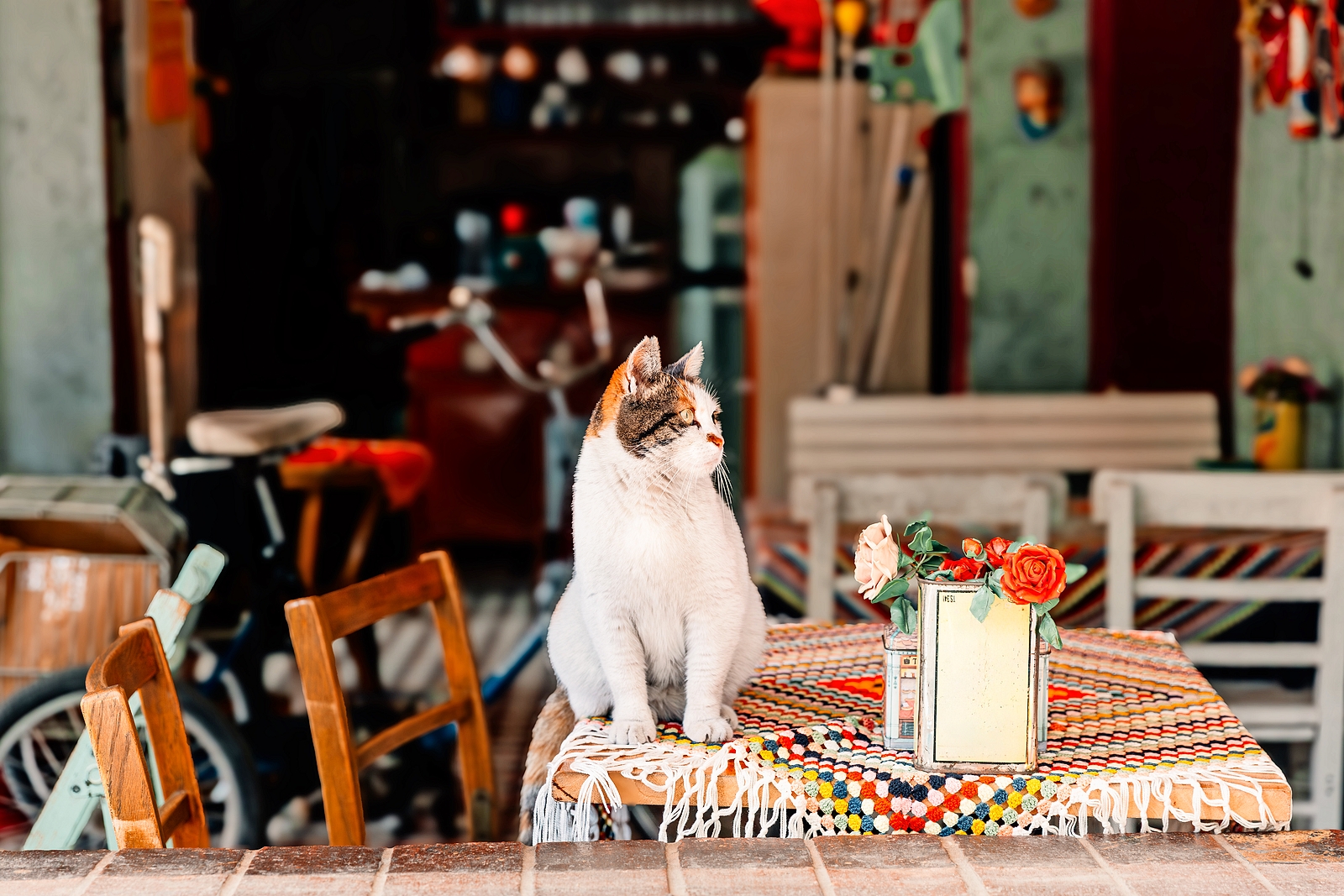
The charm of Istanbul won over Mark’s son
GETTY IMAGES
My son loved every minute. As we passed back through Istanbul he turned to me and said, nodding thoughtfully, “I can see why you love Istanbul, Dad.” The Force is strong in this one.
And my daughter? I never expected to see such enthusiasm as she wandered around St Vitus cathedral examining every corner or to see her so enthralled by Budapest. She loved the cats in Istanbul and swimming in Kusadasi, and the travel didn’t faze her nearly as much as I’d feared. Back home she had been worried about the commute to her new college. To our surprise she’s taken it in her stride. After all, what’s two stops on Chiltern Railways when you’ve ridden the Turkish couchette car from Bucharest to Istanbul?
Mark Smith travelled independently