
Earlier this week, Housing Secretary Steve Reed effectively handed in his resignation. He told BBC One’s ‘Panorama’ that his job should ‘be on the line’ if he failed to meet Labour’s target to build 1.5 million homes by the end of the parliament.
Even if it is far shy of the estimated 6.5m homes we’d need to simply catch up with our historical housing deficit, 1.5m is still a big number to reach for. At Britain’s housebuilding peaks in the 1930s and 1960s, we rarely managed to sustain building more than 300,000 homes a year.
And 15 months into this parliament, it isn’t going well. The Office for National Statistics estimates that 186,600 net additional homes have been delivered in England between the start of parliament in July 2024 and mid-June this year. In London, in the 2024-25 financial year, developers began work on a measly 4,170 homes.
Speaking to some of the most well respected civil servants and experts involved in housing and infrastructure during the last few weeks, none of them believe Reed can pull it out of the bag in time. In fact they are fairly resigned, even despairing, of anything meaningful being built at all.
In that same ‘Panorama’ interview Reed said: ‘We can do anything in this country that we want to do.’ Building 1.5m homes in five years is not looking to be one of those things.
So who is to blame? Perhaps it is the Nimbys, angrily protesting every new road, pylon and data centre even if that means the country’s economy grinds to a halt? Perhaps it is, as Reed himself used to argue before he saw the light, land banking developers who simply won’t build until they see maximum profits? Or maybe it’s the conservationists who want to put the lives of every bat, newt and snail before the prospects of young adult humans desperate to have children? Or maybe it is politicians, too gutless to stand up for the long term interest and build a few flats, let alone sign off on new runways?
Or could it be the fault of my own generation? Speaking to me, one of the most senior civil servants in the country involved with delivering very high profile infrastructure projects for the last two decades asked how we expected politicians to battle the naysayers when young adults can’t be bothered to get out and protest about their situation. He isn’t wrong. Celebrity Millennials, the oldest of whom are now in their early forties, are more likely to raise tens of thousands to block housing developments in the heart of London, than they are to protest sky-high rents, which, in the capital, turn out to be completely unaffordable for every single income level.
As the co-founder of Looking For Growth, I placed the blame squarely on our outdated and byzantine planning rules. We’ve been successful in getting some crucial changes to Labour’s new planning bill, which means we might not have to spend twice as much deciding on whether to build tunnels, than it takes our near neighbour Norway to build the longest road tunnel in the world.
But it’s also clear that even with planning reform, we’d still be lacking something else – real ambition.
Let me give an example. New towns. One of the Government’s first acts when Labour got into power was to set up a New Towns Taskforce. After a year scouting locations across the country, it recommended 12 sites for development, many of them extensions to existing cities in order to cash in on what economists call agglomeration effects. But in the end, Labour picked just three sites. Small in number. But also small in nature. From these three schemes we might only produce 120,000 homes. And there’s a second aspect. Towns are nothing like cities. They tend to be places to commute to and from. They rarely offer meaningful employment opportunities themselves. They just aren’t big enough.
There’s good news though. The last time Britain acted ambitiously – Milton Keynes – it worked. Beyond anyone’s imagination. With just six weeks of public consultation, the government of the late 1960s pushed through plans that would eventually create homes for 290,000 people, and a city that is now the most productive place in the UK outside of London.
Ambition is why my co-founder, author and entrepreneur Shiv Malik, and I are embarking on a new campaign. Last night, in front of a crowd of over 1,200 people, at the O2 in London, we launched plans to build Britain’s next new city; this time a place for a million people.
Located to the east of Cambridge – the densest concentration of talent in Europe – the new city can be easily connected to the M11, Stansted, the new East West Rail line and our biggest port Felixstowe. Covering a plot of 45,000 acres and utilising gentle density standards like London’s Knightsbridge or Belgravia, we can unlock not just space for 400,000 homes but also thousands of acres of land for commercial development. That commercial space is desperately needed by the global companies and startups currently constrained by Cambridge’s green belt – a constraint that looks unlikely ever to be changed.
Right now that land is populated by arable land, a few stud farms and only 7,500 people. If it is as successful as Milton Keynes, this new city would generate £55 billion in GDP – a permanent 1.5% added to the UK’s bottom line each year.
But what’s really innovative is how we are merging radical ideas from both Left and Right to galvanise success. On the residential side, we’re using community land trusts to ensure housing can’t be used as a speculative asset. Combined with building on greenfield land, it means residents could buy a four bed house for £350,000, a huge reduction in price compared to Cambridge.
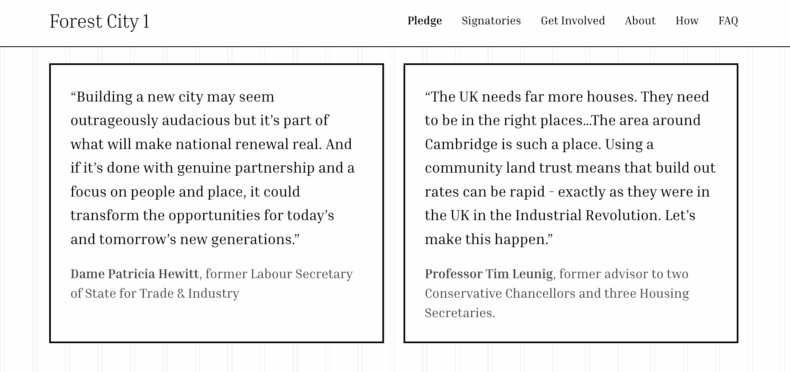
The Forest City project has cross-party support
On the commercial side, we’d be asking the Government to designate this a Special Economic Zone, to lower business rates and taxes associated with new infrastructure, as we once did with Canary Wharf, and also make this a Nimby-proofed development zone via a development corporation with its own powers of compulsory purchase and planning. It’s how we got the Olympic Park built on time, and that set up would massively help companies like AstraZeneca and ARM physically expand when they need to, not when the local parish council allows them to.
This blend of Left and Right is why we’ve already garnered cross-party support from the likes of former Labour Secretary of State for Trade and Industry, Dame Patricia Hewitt, Professor Tim Leunig, who advised two Tory chancellors and three Housing ministers and the scores of people who have already signed our pledge.
Steve Reed is of course right. There is nothing the people of this country, who gave the world the spinning jenny and the jet engine, can’t do if we set our mind to it. We just need to remember how to be as ambitious as we once were. It’s time to build – with ambition.
Pledge your support for Britain building its next great city here.
– the best pieces from CapX and across the web.
CapX depends on the generosity of its readers. If you value what we do, please consider making a donation.
Columns are the author’s own opinion and do not necessarily reflect the views of CapX.