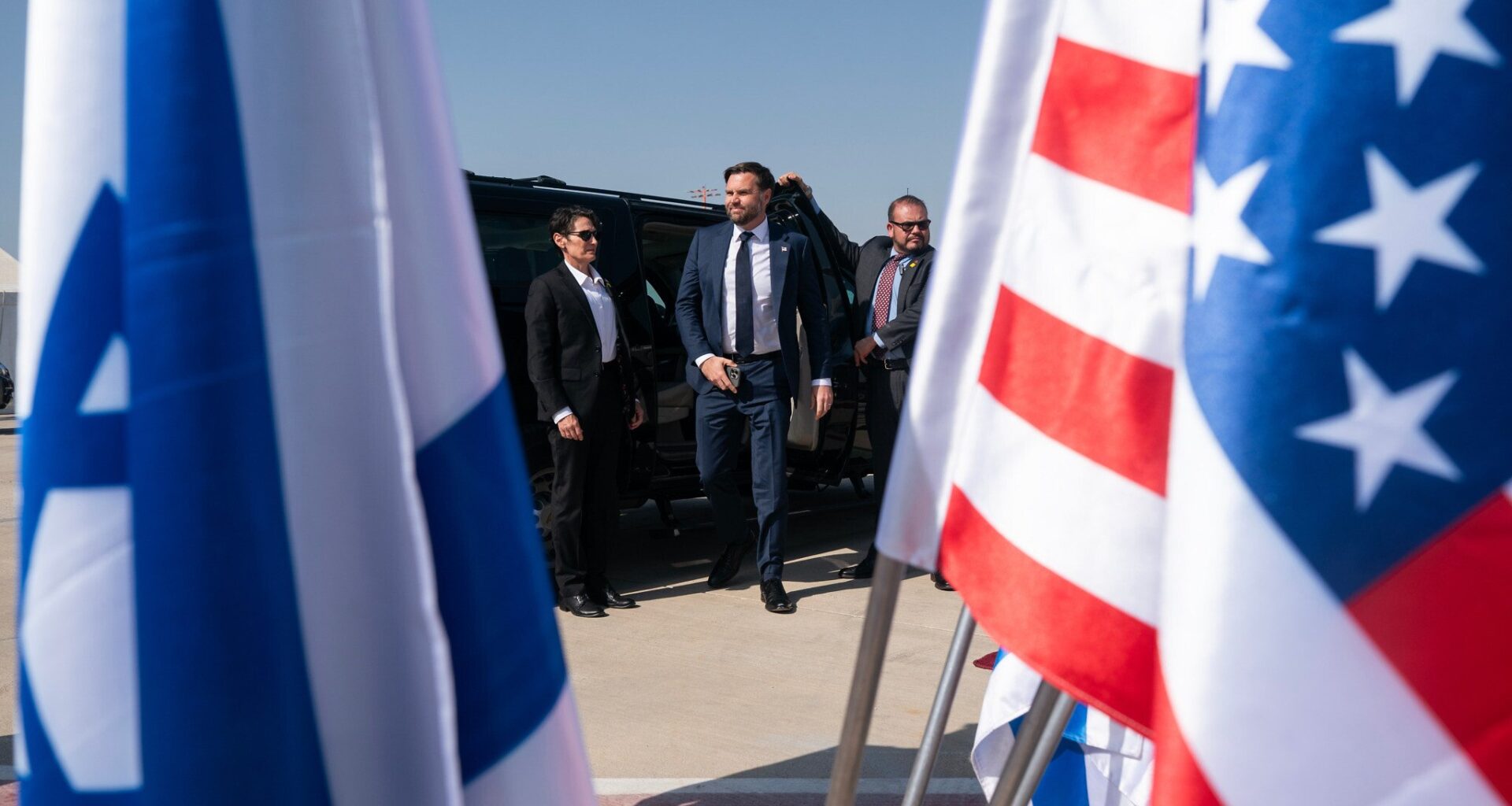
WASHINGTON — Organizers of US Vice President JD Vance’s Tuesday press conference in southern Israel made a point of flanking his podium with two six-foot placards containing the blown-up text of President Donald Trump’s 20-point plan for ending the Gaza war.
It’s Washington’s guiding document as it seeks to build on the ceasefire inked earlier this month.
But while the full 20 points were what was first presented to the public in September as Washington sought to rally international support for the plan, Trump’s top negotiators Steve Witkoff and Jared Kushner ultimately decided to split them in two, only securing Israeli and Hamas signatures on the first phase pertaining to the ceasefire, initial IDF withdrawal, hostage-prisoner swap and humanitarian aid provisions.
For the time being, the points detailing the postwar management of Gaza and Hamas’s disarmament remain on paper (or on the poster to Vance’s right).
The US is working to actualize the second phase and began with the establishment of a Civil-Military Coordination Center (CMCC) in Kiryat Gat, which hosted the Tuesday press conference and will serve as the hub for monitoring and sustaining the Gaza ceasefire.
Get The Times of Israel’s Daily Edition
by email and never miss our top stories
By signing up, you agree to the terms
The Trump administration has recruited the UK, Canada, Germany, Denmark and Jordan to take part in the CMCC, and their flags were set up on either side of the placards featuring Trump’s 20-point plan.
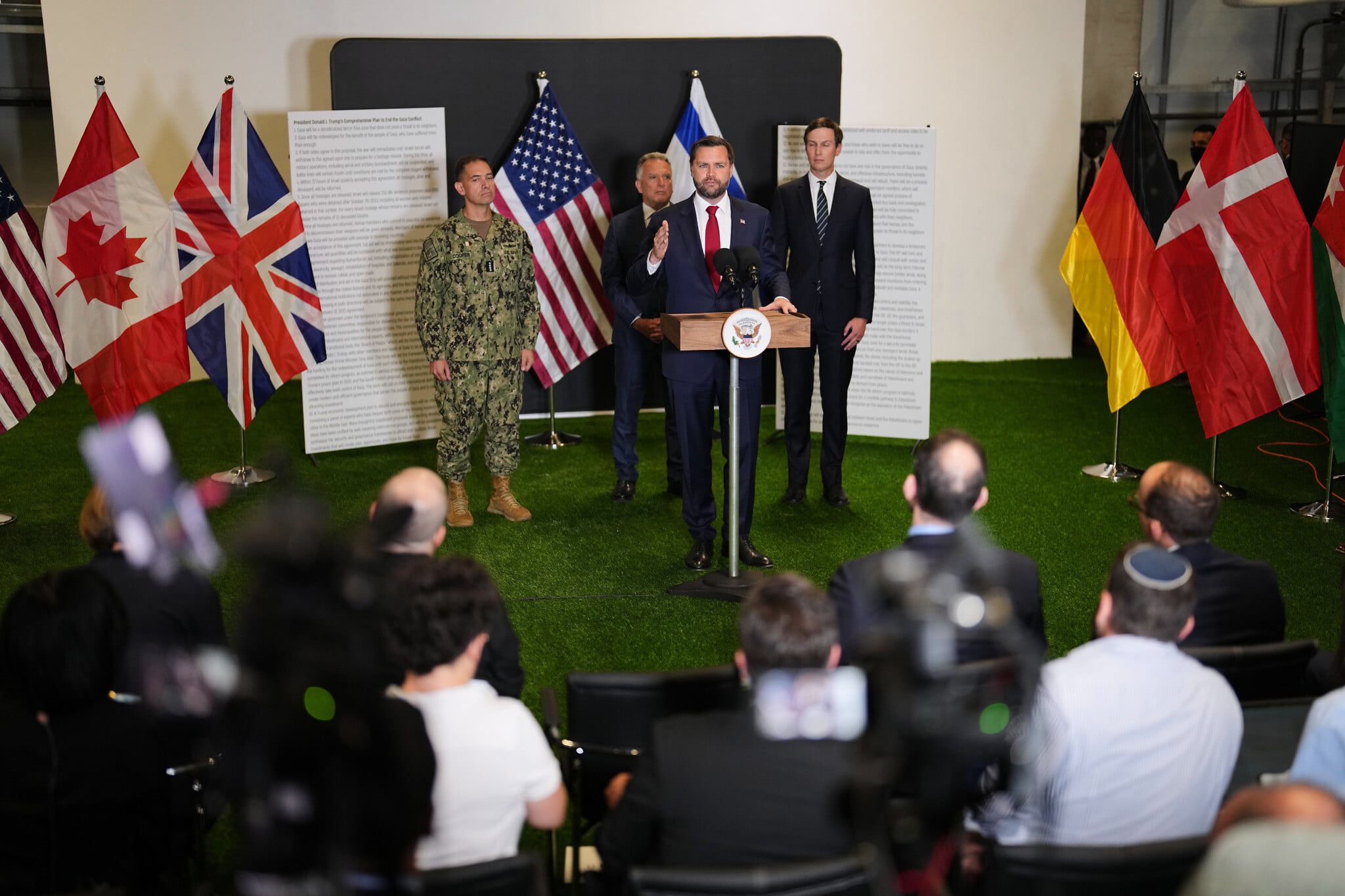
US Vice President JD Vance speaks to the media as U.S. Special Envoy to the Middle East Steve Witkoff and Jared Kushner stand next to him, in Kiryat Gat, Israel, Tuesday, Oct. 21, 2025. (AP/Francisco Seco)
But most other details regarding phase two are still being hammered out, and the US has shared very little on how Gaza will be governed, secured, and rebuilt.
Kushner, at the press conference, said “there are considerations” to launch construction projects in Gaza areas that the IDF still controls — over 50 percent of the Strip, even after its partial withdrawal commencing the ceasefire.
A senior Trump aide briefing reporters earlier this month highlighted the southern Gaza city of Rafah as a potential candidate for such an inaugural construction project, as it was already completely leveled during Israeli military operations over the past two years.
But focusing on the mostly eastern half of Gaza still under Israeli control — while forgoing the western half where Hamas has wasted no time in reasserting its dominance — risks losing the support of some key Arab allies who Washington is hoping will help stabilize the postwar Strip.
To varying degrees, Egypt, Jordan, the United Arab Emirates and Saudi Arabia believe that prioritizing Israeli-controlled areas will engrain the status quo in Gaza, a senior Arab diplomat from one of those countries told The Times of Israel. Israel will be able to keep its half of Gaza, while Hamas will remain in control of its half.
Instead, those four countries have advocated for a more holistic approach in which a technocratic Palestinian government tied to the Palestinian Authority is phased in to run all parts of Gaza to isolate and weaken Hamas.
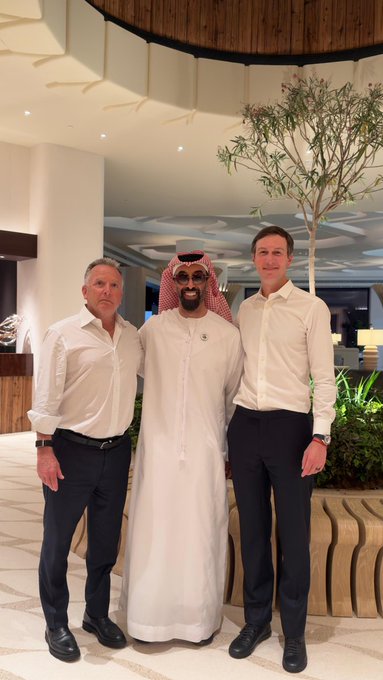
US special envoy Steve Witkoff (L), UAE National Security Adviser Tahnoon Bin Zayed and US President Donald Trump’s adviser and son-in-law Jared Kushner in Abu Dhabi on October 22, 2025. (Tahnoon Bin Zayed Al Nahyan/X)
The four Arab countries have indicated willingness to either contribute funds to this effort or assist in the establishment of an International Stabilization Force (ISF) that will gradually replace the IDF in Gaza, the Arab diplomat and a US official said.
But Israel has made clear that it will condition the IDF’s continued withdrawal on the disarmament of Hamas, which the terror group has shown little indication that it is prepared to carry out.
The senior Arab diplomat said that a compromise could be struck whereby Hamas agrees to give up its “heavy weaponry.”
This would still leave Hamas with the “light weapons” it used to carry out the October 7 attack, and that it continues to utilize to terrorize Gazans since the ceasefire.
However, the Arab diplomat said that the threat of Hamas could be mitigated, as the technocratic Palestinian government and ISF pick up steam and legitimacy throughout the Strip.
An Israeli official pushed back on this notion, arguing that neither the technocratic government nor the ISF will be able to assert control in Gaza so long as Hamas maintains its weapons, whether they’re missiles or AK-47s.
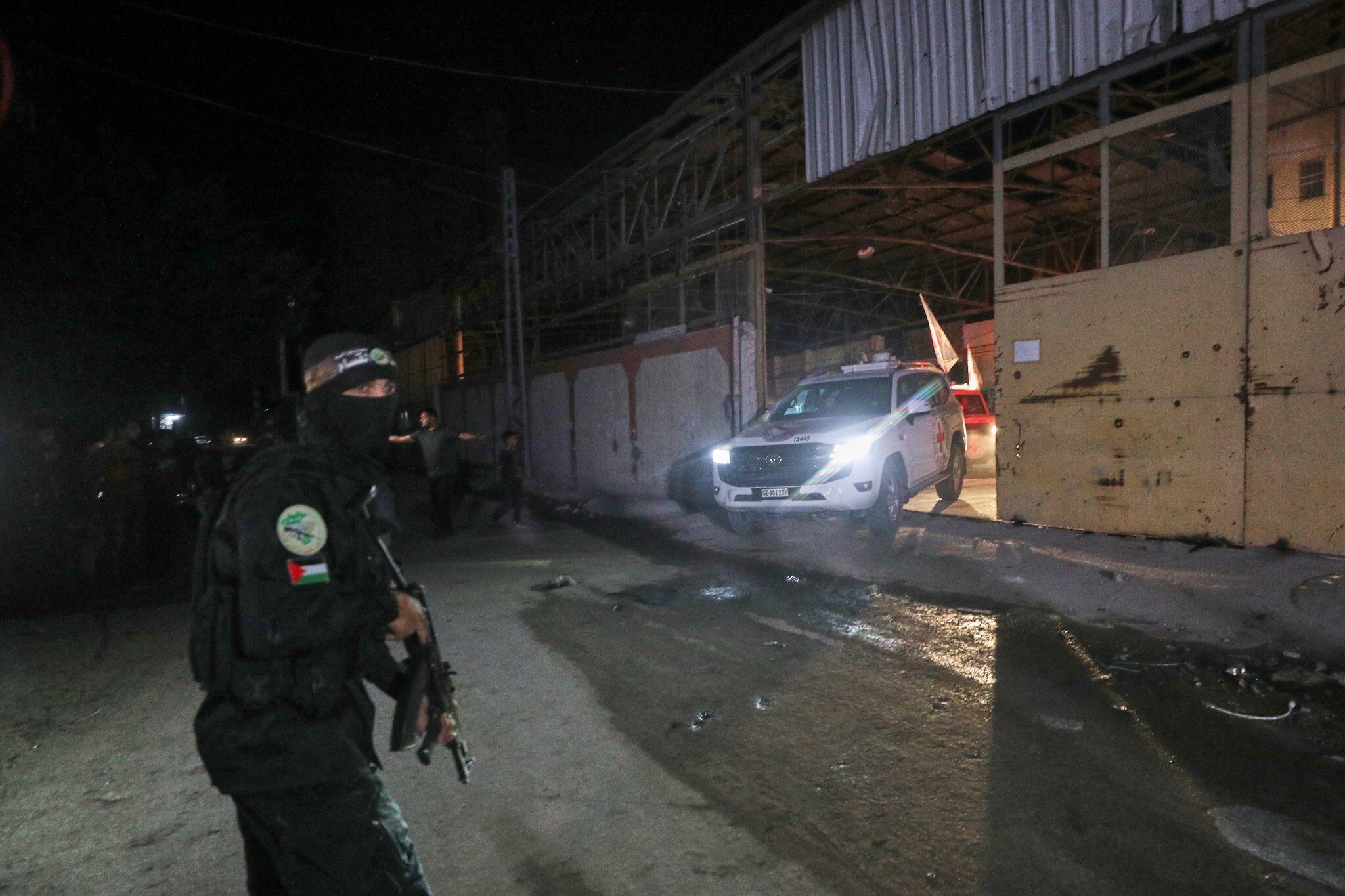
A gunman from the military wing of Hamas stands guard as Red Cross vehicles allegedly transporting coffins containing the bodies of four deceased hostages leave a warehouse for Israel, in Gaza City, October 14, 2025. (AP/Yousef Al Zanoun)
The Arab diplomat did acknowledge that no country will be willing to contribute troops if the expectation is for the ISF to spar with Hamas, rejecting Trump’s claim to the contrary.
“If the US isn’t interested in sending troops to fight Hamas, why would any of us want to?” the Arab diplomat asked rhetorically.
“We can help with training Palestinian police and border security, but we’re not about to try and disarm Hamas through combat after two years of Israel being unable to do so,” the diplomat added.
But the assistance is still conditioned on a postwar Gaza role for the PA, which the four Arab countries view as their off-ramp out of the Strip.
Prime Minister Benjamin Netanyahu has pushed back forcefully on the PA gaining a foothold in Gaza, likening it to Hamas and insisting that it is too irremediable for a role in the Strip.
The US will have to decide which red line regarding Ramallah to respect.
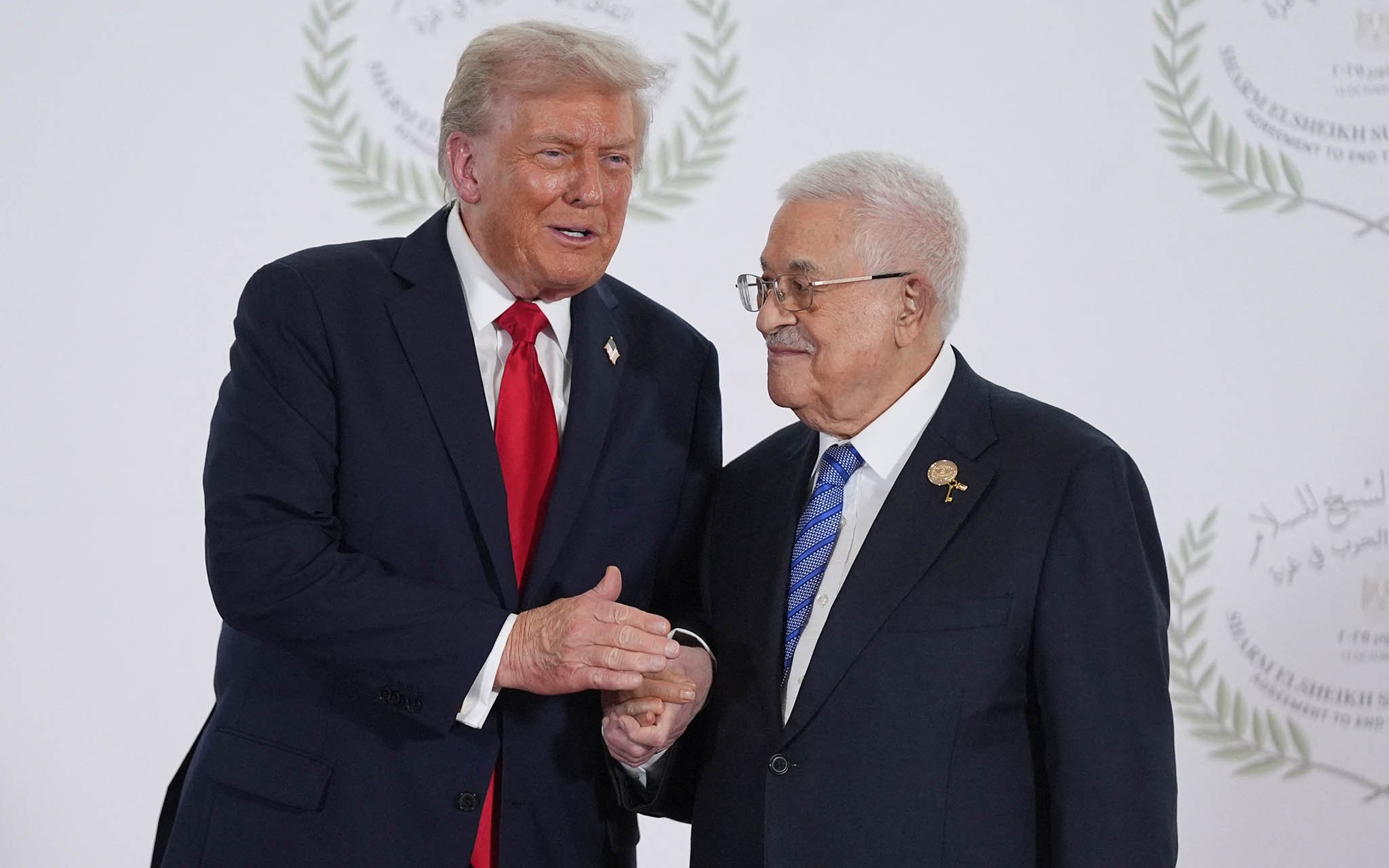
US President Donald Trump (L) greets Palestinian Authority President Mahmoud Abbas during a summit on Gaza in the Egyptian resort town of Sharm el-Sheikh on October 13, 2025. (Evan Vucci/Pool/ AFP)
Kushner’s memories of the Authority are far from nostalgic, given that PA president Mahmoud Abbas refused to engage with his peace plan during Trump’s first term. Witkoff, on the other hand, was not involved in that initiative and has built a rapport with Abbas’s deputy, Hussein al-Sheikh, after meeting him twice this year.
Sheikh is slated to meet with a delegation of senior US officials in the region over the weekend, a source familiar with the matter told The Times of Israel, in an indication that Washington is not looking to box Ramallah out of the process entirely.
Trump himself was non-committal when asked whether a reformed PA led by Abbas should be put in charge of Gaza in an interview last week with Time Magazine.
Even if the US does side with its Arab allies regarding the PA’s role in Gaza, that’s not the end of their conditions for involvement in the postwar stabilization of the Strip.
“We’re seeking assurances that Gaza doesn’t become Lebanon,” the Arab diplomat said, referring to the dynamic along Israel’s northern border where the IDF has carried out near-daily strikes targeting Hezbollah positions over alleged violations of a November ceasefire.
“There can be a discussion about when Israel can engage, but the [technocratic government and the ISF] need to be given the space and legitimacy to operate,” the diplomat added.
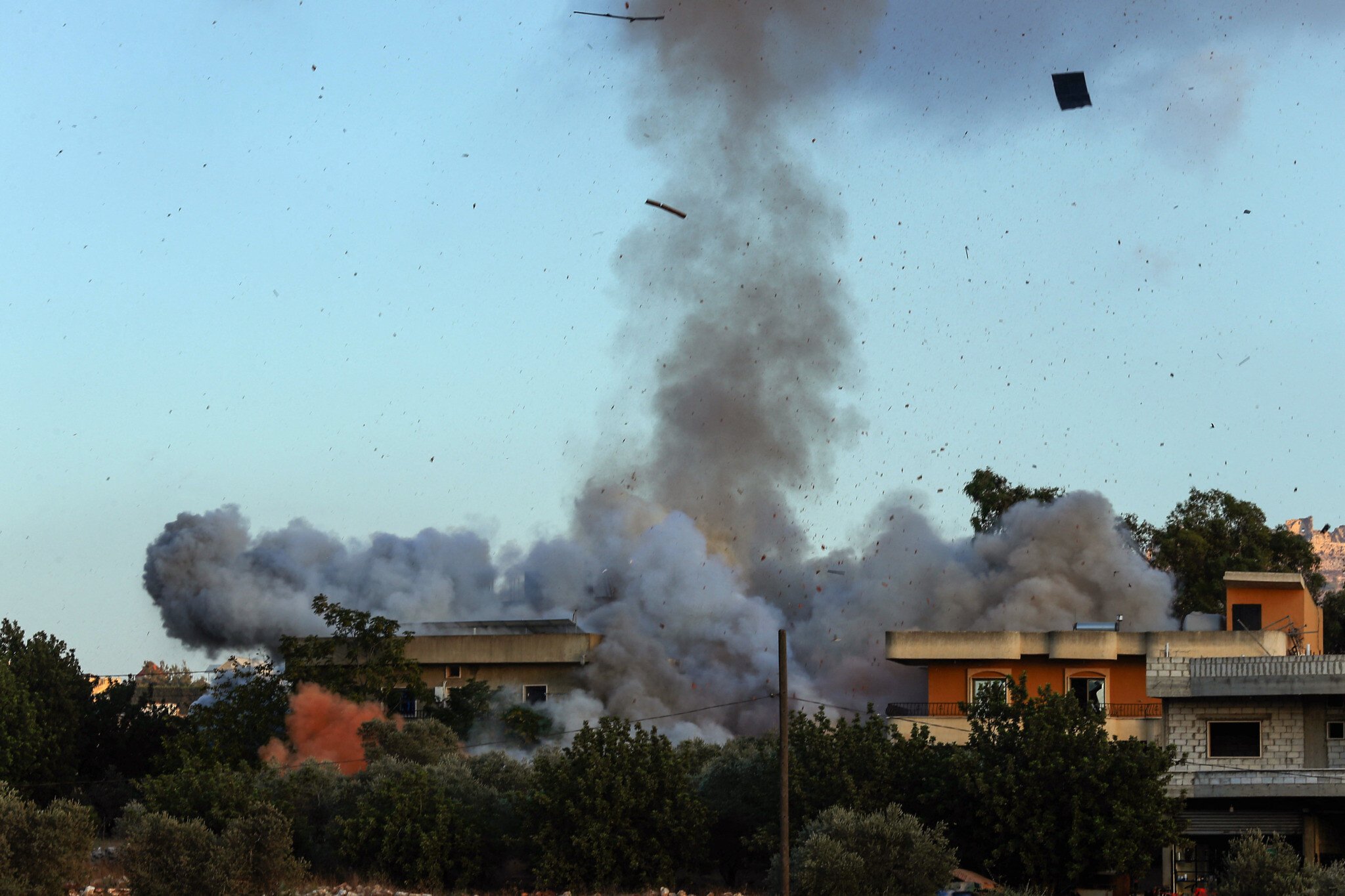
Smoke billows amid Israeli strikes in the southern Lebanese village of Kfar Tibnit on September 18, 2025. (Mahmoud Zayyat/AFP)
In another indication of Washington’s thinking on the matter, US Secretary of State Marco Rubio told reporters on Thursday that once the CMCC is up and running, “then the work will begin [on]… going to the UN potentially and getting the international mandate [to] build the international defense security forces (ISF).”
This appeared to be the first time that a US official has publicly declared that the administration is seeking a UN mandate for the ISF.
The Arab diplomat said hearing this was a relief for many of the potential contributing countries, as it will require more international consensus to stand up and eventually conclude the ISF under a UN mandate.
The other option the US is considering would see it relying less on Riyadh, Abu Dhabi, Cairo and Amman and more on Doha, which has issued fewer conditions for its involvement and funding.
“The Qataris aren’t getting into how Gaza is split up or whether there’s a UN mandate or role for the PA,” the Israeli official said.
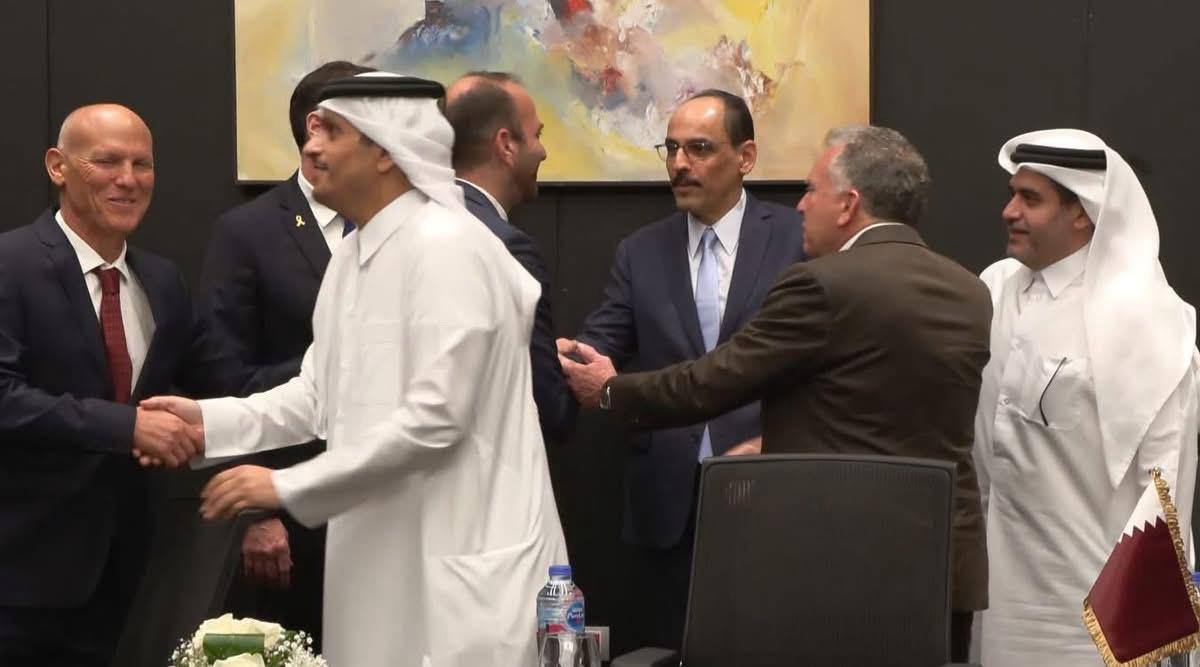
Israeli negotiator Nitzan Alon (far left) shakes hands with Qatar’s Prime Minister Mohammed bin Abdulrahman bin Jassim Al Thani in a photo indicating success in the mediated Israel-Hamas negotiations on a Gaza hostage-ceasefire agreement in Sharm el-Sheikh, in the early hours of October 9, 2025. Second from right with back to camera is US special Middle East envoy Steve Witkoff. (Telegram / used in accordance with clause 27a of the copyright law)
Accordingly, the senior Arab diplomat speculated that Netanyahu — despite recent baggage — will ultimately prefer allowing Qatar to play a role in postwar Gaza to avoid the conditions that come with the support from the UAE, Saudi Arabia, Egypt and Jordan.
“Ultimately, it will be up to Jared to decide,” said the Arab diplomat, suggesting that Trump’s son-in-law is the main decision maker regarding the implementation of phase two, as opposed to Witkoff.
While Trump declared the commencement of the Gaza deal’s second phase already last week, too many questions regarding its implementation have yet to be answered, and the senior Arab diplomat speculated that there won’t be any answers until the US president hosts Saudi Crown Prince Mohammed bin Salman at the White House on November 18.
“That’s when I’d expect things to start moving again,” the diplomat said.