
Sante publique France reports, as of October 20, 766 locally acquired chikungunya cases were reported in mainland France.
In addition, 29 local transmission of dengue fever have been reported this year.
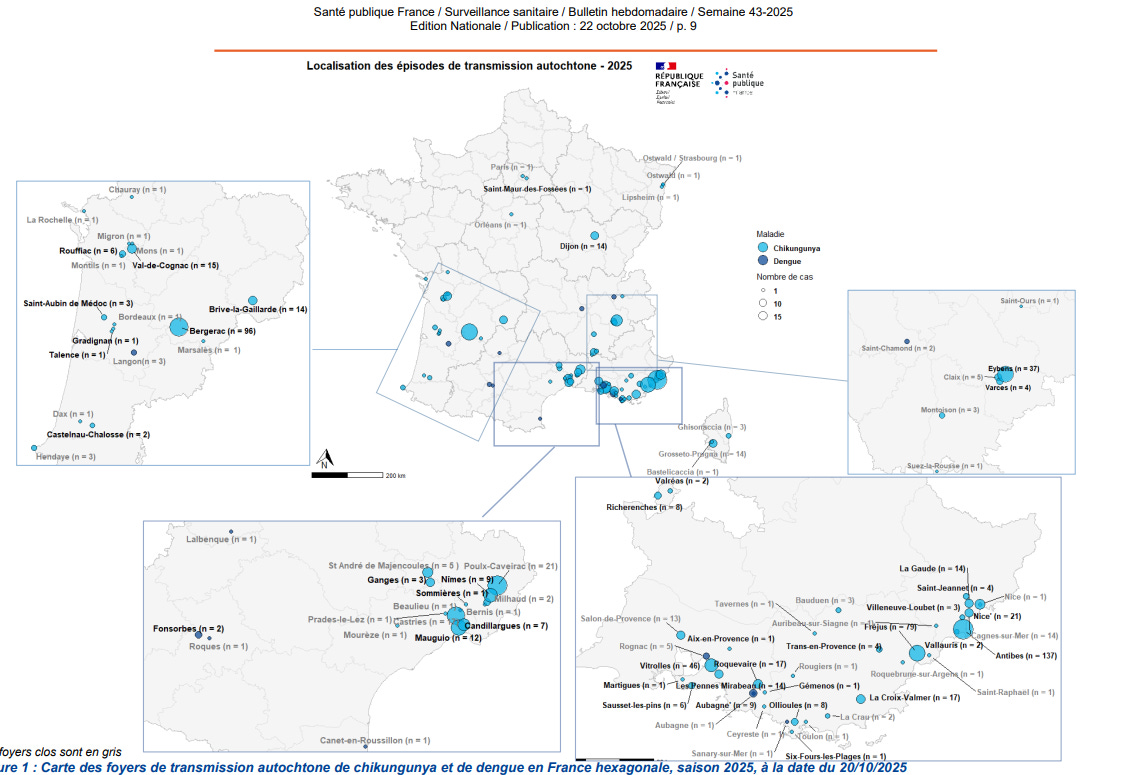
91 outbreaks of indigenous vector-borne transmission of chikungunya (79) and dengue fever (12) were reported.
The indigenous cases are located in the Auvergne-Rhône-Alpes, Corsica, Île-de-France, Occitanie, and Provence-Alpes-Côte d’Azur regions, which were already affected in previous years, and for the first time this year in Burgundy-Franche-Comté, Centre-Val-de-Loire, Grand Est, and Nouvelle-Aquitaine.
The increase in outbreaks and the existence of secondary outbreaks are linked to the successful adaptation of the viral strain to the Aedes albopictus mosquito vector and to environmental conditions favorable to the mosquito’s reproduction.
With the persistence of active outbreaks (particularly in tourist areas in southern France), the risk of secondary outbreaks in other regions of France remains high.
The diagnosis should be considered in the event of a fever upon returning from areas of chikungunya and dengue virus transmission, abroad, overseas, and also in mainland France.
Public Health France reiterates the importance of reporting cases, which allows for rapid intervention to limit transmission. Public Health France also reiterates the importance of protective measures against mosquito bites and the control of mosquito breeding sites.
Concerning imported arboviruses, since May 1, the start of enhanced surveillance, and through October 20, 2025, the following have been identified:
• 1,016 imported cases of chikungunya
• 996 imported cases of dengue
• 11 imported cases of Zika virus
As of October 20, 2025, 57 human cases of vector-borne West Nile virus infection have been identified in 17 departments across mainland France.
These cases are located in the Provence-Alpes-Côte d’Azur, Nouvelle-Aquitaine, and Occitanie regions, historically affected by the West Nile virus, and in Île-de-France, Auvergne-Rhône-Alpes, and Normandy, which have been affected for the first time.
In the Occitanie region, the departments of Haute-Garonne and Tarn-et-Garonne have been affected for the first time, as well as Lot-et-Garonne in Nouvelle-Aquitaine.