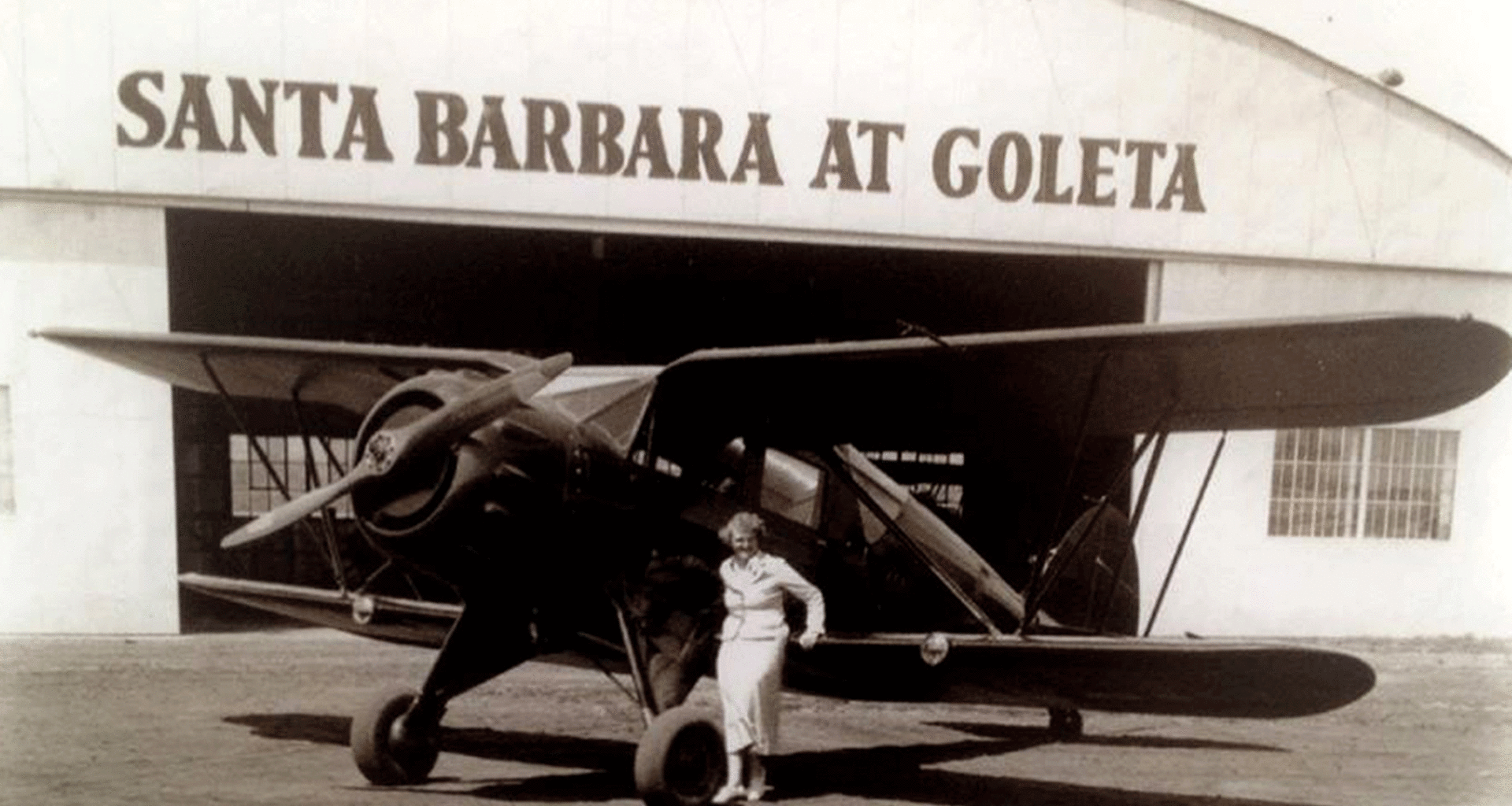
Ever wonder why the Santa Barbara Municipal Airport is smack dab in the middle of Goleta? It’s kind of an unusual situation.
Look at a map and you’ll see the airport is surrounded by Goleta, but Santa Barbara is connected to the airport via a thin strip of ocean that goes out to sea, and then back to land in Santa Barbara proper.
This is what’s called a Shoestring Annexation, a fancy maneuver that was only used a few times and has since been made illegal.
The real estate the airport sits on was annexed to the city of Santa Barbara by a seven-mile long “shoestring” that’s only 300 feet wide, and the majority of it is under the Pacific Ocean.
How did this happen?
The situation hatched in 1931 when the Santa Barbara City Council voted to terminate Earl Ovington’s permit to operate his Casa Loma Airport in Santa Barbara, which was in the hilly terrain of Samarkand.
This left the airfield in Goleta as the only viable spot for an airport. There had been an airfield at the Goleta Slough since 1928, and when the General Western Aero Corporation built an airplane factory there in the early 1930s, it gained more popularity.
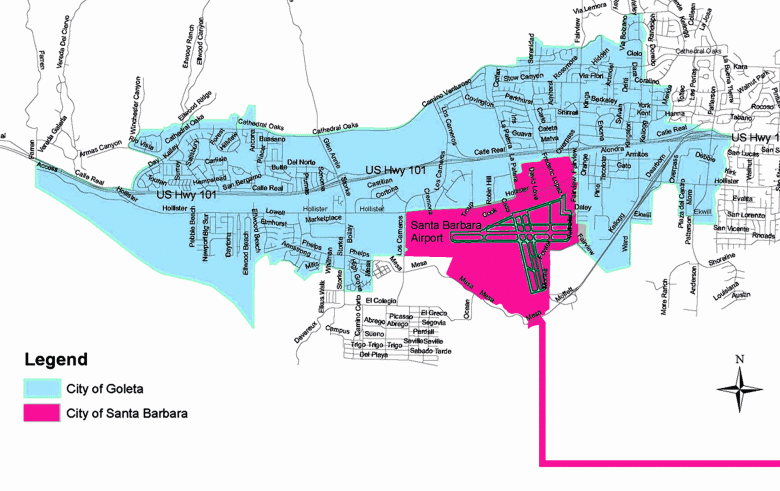
Shoestring Annexation was used to put the airport in Santa Barbara. (Courtesy)
Soon, movers and shakers were pushing for the construction of an airport Santa Barbara could be proud of.
In 1940 T.M. Storke managed to get a promise from the federal government to build a modern airport at Goleta, if the real estate could be secured — which it was.
After the bombing of Pearl Harbor, construction of the airport at Goleta was quickly taken over by the U.S. Navy, and it was built in record time.
They all but destroyed Mescaltitlan Island for fill dirt to transform the Goleta Slough into runways.
For the next five years, the Santa Barbara Airport served as a Marine base. In 1947, the federal government turned the airport and the mesa at Goleta Point back over to Santa Barbara County.
The mesa area that housed the Marines was sold to the University of California, and the airport was controlled by the county of Santa Barbara. But in the mid 1950s the city of Santa Barbara decided it wanted to annex the airport for a number of reasons, not the least of which was to collect taxes from all the business taking place on airport property.
The original idea was to link the airport to the city by a corridor running along the mountains, but there were too many landowners to deal with.
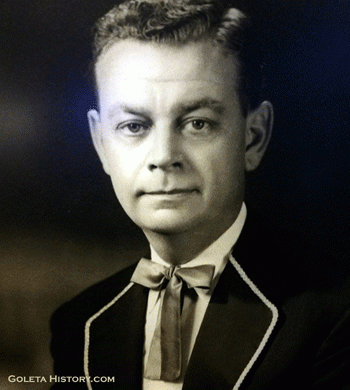
Santa Barbara Mayor Jack Rickard
A Santa Barbara News-Press reporter came up with the crazy idea of connecting the airport by an offshore corridor, but one local politician didn’t think that idea was so crazy.
In 1954, Santa Barbara had created an “oil sanctuary” out to the three-mile limit to keep the unsightly oil platforms from tainting their views.
Santa Barbara Mayor Jack Rickard was convinced he could annex this sanctuary, which ran from Ortega Hill to UCSB, thus connecting the airport to the city.
The plan met heavy opposition, mostly from the State Lands Commission and Pacific Lighting Gas Supply Company, objecting to the city getting control of the mineral rights under the ocean floor.
The annexation was tied up in courtrooms for years, until 1959, when the attempt was officially denied.
But the city of Santa Barbara would not take no for an answer, so the city came up with a “horizontal annexation” of water only, waiving the mineral rights under the ocean floor.
In late 1961, the new “water only” plan was accepted, and the airport officially became part of the city of Santa Barbara.
The state of California immediately plugged the legal loophole Santa Barbara used to keep this “gerrymandering procedure” from ever happening again.
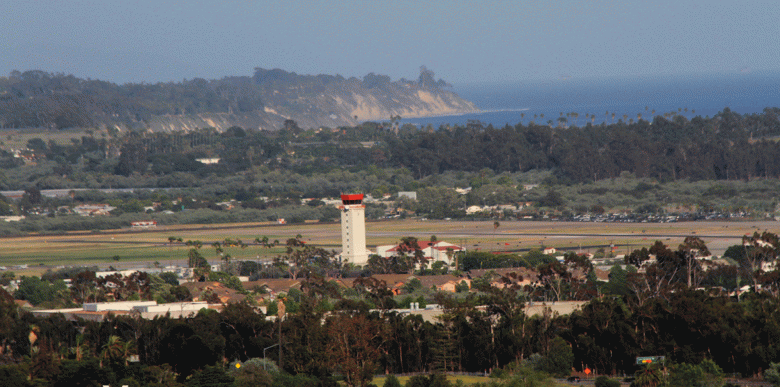
Santa Barbara Airport sits in the heart of Goleta. (Goleta History photo)
In 2012, a new terminal was completed, and the Santa Barbara City Council debated naming the new building after Jack Rickard. The public was invited to provide comments and, not surprisingly, everyone in Goleta thought Goleta or Goleta Valley should be incorporated into the new name.
After much public debate, the terminal was named after Mayor Jack Rickard, “since he is credited with figuring out a way to get the airport annexed to Santa Barbara.”
It seems to us the logical choice would have been something like the Santa Barbara Terminal at Goleta, or the Goleta Valley Terminal, or how about the Mescaltitlan Terminal?
You would think the mention of something about Goleta would have made sense, especially since that’s where it is located. But in the end, they went with the Rickard Terminal, to honor the slick politician who got away with a good one. And really, it didn’t matter, because literally no one calls it the Rickard Terminal.
To quote a local newspaper, “In one of the most brilliantly sneaky legislative moves ever, Rickard would seize upon this obscure fact when seeking to annex 800 acres of land right in the heart of Goleta and home to what was then Santa Barbara’s fledgling airport.
The state legislature, dazzled by Rickard’s ingenuity, passed a law prohibiting anyone else from ever doing the same thing.”
And the rest, as they say, is history.
Sources: SB Independent, UCSB, Walker A. Tompkins, Adam Lewis, Nick Welsh, Edhat, Noozhawk, City of Goleta, Tom Smothermon.