However, a student study shows the status could be contested, though with mixed results.
Soviet mechanisms of repression and the fate of the repressed have been studied quite extensively. Less is known, however, about the means with which the repressed tried to contest their convictions.
Hugo Treffner Gümnaasium student Helena Gross has examined just that, through the example of one farm family from Lääne County, who decided to challenge their classification as “kulaks.”
The research revealed that this turned out to be a kind of Sisyphean struggle, in which seeming gains could suddenly be easily annulled, forcing the entire process to start anew, writes Karoliina Kalda, exhibition specialist at the University of Tartu Museum of History and a member of the editorial board of the journal Akadeemiake.
Being labeled a ‘kulak’ a fate which many faced
World War II and the establishment of Soviet power in Estonia brought not only economic, political, and social transformation, but also widespread political violence. Farmers were severely hit by the loss of private property under the occupiers, and the creation of the Kolhoz, the collective farms.
Forced collectivization was accompanied by a campaign against the kulaks, meaning farmers accused of systematically employing wage labor or earning income via various services — such as renting out land or agricultural machinery, running mills, or trading.
The label emerged early on in the Soviet regime, when Estonia was an independent and democratic republic. However, that all changed with the occupation from 1940 onwards.
Since in Estonia, keeping hired help and renting out property had been common before Soviet rule, the threat of being labeled kulaks was a fait accompli for many.
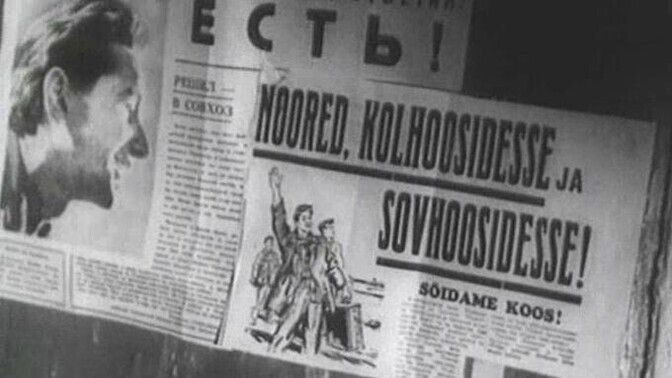 Newspapers from the Soviet occupation of Estonia. Source: ERR
The Soviet authorities regarded kulaks as enemies of socialism and therefore of the people. This demographic was subjected to higher agricultural taxes and, along with other groups deemed undesirable to Soviet power, appeared on the deportation lists of March 1949. Little research has been done, however, on how the repressed, including those labeled kulaks, tried to fight against the repressive status imposed on them.
Lindal family’s fight to contest the ‘kulak’ label
Hugo Treffner Gümnaasium student Helena Gross studied the long procedure involved in contesting being designated a kulak through the example of one farm family from Lääne County. The author chose as her research subject the Lindals, who lived at Kangru farm in Kullamaa municipality, Lääne County (then – the farm today lies in Märjamaa municipality, Rapla County).
The farm, where Rosalie (1889–1966) and Jüri Lindal (1879–1948) lived with their six children, was declared a kulak household in September 1947. The family were charged with employing outside labor and owning a tractor.
Lists of “kulaks” were drawn up by municipal executive committees, though their decisions could be appealed to the county committee. If the county executive committee did not overturn that decision, it could be further appealed to the Council of Ministers of the Estonian SSR, whose ruling was final.
The first attempt to contest the kulak designation was made by the farm’s owner, Jüri Lindal, in November 1947, when he submitted an application to the county executive committee. Jüri explained that Evald Lindal, stated in the charged sheet as hired labor, was actually his nephew, residing at the farm because of a hand injury, and not as a paid worker. He also clarified that another farmhand, Leida Veevälja, had indeed worked at the farm occasionally during harvest season, though not on a permanent basis.
The tractor described in the indictment had reportedly been acquired at the demand of the preceding nazi German occupation authorities, ahead of the1942-1943 harvest season; it actually belonged to Lindal’s son-in-law and had been handed over to the Sipa machine and tractor station in 1944, and no longer belonged to Jüri. Statements from Evald and Leida were attached to the appeal. That information was verified by the municipal executive committee, and so Kangru farm was removed from the list of kulak households.
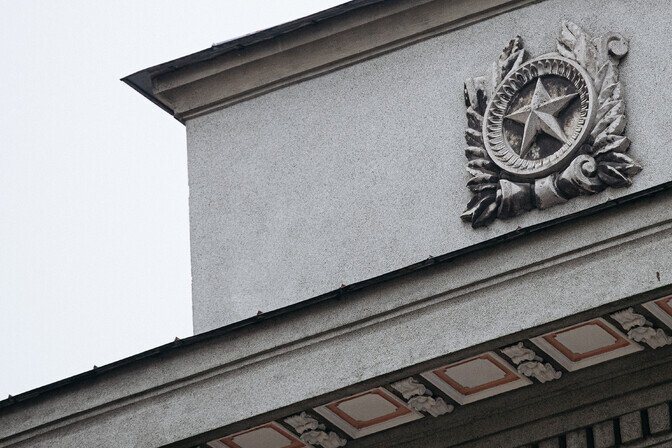 Some Soviet symbolism can be found even today, such as this detail on a Tallinn building, though the invasion of Ukraine by the Soviet Union successor state, Russia, has led to a project to mostly remove such edifices. Source: Priit Mürk/ERR
Favorable outcomes tended to be short-lived
The favorable decision was not long lived, however, and the matter was reconsidered by the municipal executive committee the following spring. Since Jüri had passed away earlier that year, his widow Rosalie was now declared a “kulak.”
The family again appealed the second decision, this time to the Council of Ministers of the Estonian SSR, which ordered the farm once more to be struck off the list of “kulak” households.
But even this reversal was insufficient in the end. In March 1949 Rosalie was once again declared a kulak, and on the same charges. Following an arbitary procedure, Rosalie, by the 60, was deported to Siberia, on March 25, 1949. While her deceased husband Jüri was also listed, their youngest son, also named Jüri, was sent to Siberia in his place.
After Rosalie and Jüri were deported, their relatives remaining in Estonia continued the attempts to contest the kulak designation. Following new petitions, the investigation was reopened and additional testimony was taken from Leida, who as noted had helped out at Kangru farm.
This time, Leida testified that she had worked at Kangru farm between 1933 and 1936 as domestic help, with part of the promised wages remaining unpaid, adding that her earlier statements applied to the situation in 1947 only. She also confirmed that her nephew, Evald, had worked there as a seasonal laborer. However, following this testimony, the decision was made to keep the Kangru farm on the list of kulak households.
The death of Stalin in March 1953 prompted new petitions.
Letters were sent to the highest authorities in the Estonian SSR. Jüri Lindal junior, as noted in Siberia at this point, also wrote to the Prosecutor General of the Estonian SSR, pointing out among other things that he had been sent there in his late father’s stead. Yet all these appeals were rejected too.
A decision ordering the Lindals’ release came only on November 22, 1957, and even then the kulak status itself was not wiped from the record.
As Gross writes in the conclusion of her study, her investigation of the Lindal family’s story shows that there was no legal certainty to speak of in the Estonian SSR. Attempts to contest kulak status could meet with temporary successes, but these often proved illusory, and the decisions were often reversed.
Even challenging the regime through the distorted prism of its own criteria for “kulak” status, in the hope that the authorities would act according to objective and verifiable facts, did not work out in the case of Jüri senior and Rosalie. Kulak status — previously annulled several times—was reinstated via summary process just before the March 1949 deportations, which saw over 22,000 Estonians deported to Siberia.
Helena Gross’s study “Kulakuks tunnistamine ja selle vaidlustamine ühe Läänemaa talupere näitel” (“Recognition as a kulak and Its contestation through the example of a Lääne County farming family”) won a special prize from the Estonian Academy of Young Scientists (Eesti Noorte Teaduste Akadeemia) as well as a letter of thanks from the President of the Estonian Academy of Sciences (Eesti Teaduste Akadeemia), at the 2025 National Student Research Competition. The study was supervised by teacher Indrek Pajur. The full Estonian text of the study is here.
—