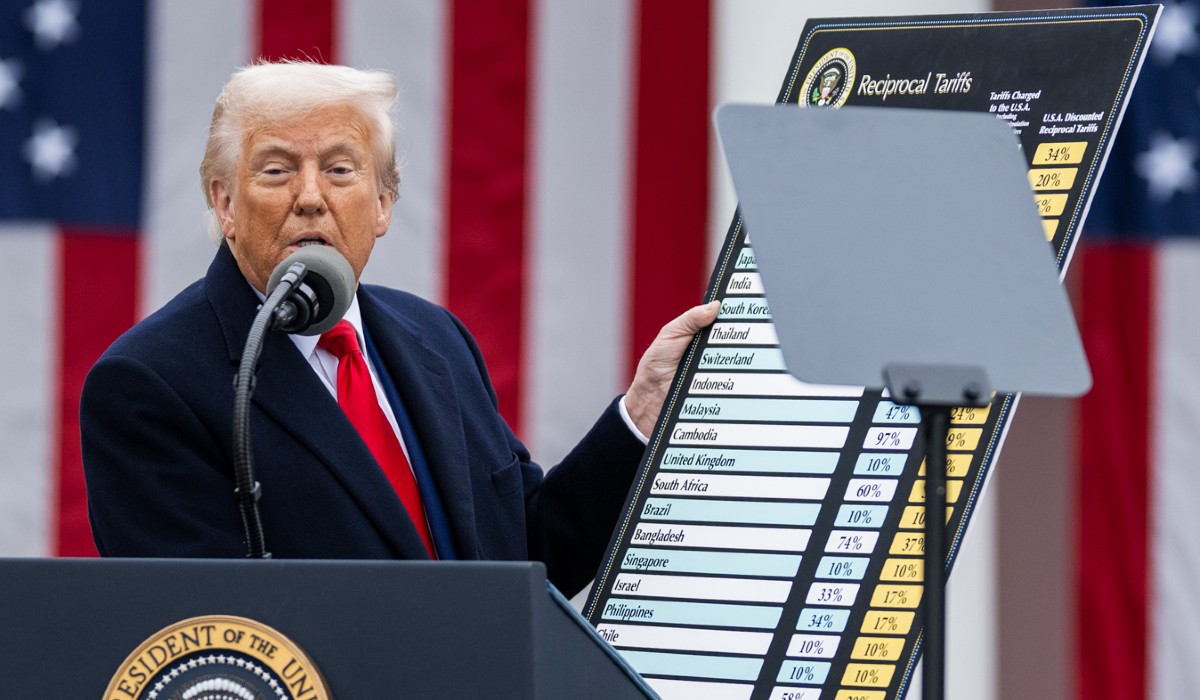
The US’s ruthless pursuit of gain in trade negotiations with everyone means no deal is likely to last, but we must not line up behind the ‘national interest’ in response, argues John Clarke
The Trump administration’s effort to redefine the terms of global trade continues to play out. Though the process is undoubtedly driven by the economic and geopolitical contradictions that the US faces, it is also greatly impacted by the pragmatic shifts and erratic decision making that characterise the president and his closest advisors.
Trump’s antics can be spectacular but it is important to appreciate that the shift from globalisation to protectionism didn’t begin with this president and is not confined to the US. Writing in Counterfire in February, John Rees pointed out that in ‘the last six years, the United States has implemented the highest number of protectionist measures, with over 11,000 policies. China implemented the second highest, with 8,100 such policies. And Brazil is third with 7,700 protectionist measures. And protectionism, although it may not always directly lead to hot war, always leads to trade war.’
Trump, however, has taken the process much further and, as Rees went on to argue in his article, his ‘aims are as brutal as they are simplistic. He wants to force his allies to pick up the bill for retooling the American economy and for financing the American military, at least in part. Protectionism implies relatively autarkic economic development and this has always gone with an expanded military-industrial sector.’
Twists and turns
This drive to further US interests by shifting the terms of trade to its major advantage continues to dominate international relations. In the last while, with ongoing twists and turns, the Trump administration has been working towards striking favourable deals all across the world.
In July, the EU agreed to terms with the Trump administration that, as reported by CNN, set ‘a 15% tariff on most European goods entering the United States, is higher than the 10% tariff Trump put in place on April 2 and significantly higher than the average of around 1.2% from before Trump’s presidency. But it’s significantly less than the enormous numbers Trump had been threatening if an agreement wasn’t reached.’
The consequences of not reaching an understanding with Trump have many countries worried but, even when terms are agreed upon, there is reason to fear that they may not be very durable. At the beginning of October, Politico reported that ‘Keir Starmer thought he had an enduring trade pact with the U.S. to lower tariffs. Donald Trump appears to have other ideas.’ However, a ‘flurry of new tariff announcements … exposed holes in the trade deal Starmer and Trump struck in May.’
This week, while attending a meeting of the Association of Southeast Asian Nations, Trump declared that he had achieved ‘trade agreements or frameworks with Malaysia, Cambodia, Thailand and Vietnam.’ It was also reported that he had ‘secured a $550 billion investment pledge from Japan.’ At the same time, the main prize for Trump remains a satisfactory agreement with China. In this regard, he will be meeting with the Chinese president, Xi Jinping, in South Korea later this week. ABC reports that ‘China’s top trade negotiator, Li Chenggang, told reporters the two sides had reached a “preliminary consensus,” while Trump’s treasury secretary, Scott Bessent, said there was “a very successful framework”.’
Given the rivalry between the rising economic strength of China and the decline of the US as the hegemonic global power, it is hard to imagine that any trade agreement between them can be anything more than a flimsy truce. This would be true even if a firm and steady hand was guiding the international dealings of the US. With Trump in the White House, however, a negotiated settlement with China will be living on borrowed time from the outset.
Trump’s capacity for impetuous and erratic conduct has also been on show in his trade negotiations with Canada. The provincial government of Ontario recently took out an advertisement, aimed at US audiences, that featured the voice of Ronald Reagan, recorded when the former president offered some remarks that were highly critical of the use of tariffs. As reported by CTV News, Trump immediately responded to this advertisement, by ‘terminating trade talks with Canada and increasing levies on Canadian goods by 10 per cent.’
On 26 October, Mark Carney told reporters that the negotiations with Washington ‘had been making progress on affected sectors like steel and aluminum until the Ontario anti-tariff ad created waves.’ The US ambassador to Canada, Pete Hoekstra, acknowledged that a deal by the end of November had been anticipated but that this will no longer be possible before the new year. ‘I’m not sure what it’s going to take to get people back to the table in a constructive and positive mode,’ he told a Canadian business audience. ‘Canada burnt the bridges with America,’ he added.
All this means that the hopes of a timely reduction in US tariffs on Canadian goods have come to nothing. According to Arab Canada News, Carney was reduced to stating that, ‘We recognize that US trade policy has changed radically from what it was in the eighties, nineties, and early new millennium, but we stand ready to build on the progress made when the US administration is ready for that.’
With any resolution of the trade dispute now out of sight, the impacts of US tariffs on the Canadian economy continue to compound. Global News quotes ‘trade expert William Pellerin’ as saying that the ‘tariffs are really having a very devastating impact … we’re starting to see a tsunami of layoffs across a number of economic sectors.’ Another source argues, quite plausibly, that whenever ‘it seems like we’re just about to make progress on a deal, something happens and the Americans walk away from the table.’
Huge volatility
This breakdown of US Canada trade talks reinforces a consideration I have previously raised. Not only is the Trump administration ready to use the most coercive tactics in order to secure trade deals that are to its advantage but, once agreements have been signed, it is highly questionable whether or not they will hold up for any length of time.
Under the changed and fuzzy rules that are being applied under the new America First approach, the ‘rules based’ world order is being replaced by a patchwork of trade deals that are likely to be scrapped whenever the US is convinced that harsher terms can be imposed. This is one particularly glaring example of the huge volatility that global capitalism is now experiencing, as the US redefines its role in the world.
In terms of the global economy, Trump is administering some very harsh medicine to a fragile patient in very poor health. As Michael Roberts has noted, the ‘major capitalist economies have all experienced a much slower pace of economic growth since the global financial crash of 2008 and the ensuing Great Recession. The US economy has done the best, but real GDP growth there has averaged no more than 2 percent a year in the last seventeen years, compared to over 3 percent a year before 2008. The other so-called G7 economies have performed worse; their average real GDP growth rate has been 1 percent a year at best. Germany, France, and the UK are stagnating, while Japan, Canada, and Italy are doing only marginally better.’
The enormous uncertainties and dislocations caused by Trump’s efforts to reconfigure world trade add an enormous additional strain to a global economic order that is in a far from robust condition. By way of an example, Reuters has looked at how ‘tariffs anxiety’ is disrupting the business operation of US importers. It found that many had decided ‘to risk loading their balance sheets with inventory that may take months to move out, and pay more for warehousing costs. They’re also betting consumer spending holds up in the spring as lower-income consumers rein in spending and the economy remains uncertain overall.’
Under capitalism, trade wars, just as much a military conflicts, are ultimately reducible to a fight over profits. Each country that is confronted with Trump’s demands for better terms of trade will either have to pay up, fight back or seek out new trading partners. All of these approaches will mean a squeeze on profits and every effort will be made to impose the costs of this on the working class.
In the present situation, we should reject appeals to line up with ‘our’ capitalists and make sacrifices in the ‘national interest’. The issue is to resist the increased exploitation and deepened austerity measures that this will lead to. As the trade war goes over to a class war, we need to be completely clear about which side we’re on.