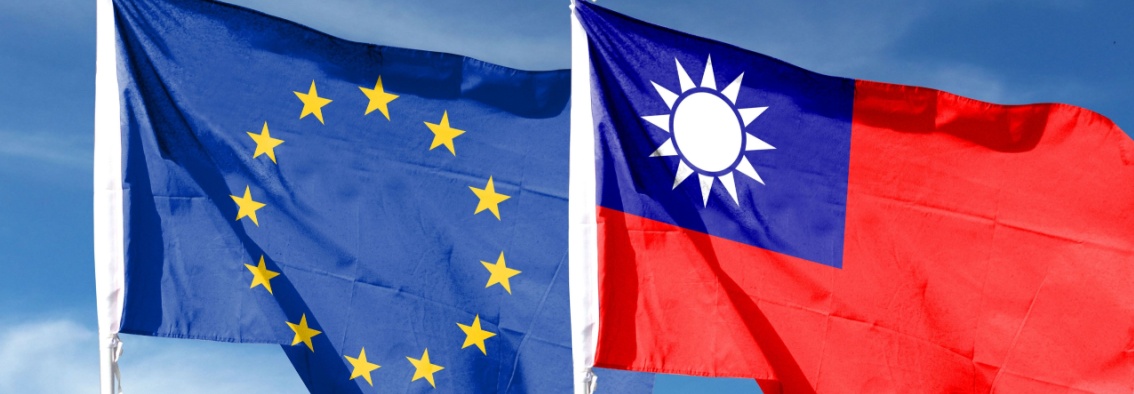
The strategic importance of Taiwan in global supply chains has led the European Union to reassess and adjust its economic strategy toward the island. Since a potential conflict in the Taiwan Strait will not only disrupt global supply chains, but also have a serious impact on the European economy, the EU now regards Taiwan as a like-minded partner in both economic and security matters. Over the past nine years, the EU’s stance on Taiwan has evolved from a cautious, economically-centered engagement into a robust, wide-ranging partnership.
Before President Tsai Ing-wen (蔡英文) came into office, the focus was almost exclusively on trade and investment, deliberately kept low-key. However, after President Tsai Ing-wen took office, the EU and Taiwan began to cooperate on high-tech and semiconductor collaboration, coordinate on securing supply chains, engage in regular high-level dialogues, and explore new domains from green energy to digital affairs. This change has been driven by Taiwan’s strategic importance to global supply chains and promoting democratic values, as well as Europe’s need to de-risk and diversify its economic ties.
Taiwan and the EU: Mutual Recognition of Interdependence
When former President Tsai Ing-wen took office in 2016, she shifted Taiwan’s economic policy towards active engagement with like-minded partners around the world—including the EU. This contrasted with the policies of her predecessor, former President Ma Ying-Jeou (馬英九), who focused more on cross-Strait relations. Moreover, after experiencing the shortage of semiconductors during the COVID-19 pandemic, the EU has also recognized Taiwan’s importance as an economic partner.
Accompanying Taiwan’s shift, the EU’s official stance has moved from passive neutrality to an active recognition of Taiwan’s significance to Europe’s economic and security interests. In his address to the European Parliament in September 2022, the High Representative of the Union for Foreign Affairs and Security Policy Josep Borrell declared that, “to preserve peace, stability, and the status quo in the Taiwan strait is key, not just for the security and prosperity of the region, but also for ours.” This statement marked a departure from the EU’s traditionally cautious stance, which for decades emphasized adherence to the “One-China” policy and avoided direct commentary on cross-Strait issues. Previously, the EU confined its engagement with Taiwan largely to economic and cultural exchanges, maintaining strategic ambiguity toward East Asia security affairs. However, as tensions in Taiwan Strait have intensified and Russia’s invasion of Ukraine reshaped European security thinking, Brussels has increasingly articulated a clear strategic interest in the Indo-Pacific. Reflecting this shift, the President of the European Commission, Ursula von der Leyen, echoed in an address in 2023 that “peace and stability in Taiwan Strait are indispensable to the prosperity of the region and global security.”
Enhancement of EU-Taiwan Economic Relations
Accompanying Taiwanese President Tsai’s shift in policy and the EU’s growing recognition of Taiwan as an economic partner, the EU and Taiwan have worked closely on semiconductor cooperation and actively engaged in various dialogues to strengthen economic cooperation over recent years.
The COVID-19 pandemic’s impact on global supply chains first alerted the EU to the vulnerability of its high-tech industries. In particular, the European automobile industry suffered major economic damage as a consequence of the ensuing shortage of chips. When pandemic lockdowns eased and demand for cars bounced back, many European companies found that they could not deliver new vehicles to the market because they were at the back of the queue when it came to global semiconductor supply. Given that Taiwan ranks first in market share for semiconductor products—producing 60 percent of the world’s chips overall, and over 90 percent of the most advanced ones—it is thus an indispensable trading partner for both the EU and the world. Furthermore, due to the increasing competition and demand for electric vehicles, the EU will only require more advanced chips in the future—which currently are largely produced by Taiwan’s Taiwan Semiconductor Manufacturing Company (TSMC, 台灣積體電路製造公司) and United Microelectronics Corporation (UMC, 聯華電子). Therefore, after realizing the importance of securing a stable semiconductor supply chain, the EU started to build up closer economic cooperation with Taiwan.

Image: In 2023, Taiwan and EU representatives held the EU-Taiwan Investment Partnership Forum on Semiconductor Clusters. (Image source: Taiwan Overseas Community Affairs Council)
This economic necessity has precipitated closer relations between the EU and Taiwan. In 2021, the European Parliament published the first stand-alone report on Taiwan, raising key concerns about security and economic cooperation with Taiwan as a like-minded partner. The report, titled EU-Taiwan political relations and cooperation, recommended the European Commission to intensify bilateral relations and pursue a comprehensive partnership with Taiwan under the guidance of the EU’s One-China Policy. In 2023, both sides co-hosted the first minister-level EU-Taiwan Trade and Investment Dialogue (TID). Previous dialogues were held at the deputy minister level on the Taiwan side and the deputy director-general level on the EU side. Thus, the upgrading of dialogue to the ministerial level represents a major step in the enhancement of EU-Taiwan economic relations.
The EU’s passage of the 2023 European Chips Act also enhances the resilience of critical supply chains by establishing legal and financial tools that facilitate cooperation with key partners like Taiwan. Semiconductors are essential inputs for automobiles, telecommunications, defense systems, energy infrastructure, which means that chip availability is critical to EU economic security. Through mechanisms such as joint supply chain monitoring, early-warning systems, and strategic partnerships, the European Chip Act enables structured collaboration with Taiwan to address semiconductor disruptions. The European Chip Act sets up a monitoring and crisis-response system that works with Taiwan to anticipate and mitigate chip shortages. This cooperative early-warning framework directly involves Taiwan’s authorities and industry in sharing information to monitor semiconductor supply chains and prevent disruption. The Act also supports joint research under the Chips Joint Undertaking and incentivizes foreign investment on semiconductor production in Europe. EU officials have pointed to areas like sub 1-nanometer and open-source hardware (RISC-V) as domains where Europe will partner with Taiwan’s industry to overcome technological roadblocks. For instance, under the name of European Semiconductor Manufacturing Company, TSMC, Infineo, Bosch, and NXP plan to collaborate on building a EUR 10 billion (USD 10.6 billion) chip facility in Germany. Backed by Chips Act subsidies, the collaboration aims to boost Europe’s capacity in making chips for cars. In addition, TSMC is also establishing a European Union Design Center (EUDC) in Munich that will open in the third quarter of 2025. In September 2025, TSMC partnered with Technical University of Munich (TUM) to establish an AI-chip R&D unit in Bavaria, furthering the Munich site’s role in European semiconductor design and talent development. These actions and mechanisms will integrate Taiwan’s advanced semiconductor capabilities into Europe’s resilience of critical supply chains, reducing EU’s vulnerability for semiconductor shortage and boosting the EU’s capability on semiconductor research and production. As the President of the European Commission, Ursula von der Leye said: “[This collaboration] is an endorsement for Europe as a global innovation powerhouse.”
In sum, the COVID-19 pandemic exposed Europe’s dependence on external semiconductor suppliers, particularly its impact on the EU’s automobile industry. This shock catalyzed a reassessment of Taiwan’s strategic role in global supply chains, especially given Taiwan’s dominance in advanced chip manufacturing. As a result, the EU has deepened economic cooperation with Taiwan, culminating in a series of policy and institutional developments. These include the European Parliament’s first stand-alone report on Taiwan in 2021, the upgrade of the EU-Taiwan Trade and Investment Dialogue to the ministerial level in 2023, and financial framework for partnering with strategic partners like Taiwan on joint supply chain monitoring, early-warning systems, advanced semiconductor research, and investment incentives. Additionally, these frameworks and actions have led to the construction of TSMC’s EUR 10 billion (USD 10.6 billion) chip facility in Germany and the establishment of a European Union Design Center and AI R&D unit in Munich. Therefore, these steps mark a structural enhancement in EU-Taiwan economic relations, embedding Taiwan’s semiconductor capacity into Europe’s broader strategy for technological resilience and supply chain security.
Enhancement of EU-Taiwan Diplomatic Relations
Diplomatic relations between the EU and Taiwan have also made substantial progress in recent years. This recent enhancement is driven not only by Taiwan’s status as a crucial technology supplier to Europe, but also by growing concerns over China’s increasingly assertive actions that challenge the rules-based order. The EU has become more cautious about its relationship with China, particularly as Beijing’s pro-Kremlin stance during the war in Ukraine raised concerns regarding China’s reliability as a partner. For instance, the President of the European Commission, Ursula von der Leyen, cautioned that “how China continues to interact with Putin’s war will be a determining factor for EU-China relations going forward.” Moreover, she noted that China has become a “formidable actor in the global information and cyber-space” and vowed the EU “will be very vigilant against any form of influence operations and cyber-attacks in Europe.”
In 2023, Taiwan’s former Foreign Minister Joseph Wu (吳釗燮) visited Brussels and various European capitals. During his term in office, Wu made two high-level visits to Europe and visited several European countries. In return, EU representatives have frequently visited Taiwan, further solidifying ties. Taiwan has also expanded its diplomatic presence, exemplified by the opening of the Taiwanese Representative Office in Vilnius, Lithuania, in 2021. Notably, in 2021—for the first time in history—the EU sent an official delegation to Taipei to meet with former President Tsai to discuss disinformation and cybersecurity issues. In 2022, the Vice President of the European Parliament visited Taiwan and met with former President Tsai, marking another milestone in bilateral relations. In 2025, the EU parliament sent a delegation of the Special Committee on the European Democracy Shield to meet President Lai to discuss disinformation, hybrid threats, and Taiwan’s “whole-of-society” approach to countering foreign interference.
In 2025, Taiwan’s Foreign Minister Lin Chia-lung (林佳龍) undertook a series of significant diplomatic visits to Europe, advancing a strategy of so-called “integrated diplomacy” by leveraging both technological strength and cultural assets to deepen multidimensional cooperation with European partners. Integrated diplomacy denotes an approach that transcends conventional political and security paradigms by incorporating economic, technological, cultural, and value dimensions to forge resilient international networks—aligning with Taiwan’s international image as being committed to democracy, peace, and prosperity.
Taiwan’s leading position in the global semiconductor sector, especially in automotive chip production and advanced manufacturing, has made it a pivotal partner for Europe’s supply chain restructuring and technological sovereignty efforts. In Brno, Czech Republic, Minister Lin visited a center for advanced chip design and AI research to bolster the potential for Taiwan-Czech technological collaboration. At the Warsaw Security Forum, Minister Lin introduced the concept of a “democratic supply chain,” highlighting the TSMC-led joint venture with the German government and European firms as tangible evidence of Taiwan–EU economic and security integration. Taiwan’s Lieutenant General Hsieh Jih-sheng (謝日升), deputy chief of the Ministry of National Defense’s Office of the Deputy Chief of General Staff for Intelligence, attended the Warsaw Security Forum as well. A senior Taiwanese general’s appearance in full uniform at a high-profile security forum in Poland signals closer security exchanges between Taipei and Warsaw, and reflects Europe’s growing concern over China’s military ambitions. This signals a shift toward more open Taiwan–EU security cooperation and shows European countries’ autonomy to engage with Taiwan.
As part of Taiwan’s cultural diplomacy, Minister Lin participated in the 2025 European Taiwan Culture Year events, attending the performance in Rome and the East Meets West concert in Vienna, highlighting Taiwan’s vibrant, democratic, and innovative culture while deepening connections with European society. Technology, culture, and value work as three pillars for Taiwan’s integrated diplomacy, enabling Taiwan to be recognized not only as an economic and security partner, but also as a reliable member in the international community.
During the visit, Lin held intensive meetings with numerous senior European political figures, including Czech Senate President Miloš Vystrčil, Speaker of the Chamber of Deputies Markéta Pekarová Adamová; Italian Senate Vice President Gian Marco Centinaio and Taiwan Friendship Association chair Lucio Malan; Austrian Parliament Vice President Harald Dossi; as well as Polish Senate Vice President Michał Kamiński, French Senator Hélène Conway-Mouret, Estonian MP Marko Mihkelson, and Ukrainian MP Oleksiy Goncharenko. These senior-level engagements reflect Taiwan’s growing political traction in Europe and establish a structural basis for deepening cooperation in trade, technology, and security.
Policy Recommendations
To further strengthen Taiwan-EU relations, the author recommends that the two sides pursue flexible diplomacy to advance economic cooperation. The Taiwanese government has adapted to its unique international status by implementing so-called “amphibious diplomacy,” which involves formal diplomacy with its diplomatic allies, as well as diplomacy in the grey area between formal and informal engagement, enabling interactions with non-diplomatic allies such as the United States and European countries. Therefore, the EU and Taiwan should continue to capitalize on this model of amphibious diplomacy to ink a bilateral trade agreement to strengthen EU-Taiwan collaboration on semiconductors.
In particular, the acute shortage of automotive chips during COVID-19 pandemic exposed Europe’s dependence on external suppliers and revealed its vulnerabilities in high-tech manufacturing. This disruption—which was especially harmful to Europe’s automobile industry—underscored the strategic necessity of developing resilient semiconductor supply chains. While the European Chip Act has laid out an important legal framework, the EU should also seek to reinforce semiconductor collaboration with Taiwan through formalized economic agreements. For instance, the EU and Taiwan could settle on a comprehensive economic partnership agreement akin to the US-Taiwan Initiative on 21st Century Trade. Such an agreement would not only institutionalize semiconductor cooperation from a holistic policy perspective, but would also contribute to the EU’s broader goal of enhancing its economic security in an era of geopolitical uncertainty.
The main point: Since 2016, EU-Taiwan relations have developed positively via cooperation on semiconductors and closer diplomatic engagement. These growing ties reflect not only Taiwan’s importance as a semiconductor supplier but also concerns regarding China’s aggressive actions that challenge the rule-based order. The EU and Taiwan should deepen their collaboration by advancing a bilateral trade agreement under the model of amphibious diplomacy.