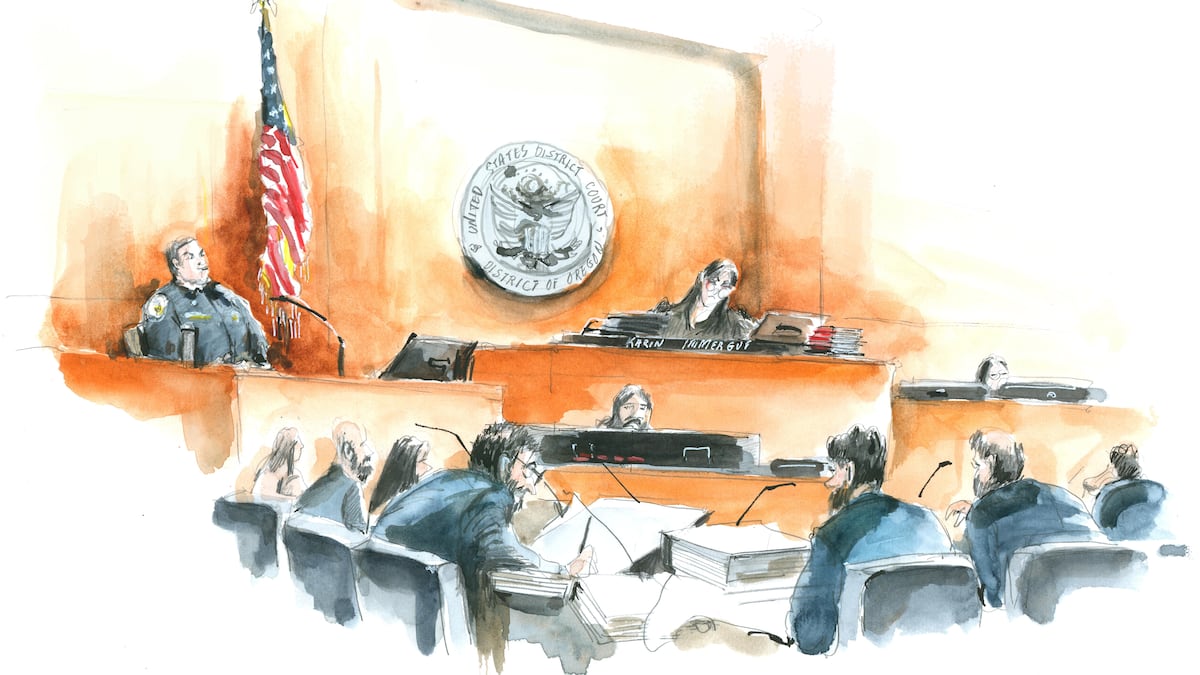
A federal trial is under way in Portland on Wednesday, where U.S. District Court Judge Karin Immergut will decide if President Trump acted lawfully or violated the state’s rights by trying to deploy the National Guard.
Illustration by Rita Sabler / OPB
A federal trial in Portland about the president’s authority to deploy the National Guard to the city got off with a stunning revelation: Troops briefly deployed to a federal immigration building in South Portland this month, appearing to defy a court order issued hours earlier blocking their deployment.
Emails summarizing the federal response say nine members of the Oregon National Guard were sent to the U.S. Immigration and Customs Enforcement facility in Portland and concluded their shift in the early hours of Oct. 5. Those emails were submitted to the court as a trial exhibit.
“At 11:35 PDT today, a force of nine MPs arrived at the ICE facility in downtown Portland, Oregon where they assumed their first support mission,” wrote Col. Jeff Merenkov at 3:28 p.m. on Oct. 4.
The email included a schedule that showed the troops’ “shift conclusion” was set for midnight.
Jean Lin, special counsel for the Justice Department, confirmed the deployment to the U.S. District Court Judge Karin Immergut on Wednesday but provided few specifics — minutes before the trial began.
Immergut issued a restraining order at 3:40 p.m. on Oct. 4, barring the president from federalizing the Oregon National Guard and blocking their deployment. Later, on Oct. 5, she issued another order temporarily blocking National Guard members from anywhere in the country from deploying to Oregon.
“We’ll talk later about whether that’s contempt,” the judge responded to Lin Wednesday.
For the next three days, Immergut will preside over a trial that’s expected to touch on a range of issues, from lofty legal arguments about the authority and limitations of presidential powers, to specific ways the Portland Police Bureau has evolved its response to protests since 2020, and rising tensions between local and federal law enforcement officers.
The trial is the result of a lawsuit filed by the city of Portland, along with the state of Oregon and later California, to block the Trump administration from deploying the military to Portland.
Opening arguments
Immergut will ultimately have to determine whether President Donald Trump followed federal law when he federalized 200 members of the Oregon National Guard, and which, apart from the brief deployment disclosed Wednesday, has been blocked by the courts from sending the military to the city.
During opening statements, the city of Portland’s Caroline Turco told Immergut the evidence at trial would show the federal government has untapped law enforcement resources that could be sent to the ICE building. She also said, so far, the local public safety system has been well equipped to handle any unlawfulness associated with the protests.
Turco told Immergut, the city of Portland “does not need the National Guard.”
Those sentiments were echoed by the Oregon Department of Justice’s Scott Kennedy, who said the military cannot perform the same role as domestic law enforcement and told Immergut the case “is a test of the outer bounds of presidential authority.”
California Deputy Attorney General Jane Reilley argued the rights of the state were infringed on when the Trump administration pulled 200 of her state’s National Guard soldiers “out of California and sent them across state lines to Portland over the objections of both states’ governors for no other reason than to contravene this court’s temporary restraining order.”
Those troops were set to be demobilized from federal service next week, but have since been ordered to remain under the president’s authority until February for a possible deployment to Portland, Reilley said.
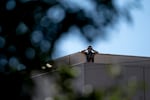
A federal agent looks through binoculars from the U.S. Immigration and Customs Enforcement building towards protesters before U.S. Department of Homeland Security Secretary Kristi Noem visits to Portland on Tuesday, Oct. 7, 2025.
Eli Imadali / OPB
The Trump administration countered that the president acted lawfully when he federalized the Oregon National Guard for a “federal protection mission.”
Deputy Assistant Attorney General Eric Hamilton argued during opening statements that “agitators” have both used and threatened violence against federal law enforcement officers who work at the U.S. Department of Homeland Security.
“The Department of Homeland Security cannot contain this threat itself,” Hamilton told Immergut, saying the president only federalized the Oregon National Guard after Gov. Tina Kotek refused to do so.
Hamilton said the president can federalize the guard when there’s a rebellion or threat of one, or if federal laws cannot be carried out, which he said is applicable in Portland.
“The president’s judgement is not subject to judicial review,” he argued, adding the president’s decision must reflect “the facts and law within a range of honest judgement.”
Police balancing protected speech
The protests’ perceived threat-levels and the degree to which Portland “needs” federal troops led to lengthy witness testimonies by local police.
National conversation about the case has at times focused on the Portland Police Bureau, which has favored deploying white-shirted “dialog officers,” embedded plainclothes officers and bike squads to monitor protests.

Portland police officers talk with a woman attempting to drive through the protesters outside the U.S. Immigration and Customs Enforcement facility in Portland, Ore., on Sept. 28, 2025.
Kristyna Wentz-Graff / OPB
The city and states’ attorneys called to the stand leaders from the bureau, as well as the Oregon State Police. State troopers have helped manage protests at times.
The police brass spent most of Wednesday fielding questions about their vantage point of the protests and the responses by federal law enforcement.
Some demonstrators have veered from protected speech and into criminal activity, they acknowledged. Portland police have made 60 arrests since the protests began in June, for crimes ranging from throwing bricks and fireworks, to pointing lasers in federal officers’ eyes and starting fires.
The crowds have also pushed the boundaries of city ordinances, blocking traffic at times and publicly using drugs.
The bureau has appeared willing to make those concessions as the protests persisted, while offering an explanation of their approach navigating dynamic demonstrations.
Multiple Portland police officials testified that wholesale riot control tactics can aggravate crowds, including Cmdr. Franz Schoening and Assistant Chief Craig Dobson. The chaotic scenes of 2020, when the city experienced more than a hundred nights of protests, were frequently invoked Wednesday.
“When protest crowds or any crowds experience what they perceive as illegitimate or unjust actions, including the use of force, that can change normative behavior and collective identity in a crowd,” Schoening said. “And so they become more resistant to exercises of authority, including by the Portland Police Bureau, to try and get compliance or deescalate events.”
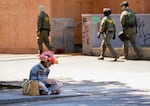
A person identifying themselves only as “Connor” sits in silent protest outside of the U.S. Immigration and Customs Enforcement building in Portland, Ore., June 17, 2025. “I try to bring a calming presence,” says Connor.
Kristyna Wentz-Graff / OPB
The crowds outside ICE were described in police records, made public in the lawsuit, as “low energy” prior to drawing Trump’s attention. Portland police made zero arrests between late June and late September.
Federal law enforcement, on the other hand, have on multiple occasions met otherwise tepid crowds with tear gas and pepper balls. One such instance, on Oct. 4, saw officers push crowds more than a hundred yards from the ICE building before suddenly dropping a volley of chemical munitions.
“The decision to use those munitions is frequently unpredictable,” Schoening said. He noted boots-on-the-ground PPB officers have been gassed and hit with pepper balls as well. “The types and amounts of force being used by federal officers is disproportionate to the level of criminal conduct we’re seeing down there.”
Local police’s tactics are also bound by prominent state laws. Oregon’s sanctuary law, for example, prevents officers from helping federal law enforcement enforce the federal government’s deportation efforts. That prohibition extends to crowd control at the ICE building, Schoening said.
Oregon lawmakers have also recently narrowed the circumstances in which local police can declare riots and use crowd control munitions.
Justice Department attorneys, however, laid out police records that documented alleged crimes at the protests that Portland police didn’t act upon. They brought up instances of people breaking windows, flinging rocks from slingshots and throwing commercial-grade fireworks.
At one point, an attorney cross-examined an Oregon State Police Captain who, in court records, wrote that officers weren’t intervening and that Portland police were using a “high threshold” to determine whether to make an arrest.
“Then you say this threshold proved difficult to meet and resulted in no real intervention by law enforcement while simultaneously allowing low level public disorder criminal activity to continue, right?” the attorney asked.
“Yes,” said Capt. Cameron Bailey.
Justice Department attorneys also pointed to the state laws, suggesting they handcuffed local law enforcement.
The Trump administration is expected to make it’s case Thursday, when the parties return to court.