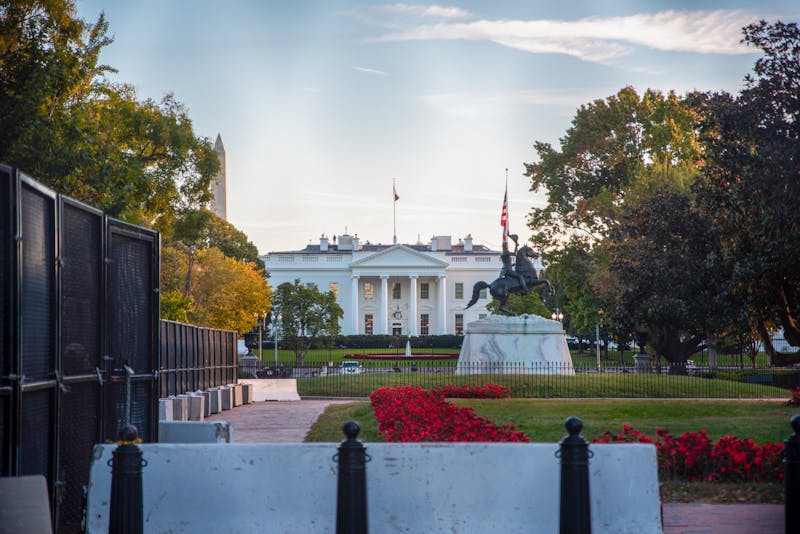
Every four years, Penn transforms into a miniature D.C. as political science majors dust off our Reddit accounts to play pundit, clubs host debate watch parties that rival Super Bowl gatherings, and dining halls buzz with “hot takes” on the latest viral campaign moment. Students who would never dream of reading a policy report suddenly talk about swing states and electoral math with the confidence of seasoned political analysts. For a few months, it feels like everyone on campus is politically plugged in.
But what happens when the lights go down, the hashtags fade, and the campaign buses move on? For too many of us, the performance of engagement ends as quickly as it began. We love the drama of politics, the clash of personalities, and the instant gratification of memes when it’s trending. What we don’t seem to love, or at least invest in with the same intensity, is the unglamorous work of understanding policy.
There’s a reason for this. Political theater is intoxicating. It’s fun to watch a candidate fumble through a tough question or land a rehearsed one-liner. It’s easy to share a TikTok dunking on a senator who said something tone-deaf. It’s satisfying to claim we’re “politically aware” because we caught the highlights of last night’s debate. But awareness is not the same as engagement, and engagement is not the same as impact.
Coming from a political science major myself: policy is boring. At least at first glance. It doesn’t make for good memes or 15 second slips. It requires patience: laboring for hours processing jargon, reading through numbers, and tracing how a proposal functions in our political system. But that “boring” part is where the power lies. The minimum wage you earn, the loans you pay, the rights you hold or may lose — those are all the products of dense, technical decisions hammered out in committees and buried in legislative text. If our political energy never makes it past the stage lights and into the rows of policy, then our “engagement” is just another form of entertainment consumption.
This culture of treating politics as a spectacle is not just harmless fun; it carries consequences. First, it forms a foundation for cynicism. If politics is just a show, then it’s easy to dismiss it all as corrupt, hopeless, or unworthy of our effort. That cynicism lets us feel smart without requiring us to act. Second, it encourages passivity. If politicians are performers and we’re the audience, then our only job is to clap, boo, or turn off the TV. Finally, it turns activism into branding. Many students care deeply about justice, equity, and reform; however, we operate under the belief that the work begins and ends with posting the right story on Instagram or signaling affiliation with the right cause, rather than doing the slow, unglamorous task of organizing that drives change.
Penn students pride themselves on being brilliant, ambitious, and future oriented. And we are. Many of us know how to analyze complex systems, craft arguments that leave opponents destroyed, and question authority when their infallibility has contradicted human nature. Yet, in politics, we sometimes act like passive spectators instead of participants. For all the energy we pour into the theatrics of national politics, the mechanics of governance remain largely invisible and untouched by our effort. The challenge is to push ourselves past the surface regardless of how solid the ice is.
The question then, is whether we’re content to be the audience and watch, or whether we’re ready to be the characters and act.
ZOE MACKEY is a sophomore studying political science from Philadelphia, PA. Her email is zmackey@sas.upenn.edu.
SEE MORE FROM ZOE MACKEY: