Nov 1, 2025
IndexBox has just published a new report: Europe – Chemical Wood Pulp (Sulphite, Other Than Dissolving Grades) – Market Analysis, Forecast, Size, Trends and Insights.
The European sulphite wood pulp market, valued at $3 billion in 2024, is forecast to experience a slight upward trend with a volume CAGR of +0.3% and a value CAGR of +1.5% through 2035. After a seven-year decline, both consumption and production saw a modest increase in 2024, reaching 2.6 million tons. France, the UK, and Russia are the largest consumers, while Germany is the dominant importer and exporter. Import and export prices have been rising, averaging $1,253 and $1,261 per ton respectively in 2024. The market remains concentrated, with the top countries accounting for a significant share of both consumption and production.
Key Findings
Market volume is forecast for slight growth with a +0.3% CAGR, reaching 2.7M tons by 2035France, the UK, and Russia are the top consuming nations, together accounting for 39% of the marketGermany is the largest importer and exporter, representing 35% of import value and 68% of export valueAfter seven years of decline, both consumption and production increased to 2.6M tons in 2024Import and export prices have been rising, reaching $1,253 and $1,261 per ton respectively in 2024Market Forecast
Driven by rising demand for sulphite wood pulp in Europe, the market is expected to start an upward consumption trend over the next decade. The performance of the market is forecast to increase slightly, with an anticipated CAGR of +0.3% for the period from 2024 to 2035, which is projected to bring the market volume to 2.7M tons by the end of 2035.
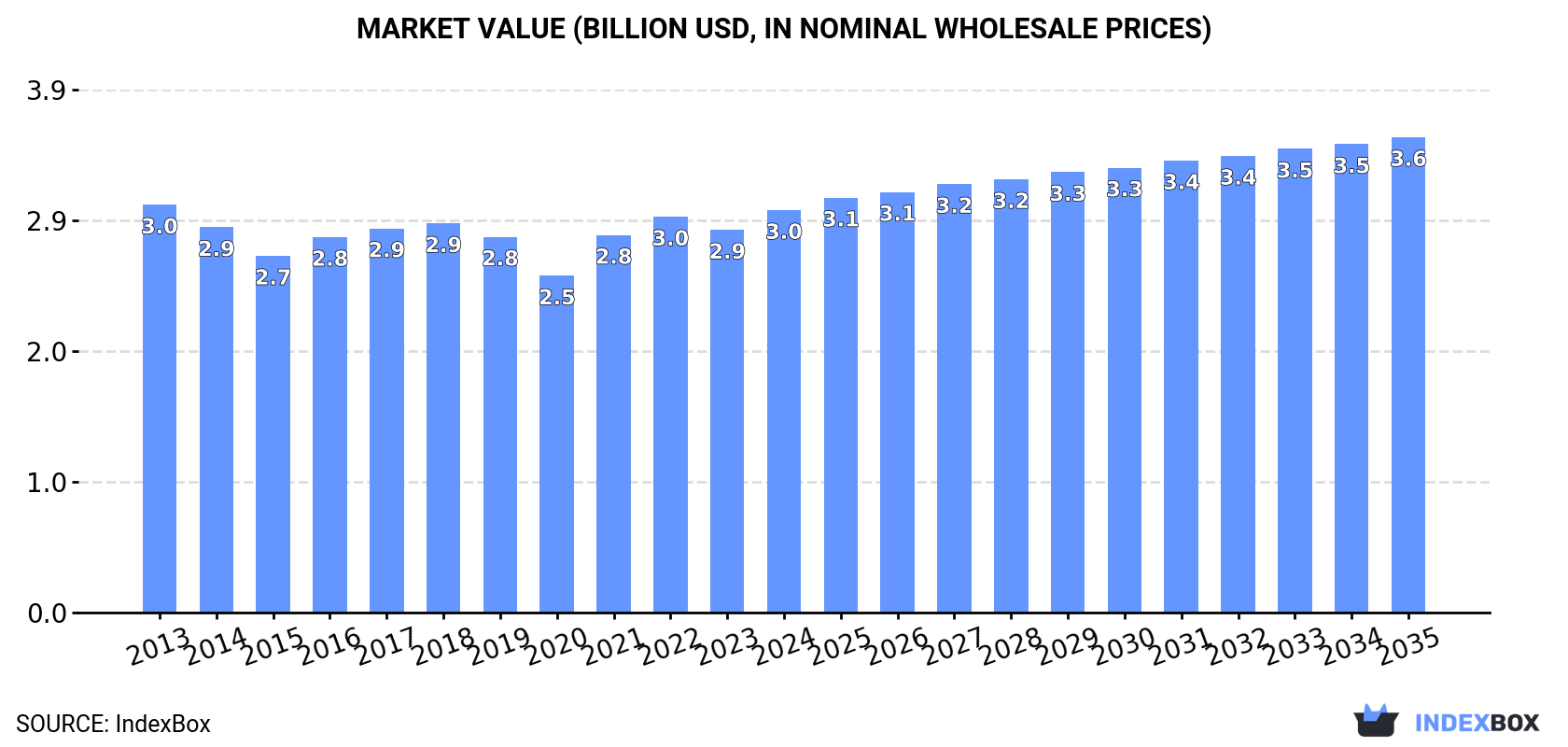
In value terms, the market is forecast to increase with an anticipated CAGR of +1.5% for the period from 2024 to 2035, which is projected to bring the market value to $3.6B (in nominal wholesale prices) by the end of 2035.
 ConsumptionEurope’s Consumption of Chemical Wood Pulp (Sulphite, Other Than Dissolving Grades)
After seven years of decline, consumption of chemical wood pulp (sulphite, other than dissolving grades) increased by 1.1% to 2.6M tons in 2024. In general, consumption, however, recorded a relatively flat trend pattern. The most prominent rate of growth was recorded in 2016 when the consumption volume increased by 2.2%. As a result, consumption attained the peak volume of 3M tons. From 2017 to 2024, the growth of the consumption remained at a lower figure.
The size of the sulphite wood pulp market in Europe was estimated at $3B in 2024, growing by 5.2% against the previous year. This figure reflects the total revenues of producers and importers (excluding logistics costs, retail marketing costs, and retailers’ margins, which will be included in the final consumer price). Over the period under review, consumption, however, continues to indicate a relatively flat trend pattern. The level of consumption peaked at $3B in 2013; afterwards, it flattened through to 2024.
Consumption By Country
The countries with the highest volumes of consumption in 2024 were France (356K tons), the UK (346K tons) and Russia (316K tons), together comprising 39% of total consumption.
From 2013 to 2024, the biggest increases were recorded for Russia (with a CAGR of +0.6%), while consumption for the other leaders experienced a decline in the consumption figures.
In value terms, the largest sulphite wood pulp markets in Europe were the UK ($420M), France ($401M) and Italy ($352M), together accounting for 39% of the total market.
The UK, with a CAGR of +2.1%, recorded the highest rates of growth with regard to market size in terms of the main consuming countries over the period under review, while market for the other leaders experienced more modest paces of growth.
In 2024, the highest levels of sulphite wood pulp per capita consumption was registered in Austria (18 kg per person), followed by France (5.2 kg per person), the UK (5.1 kg per person) and Italy (4.9 kg per person), while the world average per capita consumption of sulphite wood pulp was estimated at 3.5 kg per person.
From 2013 to 2024, the average annual rate of growth in terms of the sulphite wood pulp per capita consumption in Austria stood at -3.0%. In the other countries, the average annual rates were as follows: France (-0.8% per year) and the UK (-0.8% per year).
ProductionEurope’s Production of Chemical Wood Pulp (Sulphite, Other Than Dissolving Grades)
In 2024, production of chemical wood pulp (sulphite, other than dissolving grades) was finally on the rise to reach 2.6M tons after seven years of decline. Overall, production, however, recorded a relatively flat trend pattern. The most prominent rate of growth was recorded in 2014 with an increase of 5.7%. The volume of production peaked at 2.9M tons in 2016; however, from 2017 to 2024, production stood at a somewhat lower figure.
In value terms, sulphite wood pulp production amounted to $3.1B in 2024 estimated in export price. Over the period under review, production saw a relatively flat trend pattern. The pace of growth was the most pronounced in 2021 when the production volume increased by 15% against the previous year. Over the period under review, production attained the peak level in 2024 and is likely to see steady growth in the immediate term.
Production By Country
The countries with the highest volumes of production in 2024 were France (381K tons), the UK (344K tons) and Russia (326K tons), with a combined 41% share of total production. Italy, Spain, Austria, Poland, Germany, Ukraine and the Netherlands lagged somewhat behind, together comprising a further 39%.
From 2013 to 2024, the most notable rate of growth in terms of production, amongst the main producing countries, was attained by Spain (with a CAGR of +4.8%), while production for the other leaders experienced more modest paces of growth.
ImportsEurope’s Imports of Chemical Wood Pulp (Sulphite, Other Than Dissolving Grades)
In 2024, overseas purchases of chemical wood pulp (sulphite, other than dissolving grades) increased by 4.9% to 218K tons for the first time since 2020, thus ending a three-year declining trend. Overall, imports, however, continue to indicate a abrupt shrinkage. The pace of growth was the most pronounced in 2020 with an increase of 6.9%. Over the period under review, imports attained the peak figure at 497K tons in 2013; however, from 2014 to 2024, imports failed to regain momentum.
In value terms, sulphite wood pulp imports rose markedly to $273M in 2024. In general, imports, however, continue to indicate a noticeable downturn. The pace of growth was the most pronounced in 2018 with an increase of 17% against the previous year. The level of import peaked at $423M in 2013; however, from 2014 to 2024, imports stood at a somewhat lower figure.
Imports By Country
In 2024, Germany (70K tons), distantly followed by Slovakia (37K tons), Sweden (22K tons), Austria (14K tons) and Italy (13K tons) were the largest importers of chemical wood pulp (sulphite, other than dissolving grades), together committing 72% of total imports. The following importers – Slovenia (9.6K tons), the Netherlands (8.5K tons), Belgium (8.4K tons), France (8.2K tons) and Spain (5K tons) – together made up 18% of total imports.
From 2013 to 2024, the most notable rate of growth in terms of purchases, amongst the main importing countries, was attained by Slovakia (with a CAGR of +11.8%), while imports for the other leaders experienced more modest paces of growth.
In value terms, Germany ($95M) constitutes the largest market for imported chemical wood pulp (sulphite, other than dissolving grades) in Europe, comprising 35% of total imports. The second position in the ranking was taken by Slovakia ($34M), with a 13% share of total imports. It was followed by Italy, with a 7.5% share.
In Germany, sulphite wood pulp imports declined by an average annual rate of -5.6% over the period from 2013-2024. In the other countries, the average annual rates were as follows: Slovakia (+13.5% per year) and Italy (+2.2% per year).
Import Prices By Country
The import price in Europe stood at $1,253 per ton in 2024, surging by 7.7% against the previous year. Over the last eleven years, it increased at an average annual rate of +3.6%. The pace of growth was the most pronounced in 2022 when the import price increased by 17%. The level of import peaked in 2024 and is likely to continue growth in the near future.
There were significant differences in the average prices amongst the major importing countries. In 2024, amid the top importers, the country with the highest price was the Netherlands ($1,880 per ton), while Sweden ($507 per ton) was amongst the lowest.
From 2013 to 2024, the most notable rate of growth in terms of prices was attained by Sweden (+14.8%), while the other leaders experienced more modest paces of growth.
ExportsEurope’s Exports of Chemical Wood Pulp (Sulphite, Other Than Dissolving Grades)
In 2024, the amount of chemical wood pulp (sulphite, other than dissolving grades) exported in Europe stood at 169K tons, remaining stable against the previous year. Over the period under review, exports, however, continue to indicate a noticeable decline. The pace of growth appeared the most rapid in 2020 with an increase of 31%. The volume of export peaked at 267K tons in 2013; however, from 2014 to 2024, the exports remained at a lower figure.
In value terms, sulphite wood pulp exports rose rapidly to $213M in 2024. In general, exports, however, recorded a slight shrinkage. The pace of growth appeared the most rapid in 2022 with an increase of 15% against the previous year. Over the period under review, the exports hit record highs at $242M in 2013; however, from 2014 to 2024, the exports remained at a lower figure.
Exports By Country
Germany represented the largest exporter of chemical wood pulp (sulphite, other than dissolving grades) in Europe, with the volume of exports accounting for 82K tons, which was approx. 48% of total exports in 2024. It was distantly followed by France (34K tons), Sweden (13K tons), Norway (12K tons), Austria (12K tons) and Russia (10K tons), together achieving a 48% share of total exports. The Netherlands (3.4K tons) followed a long way behind the leaders.
Germany experienced a relatively flat trend pattern with regard to volume of exports of chemical wood pulp (sulphite, other than dissolving grades). At the same time, France (+64.1%) displayed positive paces of growth. Moreover, France emerged as the fastest-growing exporter exported in Europe, with a CAGR of +64.1% from 2013-2024. The Netherlands experienced a relatively flat trend pattern. By contrast, Austria (-2.7%), Norway (-3.3%), Russia (-5.2%) and Sweden (-7.8%) illustrated a downward trend over the same period. France (+20 p.p.) and Germany (+18 p.p.) significantly strengthened its position in terms of the total exports, while Sweden saw its share reduced by -4.3% from 2013 to 2024, respectively. The shares of the other countries remained relatively stable throughout the analyzed period.
In value terms, Germany ($144M) remains the largest sulphite wood pulp supplier in Europe, comprising 68% of total exports. The second position in the ranking was held by France ($30M), with a 14% share of total exports. It was followed by Sweden, with a 4.7% share.
In Germany, sulphite wood pulp exports expanded at an average annual rate of +1.7% over the period from 2013-2024. The remaining exporting countries recorded the following average annual rates of exports growth: France (+45.8% per year) and Sweden (-3.5% per year).
Export Prices By Country
In 2024, the export price in Europe amounted to $1,261 per ton, surging by 6.5% against the previous year. Over the last eleven-year period, it increased at an average annual rate of +3.0%. The most prominent rate of growth was recorded in 2021 an increase of 20%. Over the period under review, the export prices hit record highs in 2024 and is expected to retain growth in years to come.
There were significant differences in the average prices amongst the major exporting countries. In 2024, amid the top suppliers, the country with the highest price was the Netherlands ($1,953 per ton), while Norway ($7.4 per ton) was amongst the lowest.
From 2013 to 2024, the most notable rate of growth in terms of prices was attained by Sweden (+4.6%), while the other leaders experienced more modest paces of growth.