By Ritu Jha-
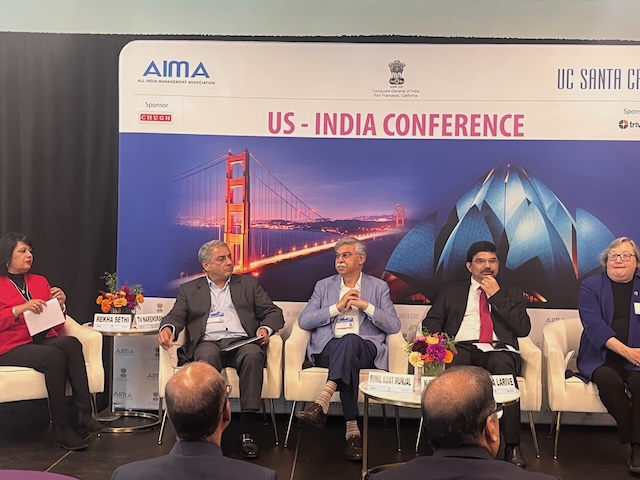
A delegation from the All India Management Association visited Silicon Valley in October to study the latest developments in artificial intelligence, biosciences and emerging technologies. The group participated in the 8th U.S.-India Conference at the University of California, Santa Cruz’s Silicon Valley campus on Oct. 7, which focused on U.S.-India tariff issues, AI and biohacking human health.
Sunil Kant Munjal, chairman of AIMA International and chairman of Hero Enterprise, said the association’s visits to Silicon Valley have become an annual tradition, interrupted only by the COVID-19 pandemic. The delegation, he said, aims to understand how innovation ecosystems like Silicon Valley work and what lessons can be adapted to India.
“We’ve been doing this for eight years,” Munjal said. “Our goal is to explore the latest innovations, particularly in technology and biosciences, as well as how technology is being used in manufacturing.”
He said the group examined companies working in generative AI, cybersecurity, drones, automotive technology and even new transportation ideas such as flying boats.
“Silicon Valley is the hotbed of innovation in the world,” Munjal said. He noted that what stands out most is the region’s ability to constantly reinvent itself. “Here, people have no hesitation in making themselves redundant by creating something new,” he said. “That mindset keeps them ahead.”
He said failure in Silicon Valley is viewed as part of the learning process.
“Failure isn’t shunned — it’s accepted and even celebrated,” he said. “People who fail are often encouraged to try again, and they get support when they do.”
Munjal said India is also in a transformative phase, growing rapidly while building both digital and physical infrastructure.
“Despite our 1.4 billion population, we are growing at 6.5 to 6.8 percent, which is remarkable for a large economy,” he said. “We’re now the fourth-largest economy in the world, doing something unique by building digital and physical infrastructure at the same time.”
He said the next challenge is ensuring that all parts of India progress equally. He pointed to government efforts to simplify business regulations, scrap outdated laws and decriminalize minor economic offenses to make entrepreneurship easier.
“Over 1,100 laws have been scrapped in the last few years,” Munjal said. “The shift is in the right direction, but we still have some distance to go.”
Munjal also highlighted the need to address challenges in agriculture, where nearly half of India’s population depends on farming but contributes a far smaller portion to GDP. He said subsidies in developed nations are many times higher than those in India, putting Indian farmers at a disadvantage.
Cynthia Larive, chancellor of UC Santa Cruz, said she views the current tariff tensions between the U.S. and India as temporary.
“It remains to be seen, but I think it’s a bump for now,” Larive said. She described India as one of America’s most important partners and praised the shared democratic values between the two nations. She also credited the Indian diaspora in Silicon Valley for driving innovation and leadership in global companies.
Larive said that while international student numbers have dipped slightly, the university expects the decline to be short-lived.
“Most of our students from India were able to get their visas,” she said. “Only two had delays, and both will start soon.”
She added that families abroad are increasingly concerned about affordability, outcomes and student safety.
“Parents want to know that their children will be safe, get a good education and have opportunities after they graduate,” she said.
Rekha Shetty, director general of AIMA, said she believes the U.S.-India relationship remains strong despite trade tensions.
“We both need each other,” Shetty said. “This relationship has been built over 25 years, and little differences aren’t going to make a major impact.”
She said both countries are already working to resolve the tariff issues and continue to cooperate in sectors such as space and defense.
“It’s work as usual, except for this bump on tariffs,” she said. “I’m sure both governments will resolve this very soon.”
Shetty said agriculture remains a sensitive issue in trade talks but expressed confidence that negotiations will find common ground.
“The U.S. understands that there are certain areas where India cannot easily negotiate,” she said. “But the dialogue is continuing.”
She also noted that India is pursuing free trade agreements with the United Kingdom and the European Union while deepening ties with BRICS nations.
“India is a huge market, and there’s tremendous global interest in working with us,” she said. “This is just a hiccup, and we’ll get over it.”
On the topic of AI, Shetty said AIMA has embraced the technology across its operations and training programs.
“AI has become a buzzword worldwide,” she said. “It’s not AI that will take away jobs — it’s people who know AI who will take the jobs.”
She explained that AIMA quickly transitioned to digital platforms during the pandemic and continues to help members adopt AI-driven tools.
“We pivoted to online testing and digital events in just two weeks during COVID,” she said. “Now, AI is the next step forward, and my team is ensuring they are up to par.”
P.K. Agarwal, dean of UC Santa Cruz Extension in Silicon Valley, said the conference fostered valuable discussions about trade, education and technology.
“We’re looking at where the opportunities are and how to move forward,” Agarwal said. He described the current U.S.-India tariff negotiations as part of a larger global economic realignment.
He said enrollment trends are shifting as some international students hesitate due to uncertainty, but interest in AI-focused programs is increasing.
“Every single program now includes AI,” he said. “Those who aren’t AI-ready will lose jobs to those who are, but new kinds of roles will emerge over the next few years.”