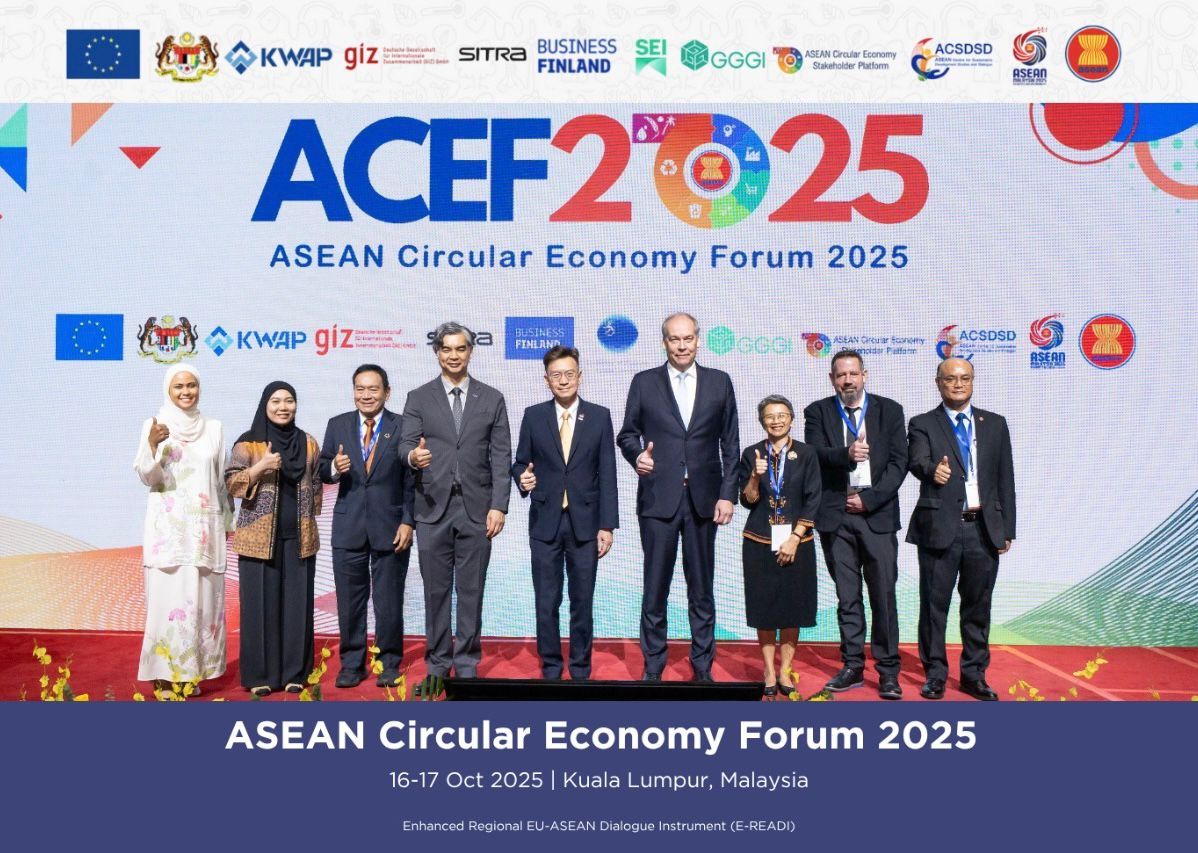
A Stronger Circular ASEAN: Highlights from the ASEAN Circular Economy Forum 2025
Hundreds of changemakers unite to advance ASEAN’s circular transition with EU support
Kuala Lumpur became the hub of Southeast Asia’s circular economy movement as more than 200 policymakers, business leaders, innovators, and development partners from across ASEAN and Europe, joined by another over 300 participants online, came together for the ASEAN Circular Economy Forum (ACEF) 2025, held on 16–17 October as the highlight of ASEAN Circular Economy Week.
Organised under the theme ‘Accelerate the Circular Economy Transition in ASEAN with Green Skills, Innovative Solutions, and Investments,’ the forum reaffirmed ASEAN’s commitment to circularity as a driver of sustainable growth and regional resilience. The event was supported by the European Union (EU), reflecting the EU’s longstanding partnership with ASEAN in building a greener, more inclusive future, notably via the deployment of the EU Global Gateway in the region.
Accelerating the Circular Transition
The ACEF serves as ASEAN’s key platform for knowledge exchange, policy dialogue, and regional collaboration on circular economy. This year’s discussions focused on three urgent priorities:
Developing a skilled workforce equipped with green and circular skills,
Scaling innovative circular solutions, and
Mobilising finance for high-impact circular initiatives.
HE Dr Kao Kim Hourn, Secretary-General of ASEAN underscored circularity as environmental and economic imperative. Through innovative approaches to the production, consumption, and reuse of resources, ASEAN can effectively recover substantial materials, generate revenue, create new employment opportunities and enhance self-sufficiency. He noted, “ASEAN confronts serious challenges: resource depletion, unsustainable consumption patterns, accelerating climate change. Rapid urbanisation and rising consumption continue pressuring our ecosystems.” HE Dr Kao Kim Hourn continued, “The circular economy presents a genuine alternative – one that maximises resource efficiency, enhances resilience, and supports deeper regional integration. ASEAN has already built strong foundations for this transition.”
Dialogue, Innovation, and Partnership
The forum showcased examples of good practices and scalable models from ASEAN Member States and international partners. Participants explored the feasibility of regional certification systems for circular skills, new investment approaches to support circular SMEs, and policy mechanisms to embed circularity in national development plans.
A highlight of the event was the multi-stakeholder dialogue co-organised by the ASEAN Circular Economy Stakeholder Platform (ACESP), the Stockholm Environment Institute (SEI) Asia, and the Global Green Growth Institute (GGGI). The session identified concrete actions and recommendations for ASEAN’s circular roadmap and examined how to balance economic growth with environmental and social objectives.
Participants underscored that achieving circularity requires education, innovation, and investment working in harmony, alongside strong local ownership of initiatives supported by development partners such as the EU.
Partnerships in Motion
Momentum for the forum began earlier during ASEAN Circular Economy Week (14–15 October), with partner-led events co-organised with ASEAN and the EU.
A major milestone was the launch of the SEA-MaP Regional Platform for Innovation and Investments, led by the ASEAN Secretariat and financed by the World Bank, connecting corporates, startups, and investors to scale plastic circularity solutions.
Meanwhile, the Finnish Innovation Fund Sitra, through the EU Circular Economy Resource Centre (EU CERC), together with the Embassy of Finland in Malaysia, Business Finland and Enabel hosted a side event on Circular Business Models, strengthening ASEAN–EU collaboration and showcasing the power of cross-regional partnerships.
HE Sujiro Seam, EU Ambassador to ASEAN stated, “The ASEAN Circular Economy Forum is the clear evidence of our dynamic win-win partnership.” He summarised, “Through the strategic approach of the EU Global Gateway, we are transforming our shared vision into concrete actions: mobilizing investment, sharing policy know-how, and prioritising the green skills needed to shape a sustainable future for both ASEAN and the world.”
A Shared Future
As ACEF 2025 concluded, participants expressed renewed determination to deepen ASEAN–EU collaboration in advancing a circular economy that is inclusive, innovative, and investment-ready.
Through the continued support of the EU, the forum reinforced the shared commitment of both regions to accelerate the circular transition, anchored in knowledge exchange, mutual learning, and joint action.
Driven by the Global Gateway strategy, the EU is committed to mobilise investment in people and innovation to support ASEAN’s green transition. The circular economy model is a vital cornerstone in shaping value chains for a more competitive global market. Global Gateway provides opportunities to work together on harmonising standards, certification, and traceability. Global Gateway also enables support to the development of green skills that are needed for the circular jobs of the future, including vocational training and higher education exchange.
Read more about Global Gateway:
https://commission.europa.eu/topics/international-partnerships/global-gateway_en
Read more about Team Europe support to work on circular economy in Southeast Asia:
Access ACEF 2025 full highlights and agenda: acef2025.acsdsd.org/