When the clock struck midnight on Oct. 1, a battle began to unfold in Washington, D.C. It was not, as some may have hoped, about how to reopen the government. No, for better or — more likely — for worse, it was a battle of memes.
President Donald Trump set the stage on the evening of Sept. 29, posting a video of Democratic leadership featuring manufactured audio on Truth Social.
To the tinkling of mariachi trumpets, (a fake) New York Sen. Chuck Schumer announced outside the White House, “Look guys, there’s no way to sugar coat it: nobody likes Democrats anymore.”
A somber (and fake) Rep. Hakeem Jeffries, D-N.Y., stood by Schumer’s side, sporting a voluminous mustache and sombrero. He nodded resolutely as Schumer shrugged and said, “We have no voters left because of our woke, trans (expletive).”
In Trump’s AI audio, listeners heard a fake Schumer talk about what Republicans believe about why Senate Democrats voted against Republicans’ continuing resolution ahead of the shutdown. “If we give all of these illegal aliens free health care, we might be able to get ’em on our side, so they can vote for us.”
It’s now been a month since the government shutdown began, and the Senate has voted 13 times against a continuing resolution to reopen the government.
Amid the serious discussions, there have been many not-so-serious moments, from both sides of the aisle.
Are Republicans winning the meme war?
Though the Republican Party is now led by a former (and some would argue current) entertainment star, the right’s knack for sarcasm and humor has not always been so fine-tuned.
For decades, the left seemed to dominate political comedy, from late-night talk shows to “Saturday Night Live.” Republicans were seen as pious, earnest and easily mockable.
But the tides have turned as the left’s approach to humor has changed. For example, humor like “SNL’s” “What’s That? It’s Pat” skit — because of its nod to gender identity — is no longer funny for many of those on the left.
It turns out that humor doesn’t care much about political correctness, and that’s made it tricky for Democrats.
Matt Whitlock, a political analyst who works with Republicans, told the Deseret News he believes Trump was a turning point for Republicans taking the lead in communications battles.
“President Trump sort of closed the gap (between Republicans and Democrats) by having this high volume barrage that had fewer limits, restrictions and guardrails on what he was willing to say,” Whitlock said. “That really knocked Democrats on their heels, and we haven’t seen a Democrat really effectively respond to that, in part because they just throw up their hands and don’t know what to do.”
And Trump’s boldness has emboldened his base, Whitlock added.
“Trump’s personality has sort of shown that if you’re not willing to aggressively stand up for your ideas and punch back, you’re going to find your voice diminished. So the Republicans right now who have found a strong voice are the ones who have done that,” he said.
Populism, self-deprecation and a willingness to be politically incorrect have placed meme victory firmly in the right’s hands.
For nearly a decade, being politically incorrect could get you fired from your job, publicly ostracized or banned from Twitter. And while some still get fired for sharing opinions that cross a line, Elon Musk ended most Twitter bans by buying the social media app and renaming it X. Those who were banned, including Trump, The Babylon Bee, Jordan Peterson and Kanye West, were allowed to return.
Trump’s social media directors are taking this newfound freedom to the next level.
The Department of Homeland Security and The White House regularly meme on ICE detainees, congressmen and the progressive left in general.
Republicans don’t just meme on their political opponents, they meme on themselves. Thousands of edited images of Vice President JD Vance took over the internet in early March. The meme started as an insult to Vance, but that changed when he embraced it — even making it his Halloween costume. And when South Park tried to take a hit at Charlie Kirk before he was killed, he changed his profile picture to his own caricature.
Humor, according to the scientific journal PNAS, occurs in situations of “benign violation.” In other words, to be funny, something has to threaten your belief about how the world should be and simultaneously be OK.
For progressives who do not find Trump’s posts funny, they most likely do not view the situation as benign, and perhaps that is the bigger issue as to why the left appears to be losing the meme battle.
The often-used phrase, “Trump is an existential threat to democracy” may prevent anything he does from being perceived as funny by those who oppose him.
As one Reddit user put it, the “left really aren’t funny, everything is offensive, everything is bad, they’re too serious about nonsense that doesn’t matter.”
Is the left winning the meme war?
Nobody enjoys being the punchline of a joke, but in the internet age what’s more embarrassing than the joke itself is being a poor sport about it.
Since Sombrero-gate, pundits have mocked Jeffries and other Democrats’ responses to the White House’s memes.
“The Democrats don’t know what to do in response,” RealClearPolitics host Tom Bevan said on “The Megyn Kelly Show.” “Democrats don’t know how to meme. They can’t meme, and Republicans — and Trump in particular — and the MAGA folks have mastered the art, and they continue to do it.”
A couple of days after the White House put mustaches and sombreros on Democratic leaders, Jeffries said the deepfake video was “racist and fake.”
“Mr. President, the next time you have something to say about me, don’t cop out through a racist and fake AI video,” Jeffries said to reporters with Democratic lawmakers standing in solidarity beside him. “When I’m back in the Oval Office, say it to my face.”
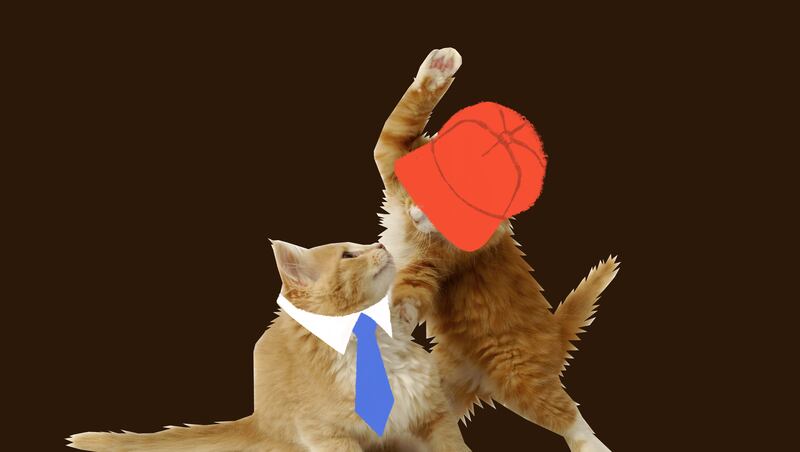
How did Trump respond? With a deepfake video of him throwing a MAGA hat on what appears to be Jeffries’ head. To the tune of the YMCA.
This isn’t the only time in the last month the Democrats have struggled in the ongoing meme war.
“If a meme war was what Republicans wanted to turn the shutdown into, Democrats decided, it’s a meme war they would get,” The Free Press writer River Page wrote. “It didn’t go well.”
On Oct. 1, the Democratic Party’s official X account posted a video explaining their take on the government shutdown using kittens. Instead of coming off as humorous, some in the comments felt it was a sign of leadership dumbing down the message for the American people.
“Republican and Democrat kitties cannot agree on what should be funded,” a generic AI voice-over says with a video of two kittens standing in front of the Capitol building — the Republican kitten depicting Trump. “Democrat kitties want you to have health care. Republican kitties do not.”
Comments under the video showed the audience wasn’t pleased. “Holy crap I thought Gavin Newsom’s meme was bad, what is this nonsense?,” one user wrote. “The left can’t meme. They don’t comprehend the magic of it,” another said.
Whitlock said Newsom’s memes have been the closest thing on the left to rival Trump’s meme success, like a chubby Vance at the club or Trump’s face on Marie Antoinette’s body.
But Whitlock sees it as an attempt to mimic what President Trump is doing.
“I think the problem with it is it’s not genuine,” he said. “And he’ll say, ‘you don’t get the joke,’ but how many times can you try and explain a joke before you just have to admit that it’s not funny?”
On Day 2 of the government shutdown, “The Daily Show” host Ronny Chieng shared two videos made by Democratic lawmakers pretending to look for Republican lawmakers in a vacant U.S. Capitol building.
“No Republicans here because they all died from secondhand embarrassment,” Chieng said. “Look, Democrats aren’t as good at video content as they are at sending emails asking for money. So I don’t know. Let’s try something else.”
Whitlock suggested Democrats are struggling because they worry about offending some of their voters.
“Democrats still live in fear of being canceled by each other,” Whitlock said.
The dark side of meme culture
In a TEDx talk last year, Muzhaffar Hazman, an AI and social media researcher from the University of Galway, explained that memes can be harmless jokes, and they can be drivers for change — but they can also be “effective vehicles for hate.”
They “have become a cornerstone of social media and how we interact with each other online,” Hazman continued, and it’s not always connecting over innocent humor.
In the last three months, the U.S. has witnessed many instances of political violence, including the death of innocent children attending a school Mass and the assassination of conservative activist Charlie Kirk. In both instances, memes were carved into the weapons that were used to take lives.
“Remember how I was engraving bullets?” alleged Kirk shooter 22-year-old Tyler Robinson said in a text exchange with his partner, according to court records. “The (expletive) messages are mostly a big meme, if I see “notices bulge uwu” on fox new I might have a stroke.”
Not even a month before Kirk’s assassination, 23-year-old Robin Westman, a transgender person who was born Robert Westman, opened fire at a Catholic church in Minneapolis where schoolchildren were praying, killing an 8-year-old and a 10-year-old and injuring many more.
The Minnesota shooter wrote several meme phrases on his weapons that he showcased in an 11-minute video allegedly posted by Westman hours before the attack including “I’m the Woker, Baby, Why So Queerious,” “skibidi,” “nothing ever happens” and “we live in a society.”
“Memes don’t just spread or convey hateful messages; they (can) trivialize that hate by incorporating it into the humor of the meme itself,” Hazman said. “They normalize it by giving the people who came up with these memes a way to connect with others who think” similarly.
Political cartoons morphed to political memes — what’s next?
Whitlock told the Deseret News he believes political memes are the natural evolution of political cartoons.
“I think (political memes) will continue to evolve as technology evolves, but I think they’ll be a core part of our messaging and storytelling forever because of how helpful they can be in explaining personalities or policies. A picture is worth a thousand words, and I think memes are a big part of that,” he said.
In the American Revolution, political cartoons were used for effective storytelling. Widely circulated etchings like “Join Or Die” and “Scotch Butchery” helped convince colonial Americans fighting a war for sovereignty was necessary.
Political cartoons also took center stage in the French Revolution, waged just six years after the United States rid itself of British rule.
As the French Revolution began to boil, critics put satirized versions of the royal court in pamphlets and newspapers to rally the poor into seeing their own oppression.
Cartoons of French Queen Marie Antoinette turned her into a symbol of the wasteful royal class. Antoinette was publicly guillotined in 1793, joining 17,000 other men and women who were officially executed during the “Reign of Terror.”
In 2025, some may expect the news and media to be more “advanced” than it has ever been, but perhaps society hasn’t changed all that much, two centuries removed from the French Revolution.
The people want (and have always wanted) to be entertained, even as they’re informed. Republicans and Democrats are trying to cash in that desire.
But at some point, Americans across the political spectrum won’t find it funny anymore. For those going on five weeks without a paycheck, “Let them have memes” may not be the right answer.