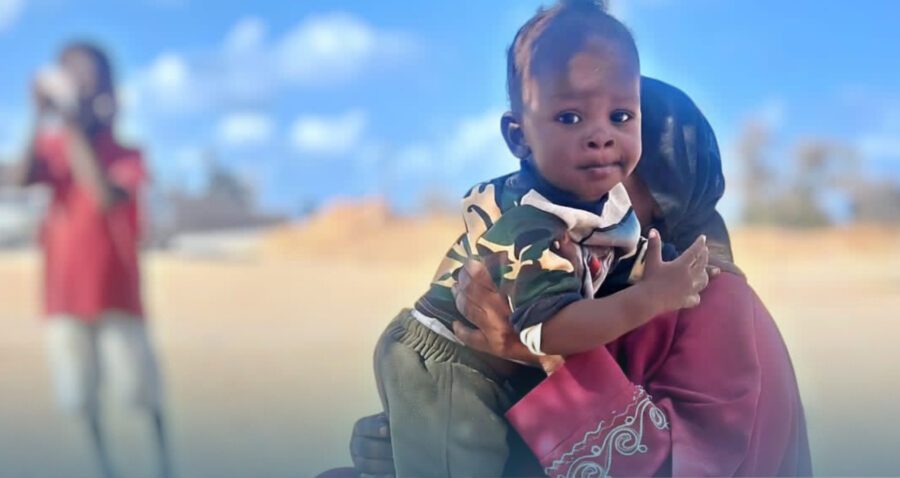
Tripoli – The children of irregular migrants in Libya are living in a tragic situation that reveals significant legal and humanitarian loopholes. These children, born in public hospitals or in random “camps,” face an uncertain fate amidst the absence of an official database, confronting the state and society with a complex humanitarian and security crisis that requires urgent strategies to protect them and guarantee their fundamental rights.
-The Effects of Conflict and Wars
The war in Sudan since April 2023 has led tens of thousands of civilians, including accompanied and unaccompanied children, or those born during the journey, to seek refuge in Libya. Migrant women often do not speak Arabic or English, which increases the likelihood of exploitation. Likewise, the absence of an official database and the proliferation of “camps” leave these children without protection or identity documents, exposing them to exploitation and marginalization, and necessitating an urgent and comprehensive solution.
-Births without Identity
The number of migrant children in Libya is unknown, with estimates ranging from tens to thousands, and no official body possesses an accurate database on them. Most of these children were born in public hospitals and private clinics, while many others remain in “camps” scattered on the outskirts of major cities, where facilities are shared and living conditions are harsh, without identity documents or legal protection.
Nigerian Aminata Othman sat on the sidewalk of a shop in Ghot al-Sha’al, west of Tripoli, holding her six-month-old baby, asking passersby for charity to provide him with food and care. She mentioned that she gave birth to the child in a “camp” in the city of Janzour, and that her husband took to the sea five months ago heading for Italy, and she has not heard from him since. Aminata is not alone; many Nigerian and Sudanese women in Libya face similar circumstances, putting their children at risk of exploitation or begging from a young age.
Researcher Salem Imjahid explains that migrant women pose a double risk to society compared to men. They sometimes seek to become pregnant to obtain asylum or win the sympathy of the community, and they face risks of sexual exploitation and work in difficult conditions, whether inside or outside detention centers. He added that children of unknown parentage or orphans who are abandoned for any reason constitute a humanitarian and legal crisis that the Libyan state will face in the near and long term.
-The Rampant Phenomenon of Begging
The phenomenon of migrant children, of both genders, carrying newborns on their backs or selling water bottles and paper tissues on the roadside has become a familiar sight in Tripoli and other Libyan cities, day and night. These children grow up in an extremely harsh environment, where they are forced to work from an early age to provide for their families or for exploitative purposes run by local and foreign networks, making them vulnerable to human trafficking or falling under the control of criminal gangs.
Imjahid confirms that foreign and Libyan non-governmental organizations from civil society play a dual role in caring for pregnant irregular migrant women by covering the costs of their childbirth in private clinics. This process appears humane on the surface, but at the same time, it poses a threat to the Libyan social fabric, as children of unknown parentage become part of society without official registration, raised in an environment that does not guarantee their rights or provide them with the necessary education or protection.
Yamis Aniki, a twenty-five-year-old Nigerian, said she gave birth to a baby girl last week at Al-Jalaa Hospital for Women and Obstetrics and left after one day. However, she returned three days later due to infections resulting from the cesarean section to continue receiving treatment. She explained that she left her daughter with a friend in a house where four Nigerian families live, each in a single room, because her husband works in a workshop and cannot care for the baby, which underscores the difficulty of living and the absence of official and community support.
According to the annual report of Al-Jalaa Hospital for Women and Obstetrics, the number of births to foreigners in 2024 reached about 1,061 cases, while 632 cases were recorded in the first half of 2025. These official figures from a single hospital in Tripoli raise concerns about the true scale of migrant children throughout Libya.
Nader Al-Thulib, a consultant in obstetrics and gynecology and the hospital’s general director, said: “Most cases arrive without any papers or proof of identity. Doctors face challenges related to detecting infectious diseases such as hepatitis and HIV, as it requires accurate registration and reporting to the authorities, with communication difficulties due to language differences. Often, the patient is alone and unaccompanied.”
Al-Thulib affirmed that the hospital deals with newborns of unknown parentage according to established legal procedures. The mother and newborn are registered, and a birth certificate is issued upon discharge. In cases where the father’s nationality is unknown, the mother is investigated by the security center attached to the hospital, but the authorities are often forced to release the mother and her child due to the impossibility of returning them to their home countries, which increases the legal and humanitarian complexities of this phenomenon.
-Legal Challenges
The issue of children of irregular migrants, especially those of unknown parentage, in Libya represents one of the most complex legal and humanitarian issues facing the state. According to Sumaya Al-Mizoughi, a legal consultant for the Civil Status Authority, a child born in Libya to a migrant mother of known nationality is attributed to his mother and is not granted Libyan citizenship under any circumstances. In contrast, newborns who are abandoned in public places without knowledge of their father or mother are registered, placed in care homes, and granted citizenship according to the law. These official procedures create a significant gap between the law and reality, as the actual number of these children is far greater than those who are documented, increasing the risk of them slipping onto the streets and into dangerous environments.
Abdul Rahim Al-Shaibani, head of the Libyan Academy for Governance, points out that monitoring these children under the current situation is almost impossible. This will lead to their proliferation on the streets, becoming a burden on Libyan society and a potential threat to neighboring countries and Europe, especially if the security-only approach persists without humanitarian or educational solutions. He adds that children who grow up without care or education become fuel for transnational organized crime gangs, including drug smuggling, human trafficking, sexual exploitation, and even organ trade crimes. They may also be exploited by terrorist or ideological armed groups, further complicating the country’s security and social landscape.
-Protecting and Integrating Children
The experiences of mothers like Awatef Abdul Rahman, a 35-year-old Sudanese mother of three, reveal the depth of the humanitarian crisis. She came to Libya five years ago from Nyala (South Kordofan) and faced the disappearance of her husband after giving birth to her third child, forcing her to beg to secure a life for her children. Awatef adds that the fear of arrest makes her choose areas far from the police while begging, which highlights the fragility of their legal status and the need for these children to have comprehensive protection, including shelter, medical care, and education.
Researcher Salem Imjahid believes that legal solutions must go beyond mere security or punitive measures to include legislation that organizes the care of newborns of unknown parentage and prevents their use in begging networks or their exploitation by human trafficking gangs. Among the legal and administrative proposals put forward by experts are: closing unlicensed facilities that use foreign female workers, preventing illegal money transfers, confiscating phones not registered in the names of citizens or legal residents, prohibiting the granting of Libyan citizenship under any pretext, deporting the mother and child together when possible, regulating the work of private clinics, combating administrative corruption and the complicity of some officials with smuggling networks, addressing weak border control, and establishing a special prosecution office to combat human smuggling.
In contrast, former diplomat Ali Maria believes that a security-only approach is insufficient. The phenomenon must be handled with wisdom and realistic diplomacy, or through parallel diplomacy, and by acknowledging the reality on the ground. He points to the necessity of registering the births of migrants of unknown parentage and enacting legislation that allows them to benefit from education and healthcare, to avoid them turning, over the years, into ticking time bombs that are difficult to defuse. He warns that neglect will multiply the social and security threats at the national, regional, and international levels.
Maria emphasizes the importance of adopting a comprehensive strategy that includes all concerned institutions, and taking urgent measures to reduce the influx of irregular migrant women by controlling borders and rigorously combating human smuggling gangs. He also stresses the rejection of any agreements that would make Libya a policeman for the European Union’s borders and the immediate withdrawal from any similar agreements to ensure the file is managed in a national and ethical manner.
-Future Options
The options available to the competent authorities in Libya to address the file of children of irregular migrants, especially those of unknown parentage, seem limited and extremely complex. They range from adopting strict measures to confront the repercussions of this phenomenon to enacting new laws that allow for the integration of these children into society. Experts and specialists have pointed to the need to look at the file with rationality and diplomacy, far from the security approaches that have proven their failure, both in Libya and in other countries facing a similar influx of migrants.
The first option proposed is to strengthen security and legal measures, starting with monitoring births of unknown parentage, closing unlicensed facilities, monitoring private clinics that provide delivery services to migrants, preventing the use of children in begging, and cracking down on human smuggling networks. These measures aim to control the phenomenon and prevent the worsening of security and social conditions, but they alone do not solve the humanitarian crisis, as the children remain without education or care, exposing them to slipping into crime and exploitation.
The second option is to adopt flexible legislation that allows for the integration of children into the formal health and education systems and provides them with legal protection. According to former diplomat Ali Maria, such legislation should include granting children the right to education, medical care, and legal residence, along with establishing central databases that include the biometric identities of children born in Libya to irregular migrant women. Maria notes that this option requires cooperation from countries of origin and European Union countries to ensure they bear their moral responsibility towards these children and provide financial and educational support to save them from the risk of slipping towards crime or exploitation.
-Involving the International Community
Experts also suggest involving civil society and international organizations in programs to support the children and their mothers, whether through establishing protection and rehabilitation centers, providing psychosocial support, or educational programs that include learning Arabic, local culture, and basic life skills. Such steps would create real opportunities for children to integrate into society, rather than turning into ticking time bombs that threaten the social and security future.
Field studies indicate that children born in “camps” are exposed from a young age to multiple risks, including begging, labor exploitation, physical and psychological abuse, and deprivation of education. Therefore, researcher Salem Imjahid believes that any successful national strategy must be comprehensive, combining legal deterrence and humanitarian integration, with a focus on the education and psychosocial health of children, and improving the living environment in migrant gathering areas.
On the other hand, experts stress the need for regional and international cooperation to combat human smuggling networks, pursue those who benefit from the phenomenon, close illegal entry points, and control borders as much as possible, while ensuring that humanitarian measures are a priority to avoid exacerbating the humanitarian crisis and increasing the suffering of children. Diplomats assert that the solution must be balanced between security, law, and humanity, taking into account the political and economic conditions the country is experiencing.
The human stories of mothers like Aminata Othman, Yamis Aniki, and Tala Saleh also confirm that integrating children and migrant women into society requires a clear national vision, which includes improving job opportunities for mothers, providing healthcare, and offering education for children from an early age, to ensure the formation of a generation capable of living with dignity, away from poverty, crime, and exploitation. Experts add that any delay in taking comprehensive measures could make these children the victims of the future, exacerbating social and security problems and threatening the stability of Libya and the region.
Specialists also recommend the necessity of involving the health, education, and civil society sectors in developing practical plans to care for migrant children, which should include programs for psychological support, nutrition, and basic education, in addition to qualifying mothers to face daily challenges. These plans emphasize the need for coordination with the African Union to support an accurate database, including children’s biometric identities, with the aim of ensuring their follow-up, providing them with appropriate care, and monitoring any attempts to exploit them in illegal activities.
In this context, the need for new legislation is urgent to ensure the integration of children into schools, giving them learning opportunities and skills that enable them to adapt to Libyan society. This would limit the risks of marginalization and dropping out of education and work, and prevent their exploitation in illegal activities or their descent into organized crime.
Addressing the crisis of migrant children in Libya requires a comprehensive national strategy that combines law, social care, education, and international cooperation, with a focus on protecting children from exploitation and abuse and ensuring their integration into society in a humane and responsible manner. At the same time, strict measures must be taken to combat smuggling networks, control borders, and prevent the increasing flow of irregular migrant women, thereby balancing security with human rights.
In conclusion, Libya faces a complex humanitarian, legal, and security challenge related to the children of irregular migrants, especially those of unknown parentage. The crisis calls for comprehensive strategies that combine legal protection, education, and healthcare, as well as the necessity of regional and international cooperation. Adopting effective integration programs will ensure the protection of children’s rights, prevent them from becoming victims of exploitation and crime, and enhance societal stability.