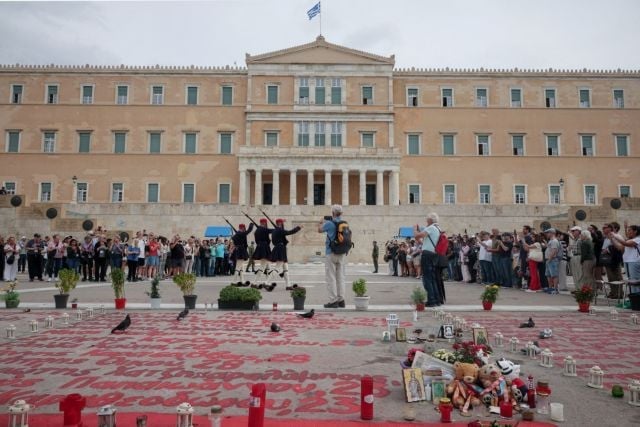
Visitors gather to watch the change of the guard at the Tomb of the Unknown Soldier, situated in front of the Greek Parliament, prior to a vote on an amendment banning protests and any alterations in the area, in Athens, on October 22, 2025.
It is odd that although Greek society is impressively homogenous, and though the great social and political questions that had occupied the country since its establishment have been solved, we never miss an opportunity to fight with each other. The monarchy was abolished; the language question was solved; old ideological differences are now insignificant; the country is living through the longest period of political stability in its history; the discussion on Church-State relations interests very few; the wounds of the Civil War are mostly healed.
So, one might ask, why is there always so much tension in our politics? However, if we examine the many problems that our society faces, and the way that our political forces manage them, the question is overturned: how is there even the slightest consensus when distrust is so prevalent in society? There we see how fertile the ground is for demagogues who, either because they can’t do otherwise, or through sheer cynicism, seek to shake trust in politics, in institutions – in democracy itself – even further.
Misinformation and propaganda in a fragmented news landscape encourage division as well as despair
Why such a lack of trust, though? Why do we tend towards division so easily? The reasons are many and they run through our history, beginning with the tradition whereby our political leaders seek to score points by destroying each other. This shaped a culture of conflict, a mentality in which compromise and consensus equal surrender or betrayal. This applies both to domestic politics and diplomacy, as tension in one sphere inflames passions in the other.
Furthermore, past periods of great polarization (the National Schism in 1915-22, the 1947-49 Civil War, the dictatorship in 1967-74) are dragged into current debates whenever someone wants to appear more “patriotic” or more “democratic,” or whatever, than the rest. The inability to reach consensus in politics reflects (and worsens) the lack of trust between citizens. The citizens observe and judge the politicians, and at the same time they must deal with chronic corruption, with an incompetent and malevolent state, with deprivation (either real or in comparison with others; because of repeated crises and an endemic lack of opportunities), and widening inequalities in a society which, admittedly, displayed less inequality than many others. Misinformation and propaganda in a fragmented news landscape encourage division as well as despair, leading to passionate conflict between few players as many citizens withdraw from politics and abstain from elections.
We note these points once again not as a lament but to suggest that the political forces that manage to inspire faith in democracy are the ones that will break the vicious cycle that feeds distrust and cynicism. Citizens need to see substantial victories against corruption, they must be given opportunities to participate in civil society (from school to old age). Politicians ought to introduce effective political and judicial reforms, to reinforce institutions (including the independent authorities whose authority has been shaken lately).
It must be clear that corruption will not be tolerated, that transgressors will be punished, that governments and the state have the best interests of citizens at heart (so that the citizens will not expect everything from “their own” party). When it appears that the polity places citizens – all citizens – at the center of politics, then they, too, will contribute to the effort, they will believe in something. The government has the need and the opportunity to persuade more citizens that it will work towards this. In any case, this great vacuum needs to be filled.