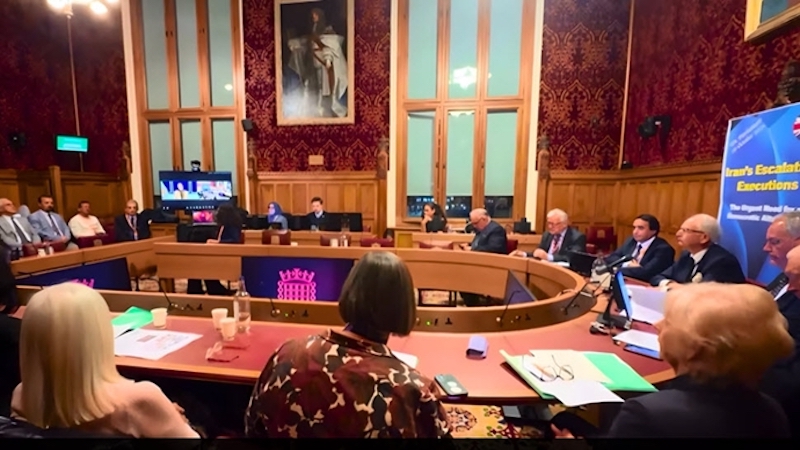
In a significant conference at the UK Parliament, a cross-party coalition of parliamentarians, human rights advocates, and members of the Anglo-Iranian community convened to address the escalating human rights crisis in Iran. The conference, which featured a keynote address by Mrs. Maryam Rajavi, president-elect of the National Council of Resistance of Iran (NCRI), focused on the regime’s alarming use of executions to suppress dissent and debated a new, principled international policy toward Tehran.
The event served as a powerful platform for speakers to condemn the Iranian regime’s brutality, call for accountability for its leaders, and voice strong support for the Iranian people’s organized resistance movement. The prevailing theme was the urgent need to move beyond words and implement decisive actions, including the proscription of the Islamic Revolutionary Guard Corps (IRGC) and formal recognition of the NCRI as a viable democratic alternative.
Mrs. Maryam Rajavi’s call to action
In her address, Mrs. Maryam Rajavi painted a stark picture of the situation inside Iran, describing the surge in executions as a political strategy orchestrated by Supreme Leader Ali Khamenei to forestall a new wave of popular uprisings. She reported that since the beginning of 2025, over 1,400 individuals have been executed, a figure she called “unprecedented in the past 36 years.” Mrs. Rajavi emphasized that these killings bypass any legitimate judicial process, with verdicts handed down by “professional killers” in sham courts.
She highlighted the specific targeting of the opposition, noting that 17 individuals are currently under threat of execution for their alleged ties to the People’s Mojahedin Organization of Iran (PMOI/MEK). Rejecting the regime’s narrative that it has no alternative, she presented the Iranian Resistance as the solution. “The mullahs have turned to mass executions to prevent the inevitable fall of their regime,” Mrs. Rajavi stated. “I am here to tell governments and international organizations that there is only one real way to stop the regime’s nuclear and missile programs and to stop its terrorism and killing machine. That way is the resistance of the Iranian people to overthrow the regime.”
Mrs. Rajavi urged the UK government and the international community to make continued relations with Tehran conditional on a complete halt to executions. She called for the proscription of the IRGC and for formal recognition of the Iranian people’s right to resist. “The fundamental solution lies in recognizing the right to resist and fight against the regime’s oppression for the people of Iran, especially the courageous and defiant youth,” she concluded.
A regime resorting to mass executions to survive
Speakers throughout the conference detailed the horrifying scale of the regime’s killing machine, a desperate measure to cling to power. Baroness Redfern noted that Iran is facing two defining realities: “a record number of executions and a growing wave of dissent.” She added, “The regime’s answer to every demand for justice is hanging. It uses the death penalty not as a law, but as a weapon, an instrument to crush opposition and silence the cry for change.” Baroness Redfern stated that since last year, more than 2,000 people have been executed, including women and political prisoners.
The conference drew urgent attention to specific cases of political prisoners facing imminent execution. Baroness O’Loan spoke of Zahra Tabari, a 67-year-old woman and university graduate sentenced to death for writing a slogan calling for freedom for women. “She has now been sentenced to death after a ten-minute trial, another of these show trials of the mullahs’ regime, and that is absolutely shocking and totally illegal,” Baroness O’Loan said, calling on the UK government to intervene. The case of Mohammad Javad Vafaei Sani, a young boxing champion whose death sentence was recently upheld, was also cited as a tragic example of the regime’s cruelty.
The systematic targeting of ethnic and religious minorities was another key point. Jim Shannon, MP, noted that the regime “disproportionately targets marginalized minorities, such as the Afghans, the Baluchis, and the Kurds,” and intensifies persecution of religious groups, including Christians, Baha’is, and Sunnis, under the guise of national security.
A call for a firm international policy and IRGC proscription
A strong consensus emerged among the parliamentarians that the era of appeasement must end and be replaced by a policy of accountability. Several speakers forcefully called for the proscription of the IRGC, expressing frustration with the UK government’s inaction. Lord Cryer labeled the regime’s leaders “clerical fascists” and criticized the UK Foreign Office for a “culture of more or less do nothing.” He recounted how the current government, like its predecessor, has cited complexities as a reason for not banning the IRGC, an excuse he dismissed as weak. “It’s about time a British government finally decided what its backbone was for and stood up to the Iranian regime and prescribed the IRGC,” he declared.
Lord McCabe echoed this sentiment, describing the IRGC as the engine behind the regime’s “doctrine of hatred designed to maximize repression and the sponsorship of terrorist atrocities around the world.” Mark Williams, a former MP, further detailed the IRGC’s role as a “transnational terror network,” citing its funding of Hezbollah and Shia militias, its supply of missiles to the Houthis, and its corrupt control over Iran’s strategic industries.
Beyond proscription, speakers demanded broader accountability measures. Bob Blackman, MP, urged the UK government to “refer the regime’s appalling human rights dossier to the United Nations Security Council for the prosecution of the regime’s leaders in an international tribunal.” Baroness O’Loan called for the use of universal jurisdiction to “seek arrest warrants and prosecute perpetrators, including the Supreme Leader Khamenei himself.”
Support for the NCRI as a viable democratic alternative
The conference presented a clear and unified message: a democratic alternative to the current regime not only exists but is organized and ready. Speaker after speaker endorsed the NCRI and Mrs. Rajavi’s Ten-Point Plan as the blueprint for a future Iran. Baroness Redfern described the NCRI’s commitment to human rights and women’s leadership as a “great source of hope” and stated that “supporting this movement is not only a moral duty, it is a strategic necessity for global peace and European security.”
Mark Williams passionately outlined the core tenets of the Ten-Point Plan, describing it as a “plan of hope for the future.” He listed its commitments to a pluralistic republic, universal suffrage, gender equality, abolition of the death penalty, separation of religion and state, and a non-nuclear Iran. “That is such an inspiring program,” he affirmed.
Lord Bellingham, in his introduction, praised Mrs. Rajavi’s “tireless” and “relentless” work “not for yourself, but for democracy, justice, for gender equality, and for the people of Iran.” A repeated call was for the UK government to officially engage with this alternative. Lord Carlile, who previously led a legal challenge on the matter, expressed his strong desire to see Mrs. Rajavi “come to The United Kingdom and address us” in person.
The unyielding spirit of resistance inside Iran
While the regime intensifies its repression, the conference highlighted how the Iranian people are responding with even greater defiance. Mrs. Rajavi described a resistance that is “growing across the country,” citing ongoing protests by workers, teachers, and retirees, as well as the expanding activities of Resistance Units. She noted that for 92 weeks, political prisoners have led a “No to Execution Tuesdays” campaign, a movement now active in 54 prisons.
The young Iranian activists in attendance gave powerful testimony to this spirit. Rosa Zarei, whose aunt was executed in the 1988 massacre, spoke for the women leading today’s protests. “Their courage carries the legacies of those lost in 1988,” she said. “Every act of defiance is a reminder that the spirit of resistance cannot be killed.” Neda Zabeti, who lost five family members to the regime, described the hunger strike of 1,500 death-row prisoners in Ghezel Hesar Prison as a symbol of the people’s unified message that “enough is enough.”
Sixteen-year-old Mehrnoosh spoke for Iran’s youth, who have been at the forefront of recent uprisings. “Girls like Nika Shakarami and Sarina Esmailzadeh were killed for demanding freedom, and yet their courage lit a flame that still burns across Iran,” she said. “Our generation carries its dream forward.”
A clear rejection of all forms of dictatorship
Parliamentarians made it clear that their support for the Iranian Resistance is rooted in a desire for a truly democratic republic, not a return to a previous autocracy. Bob Blackman stated plainly, “The people of Iran don’t want to return to the Shah. They don’t want a continuation of the theocratic regime.” This sentiment was echoed by Baroness O’Loan, who asserted that “the Iranian people are against the Shah’s dictatorship and against the mullahs’ religious dictatorship.”
Jim Shannon, MP, drew on a biblical metaphor to predict the regime’s downfall, concluding with a powerful historical parallel. “The people of Iran have sent the Shah’s dictatorship to the dustbin of history,” he said. “And soon, they will do the same to the mullahs’ regime. And may that happen sooner rather than later.”
The conference at the UK Parliament sent an unequivocal message: the international community’s policy toward Iran has failed and requires a fundamental reset. The event showcased a remarkable cross-party consensus that condemned the regime’s atrocities while simultaneously championing the organized, democratic resistance movement as the agent of change. The speakers collectively argued that supporting the Iranian people is not only a moral imperative but a strategic necessity for regional and global security. As Sir Roger Gale, MP, told the attendees, the regime’s escalating brutality is an “act of utter desperation, because they know they’ve failed.” He concluded with a note of optimism that captured the spirit of the evening: “I genuinely believe that the tide is running in your favor now. The time is coming when there will be democracy in Iran.”