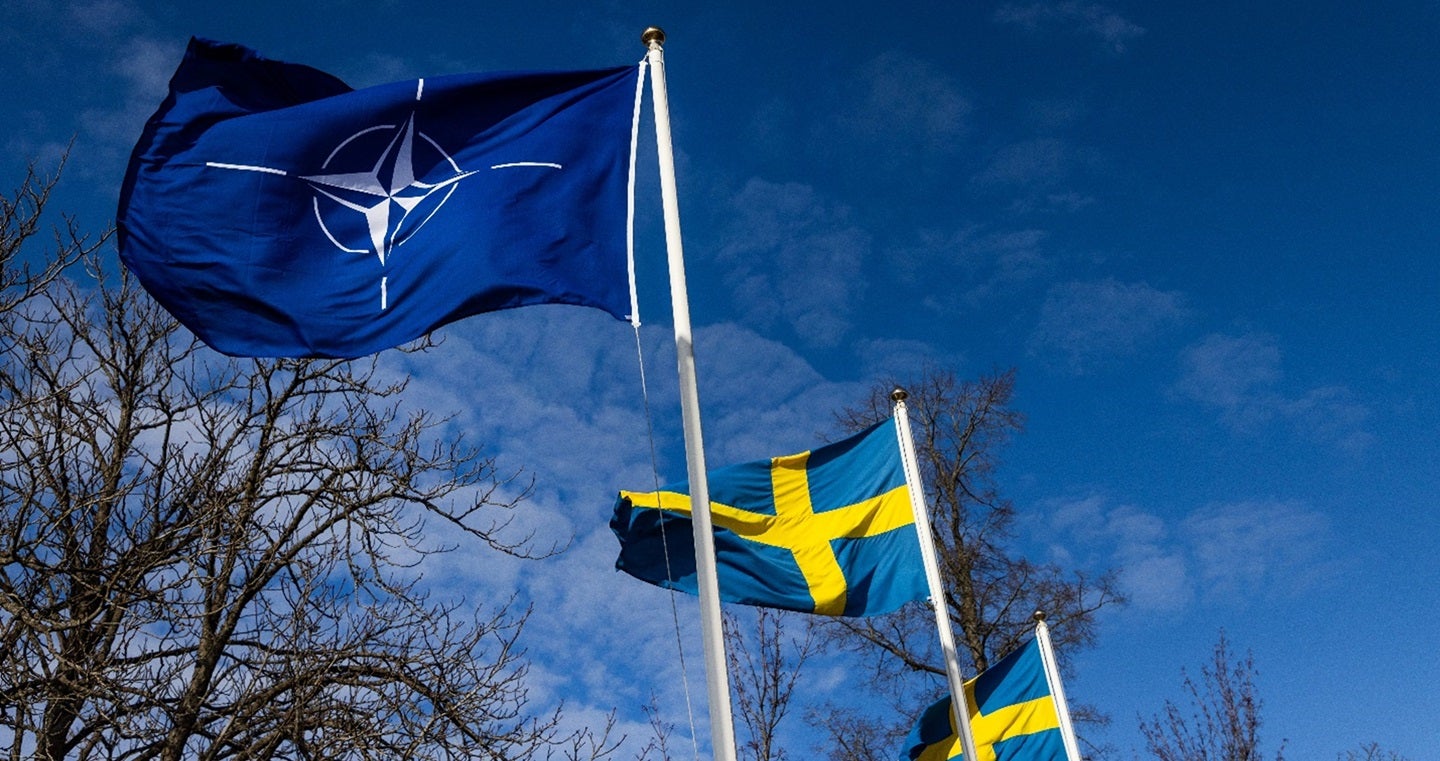

Nato and Sweden flags. Credit: Shutterstock/Jeppe Gustafsson.
Sweden will host a Nato conference on civil defence for allied military and civilian leadership through the first half of this week (3-5 November 2025) in Stockholm led by Ministers for Defence and Civil Defence, Pål Jonson and Carl-Oskar Bohlin.
It appears the Scandinavian country, which last year allocated Skr37.5bn ($3.9bn) to civil defence, is among the best placed countries to impart their knowledge on the subject, so often overlooked by nations where the Russian threat perception seems less invasive.
 Discover B2B Marketing That Performs
Combine business intelligence and editorial excellence to reach engaged professionals across 36 leading media platforms.
The gathering follows the June 2025 summit in the Hague, where allies adopted guidance to strengthen and develop civilian planning efforts. This was reflected in their defence spending, which was raised to 5% of a nation’s gross domestic product, up to 1.5% of which can be allocated to civil concerns like protecting critical national infrastructure – an obvious area of vulnerability in Europe at the moment.
For Nato, ‘civil preparedness’ is tied closely to core defence, and covers three related functions: continuity of government services, continuity of essential services for the population, and ensuring civil support for military operations.
In the end, the objective of the conference is to inform and promote civil-military collaboration. Panel discussions will take place, one will divulge details of Sweden’s latest assessment: ‘Planning assumptions for the development of the Swedish total defence 2025-2030’ while other discussions will focus on exchange of experience.
Disparate perceptions
Sweden has displayed remarkable fluidity between its military and civil defence. Through their conscription service, which was reinstated in 2018, it was said that 8,000 people would be enlisted in 2024, a target Politico said had been reached in July 2024.
But civil society offers more than just manpower. Sweden’s infrastructure supports heavier military platforms. The Air Force, for example, are able to take off and land Gripen fighter jets on reinforced roads.
This contrasts with continental efforts to build a military corridor running to Nato’s eastern flank. European auditors found that tanks from one EU country cannot move through another if they are heavier than road traffic regulations allow. Under normal circumstances, an EU country currently requires 45 days’ notification of cross-border movement authorisations.
The UK has a strikingly dissimilar conception of civil defence. In discussions among military officials and experts at the Royal United Services Institute in December 2024, it was suggested that the country must move away from considering its reservists as an appendage to regulars.
General Jim Hockenhull, commander of Cyber and Specialist Operations Command, held that the military ought to see the strategic value inherent in the reserves in any case, not to lean on them on an ad hoc basis in times of crisis.

Sign up for our daily news round-up!
Give your business an edge with our leading industry insights.