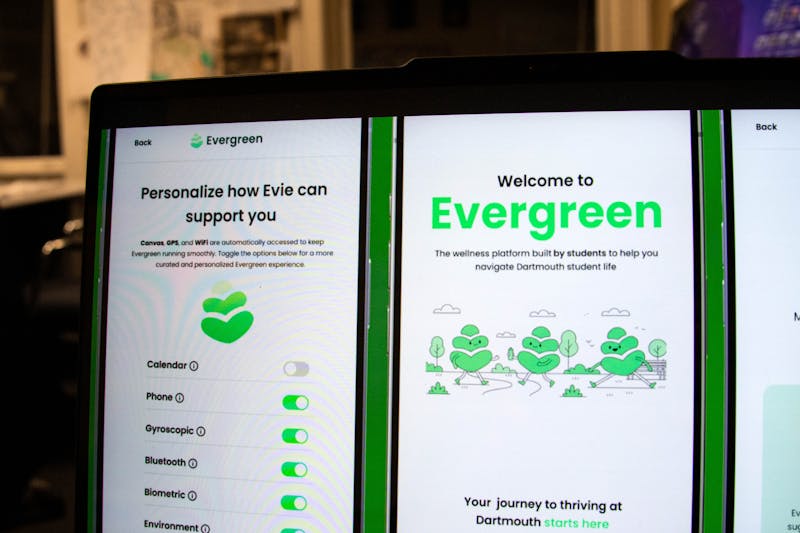
Evergreen.AI — currently being built at Dartmouth — promises to be the world’s first first college-specific wellness artificial intelligence. The price tag? $16.5 million, according to the project website.
The project is funded entirely by parent and alumni donations, according to Center of Technology and Behavioral Health at Dartmouth director Lisa Marsch. The AI program, which is still in the development stage, has raised $5 million so far from “dozens” of alumni and parent donations, Marsch said.
“Everything is philanthropy, no existing Dartmouth resources are being allocated to it,” Marsch said. “It’s all additional funds being raised, and it’s heavily from Dartmouth alumni and Dartmouth parents … who believe in the importance of this.”
Dartmouth publicly launched a fundraising campaign this January after a “quiet phase” of fundraising first, according to Marsch.
Donations to Evergreen will go towards “research infrastructure, data support, contract programmers, business development, incentives for student engagement in co-development as well as student design participation,” according to its website.
The $16.5 million price tag is split between $7.5 million for the initial two-year “launch period,” from 2025 to 2027, and an additional $9 million “to complete the project and disseminate it beyond Dartmouth.” Marsch said there are currently “no plans” to commercialize it, but that it could have “real value” on other campuses.
Marsch said Evergreen’s “multi-year” development is to ensure “safety.”
A year-long closed beta-test, where 200 undergraduates will test the AI, is scheduled for 2026. An institutional review board will evaluate if the app is helpful in improving student life. Based on the feedback from that test, Evergreen will determine next research steps, according to Marsch.
“That time investment is really, really important, so that ultimately, we want to know that this has value to a student, and if it doesn’t, then we have to pivot and change direction and so testing is the way we do it,” Marsch said.
According to Marsch, roughly 60% of their current $5 million budget is funding over 130 undergraduate positions. The majority of student employees are project assistants who are then split into teams, overseen by project managers, focusing on different aspects of Evergreen, including user interface, animation and content creation.
Undergraduate students are paid $16.25 per hour and most work 12-20 hours a week.
Student employees introduce the AI to scenarios that are specific to Dartmouth and “are developing a lot of content,” Marsch said.
“Dartmouth students are incredible, but they have an intense desire to perform academically,” Marsch said. “And so sometimes people can have negative thinking. There’s a lot of tools that ask how do you tackle negative thinking and reframe it? So those stories and examples are coming from Dartmouth students.”
Students working for Evergreen said in interviews with The Dartmouth that they have had positive experiences with the program. Jennifer Li ’27, a product manager, said working on the project has been “pretty great.”
“I’m pretty privileged to be working through DALI with a specific team of students every term with people who are returning and new,” Li said.
Vafa Batool GR, a graduate student in the Computer Science department, works in the engagement team for Evergreen. She is paid a stipend and works 2-3 hours a week.
“We are looking at some of the best practices for this app to be effective,” she said.
Luisa Michel ’29 who has recently joined the team this fall and is now a project manager for content creation said she enjoyed the “flexibility” of her work schedule.
The remaining funding is distributed to faculty and hired professionals involved in the work. Faculty with expertise in digital health, computer science, privacy and security, user design and interface and behavioral health support the students in this work as well as several professional developers, research coordinators and graduate students and post-doctoral fellows.
Another “big” piece of the current $5 million budget went to purchasing servers that are housed on campus, in an effort to ensure data privacy, according to Marsch. Marsch explained that they “invested” in servers because “data privacy is a top priority.” Marsch added the College will not have access to student data stored in the servers.
“We bought all the servers to sit here at Dartmouth so no third party touches any of the data,” she said.
Marsch declined to comment on the specific cost of the servers or their location on campus.