The Latvian president has ordered the national parliament to reconsider a bill that would withdraw the country from a European treaty opposing violence against women, after protests in the capital.
The Baltic state is flirting with becoming the first European Union member, and only the second nation, to pull out of the Istanbul Convention, after Turkey did so in 2021.
The treaty, which was finalised in 2011, obliges countries to enact a body of laws criminalising acts such as marital rape, stalking and the psychological abuse of women, and to provide shelters and other support services for victims of domestic violence.
It is under the aegis of the Council of Europe, which also oversees the European Convention on Human Rights.
So far it has been ratified by 38 of the council’s 46 member states. Notable exceptions include Hungary, Lithuania and the Czech Republic.
Critics of the convention have primarily taken issue with its definition of gender as a “socially constructed” phenomenon. They argue that this amounts to a legal Trojan horse for trans rights activism and non-traditional forms of gender identity, although the Council of Europe insists these concerns are unfounded.
When President Erdogan announced Turkey’s withdrawal from the treaty, he claimed it had been “hijacked by a group of people attempting to normalise homosexuality”.

Police clash with women protesting against Turkey’s decision to pull out of the convention in 2021
ASIN AKGUL/AFP/GETTY IMAGES
Latvia only ratified the convention two years ago, largely because parties on the right had previously portrayed it as an assault on social norms.
At the end of October its parliament, the Saeima, voted to reverse this decision after the agrarian Union of Greens and Farmers party broke ranks with the ruling coalition and sided with the opposition.
The campaign has been driven by Ainars Slesers, an oligarch and former transport minister who is frequently called a Latvian President Trump, and his right-wing populist Latvia First party.
During a rancorous 12-hour debate, a senior Latvia First MP claimed that the treaty had brought “foreign ideology creeping into our everyday lives”.
However, politicians from the left-liberal Progressives party said the opposition to the treaty had been whipped up as a form of “hybrid warfare” and that the vote would “haunt” the parliament for years to come.
• The state of the EU shows there’s still much to play for
Some Latvian analysts suggested that the Putin regime might have had a hand in swaying the result, whether by conducting disinformation campaigns against the treaty or through clandestine influence on Latvia First and other opposition parties.
Una Bergmane, a Latvian historian at Helsinki university, noted that the political turmoil “fits perfectly into the Kremlin’s playbook”.
Evika Silina, the centre-right prime minister who oversaw the ratification of the convention, said the battle against domestic violence would continue: “We will not give up, we will fight so that violence does not win.”
Diplomats from 15 other European countries had warned Latvia against pulling out of the treaty and there are concerns that the vote could encourage similar campaigns in other states.
The hard-right party Alternative for Germany, for example, has characterised the Istanbul Convention as an instrument of “ideological gender warfare”.

President Rinkevics
RICCARDO SAVI/GETTY IMAGES FOR CONCORDIA ANNUAL SUMMIT
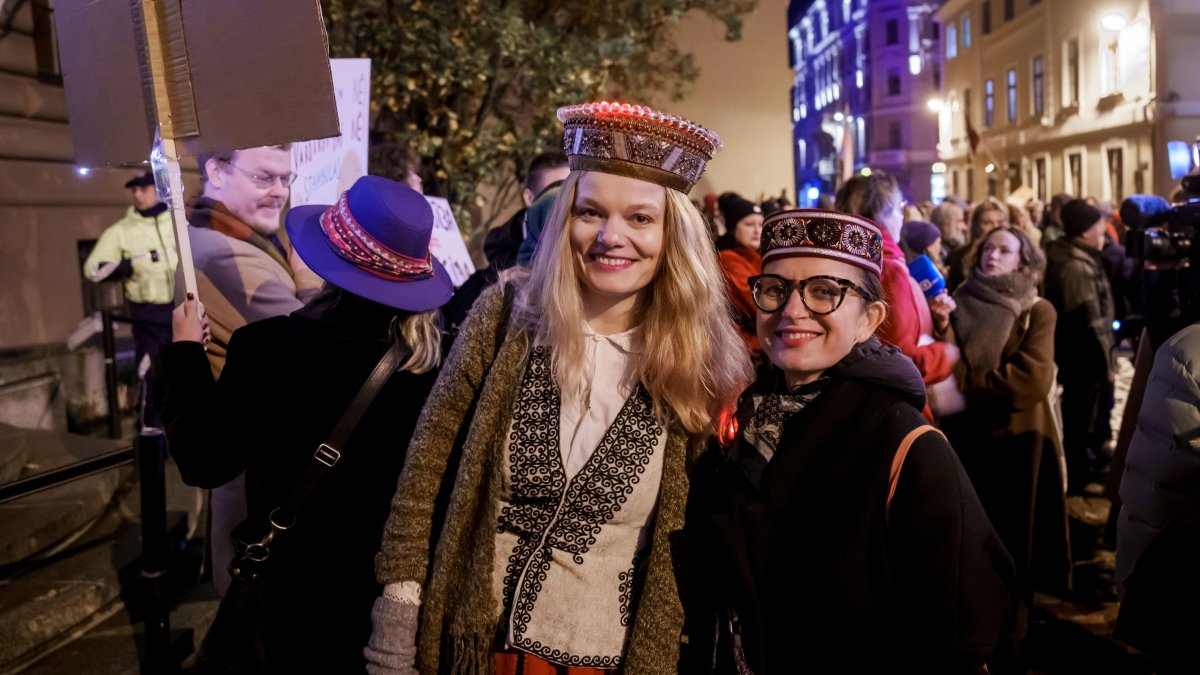
Within Latvia, more than 5,000 protesters marched through Riga in a demonstration against the decision.
Over the past four days, 66,000 people, or nearly 4 per cent of the country’s population, have signed an online petition calling on President Rinkevics to refuse to approve the law. It is the largest such campaign on record in Latvia.
In response, Rinkevics sent the bill back to the Saeima for review, saying that it risked giving “contradictory messages” to the country’s allies and its own society about “Latvia’s willingness to fulfil its international obligations in good faith”.
“It should also be taken into account that Latvia would be the first European Union member state to withdraw from an international human rights treaty,” the president wrote in a letter to the parliament’s speaker.
Rinkevics suggested the issue should be resolved by MPs after the next general election, which is due to be held in October 2026.