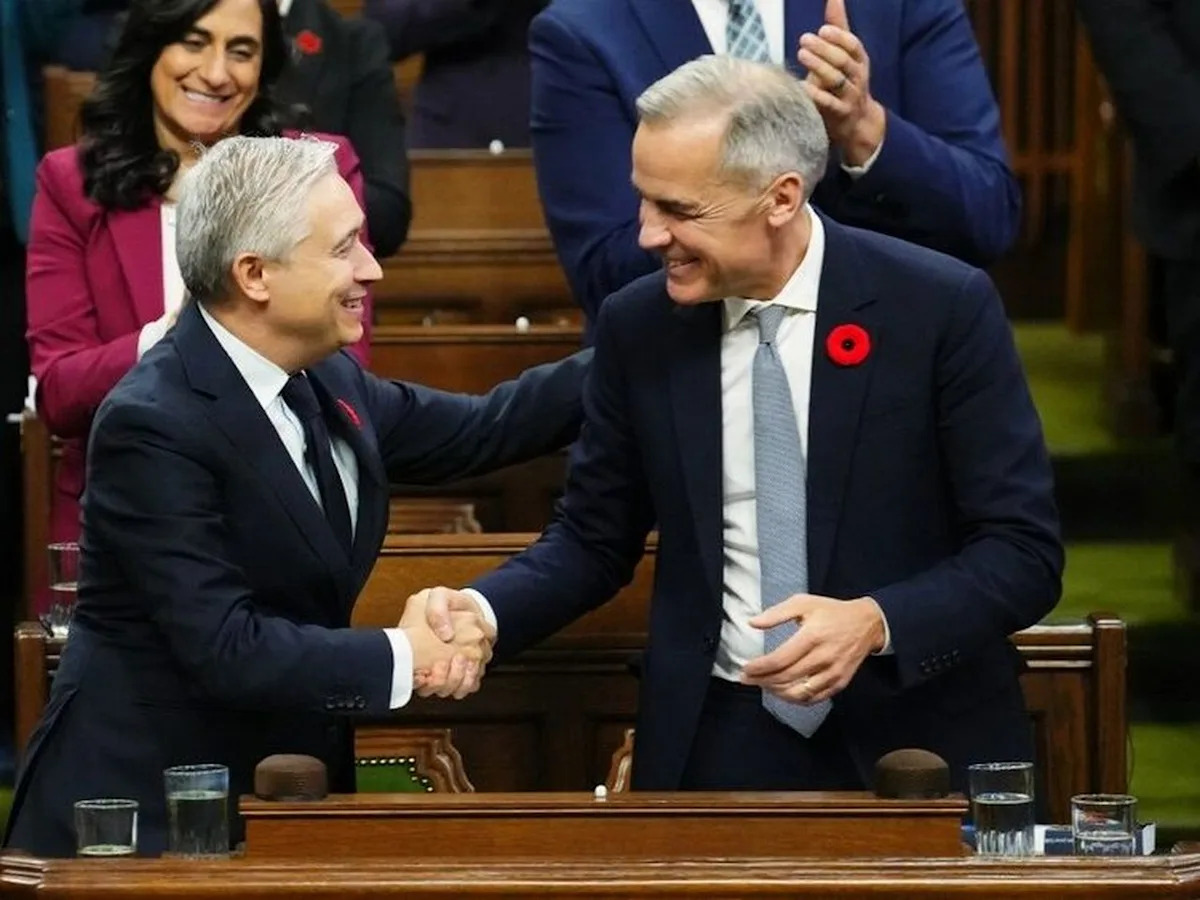
The deficit is up, spending is up despite claims of savings and austerity, and the cost of servicing Canada’s debt is more than what the federal government spends on health. Mark Carney’s first budget wasn’t about austerity; it wasn’t a generational shift; in fact, it wasn’t what was advertised in any way shape or form.
That doesn’t mean there aren’t worthwhile measures, but this is another example of the Carney government overselling and under delivering.
The annual spending deficit is up dramatically. Coming in at $78.3 billion, the figure is more than double the $38.9 billion deficit the government projected in the 2024 budget, and still far more than $42 billion projected in the Fall Economic Statement tabled last December.
The government is projecting that revenues will come in at $507 billion, about $4 billion less than last year while total government spending is up by $37.6 billion. The cost of servicing the government’s debt will hit $55.6 billion this year and grow to $76.1 billion by 2029-30.
By comparison, the federal government’s spending on health, the Canada Health Transfer, will be $54.7 billion and grow to $65 billion by 2029-30 — well below the interest costs on the debt.
Recommended video
This is a big spending budget; this is not a cost cutting or austerity budget. Even the reduction of the civil service by 40,000 won’t take us back to pre-pandemic levels of federal employment and is likely to be met by not replacing people who quit or retire rather than actually laying off workers.
Budget gives CBC an extra $150M
Further proof that this isn’t a cutting budget – beyond spending going up by 7% – is that Carney has promised an additional $150 million this year to CBC, and even better, has committed in this budget to endeavour to get Canada into the Eurovision Song Contest.
The government also promised $38.7 million over three years to fund the $742-million gun confiscation program that is unlikely to work. Dropping a program to take guns away from licenced law-abiding Canadians would have been an easy way to save money.
The government has dropped some taxes that were more virtue signalling than revenue generating, and that’s a good thing.
Luxury tax dropped
Gone is the 10% luxury tax on things like private planes and yachts. The tax hit boat makers in Canada and Bombardier, one of the global leaders in private planes which hasn’t sold a jet in Canada since the tax was introduced in 2021.
The government is also promising to drop the underused housing tax which is costly and difficult to administer.
Also on the positive side, the government is introducing measures for the “immediate expensing for manufacturing or processing buildings.” This will allow companies to write down, for tax benefits, investments that they make which will encourage productivity in the economy.
They are also extending tax credits for liquified natural gas projects which have the real potential to boost Canada’s GDP.
The government hasn’t announced that they’re doing away with the emissions cap for the oil and gas industry, but they are hinting that they are leaning in that direction. One thing they will not do is eliminate the industrial carbon tax which is considered core to the government’s climate plan.
It’s fascinating to read a federal budget that still frets about the expansion of the oil and gas industry while also pointing out that the price of oil being as low as it is puts pressure on the Canadian economy and government revenues.
Carney misses opportunity
Carney had the opportunity to live up to his own words with this budget and think big, act bigger, and move at speeds not seen in generations. Once again, Carney is not living up to his own promises even though the public would wildly back him doing just that.
It’s unlikely that we will see an election as a result of this budget. Conservative MP Chris d’Entremont, of Nova Scotia, became Liberal MP Chris d’Entremont, of Nova Scotia. Other MPs may follow or we will see MPs find a way to allow the budget to pass.
Unfortunately for Canadians, this budget is a missed opportunity for generational change and we will all be poorer for it.