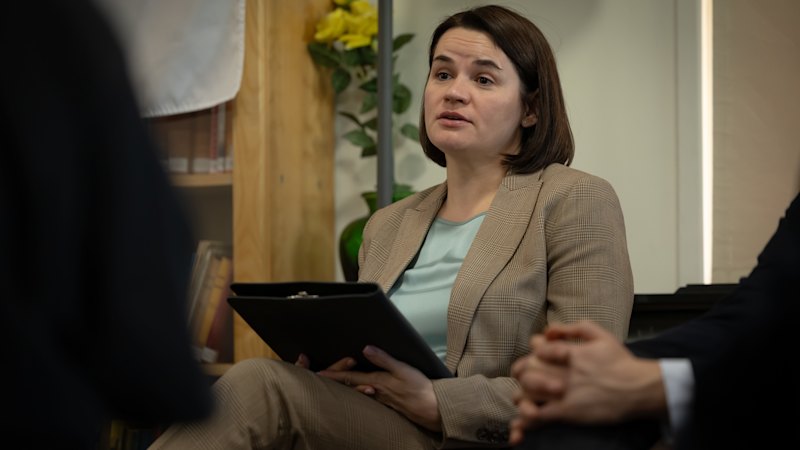
While in Australia, she has a packed itinerary including meetings with Foreign Minister Penny Wong, a trio of former prime ministers (John Howard, Tony Abbott and Scott Morrison), Labor Party national secretary Paul Erikson, House of Representatives Speaker Milton Dick, foreign ambassadors and members of the Belarusian diaspora. The one gap in her schedule: she has yet to secure a much-desired meeting with Anthony Albanese in Canberra.
Loading
Belarus, a post-Soviet nation of 9 million people, is a long way from Australia physically, and psychologically. It hits the headlines occasionally, but it occupies little time in our national imagination. So what would be her message be for Albanese?
“Australia has a very important, loud and powerful voice on the international arena,” she says. “It’s important for us that Belarus is out of the shadows, that Belarus is known, that our fight is recognised as important. Politically, Australia can do a lot.”
Noting Australia’s $1.5 billion in military support for Ukraine, she wants Albanese to think about Belarus strategically. After all, it was from Belarus, not Russia, that Putin launched his ground assault on Kyiv in February 2022. Ukraine, she says, will never be truly safe from the threat of Russian invasion while a Putin puppet remains in power in the presidential palace in Minsk. And while Belarus is not being targeted with Russian drones and missiles, she says her nation’s sovereignty is also under attack.
A leaked internal document from Putin’s office in 2023 laid out a detailed plan for Russia to take full control of Belarus by 2030 under the pretext of a merger between the two countries. “We are facing the same enemy: the imperialistic ambitions of Russia,” she says, speaking with the moral clarity of someone convinced they are on the right side of history. “Next it might be Lithuania, Poland. If we don’t show red lines to dictators, they will go further.”
It’s difficult to believe, but this eloquent and assured activist was, in her own words, an “accidental candidate” when she ran for president in 2020.
The daughter of a concrete factory driver and a cafeteria cook mother, Tikhanovskaya grew up in southern Belarus, near the Chernobyl exclusion zone. She spent several childhood summers in Ireland as part of a charity program to reduce children’s exposure to radiation.
After studying teaching, she fell in love with nightclub owner Sergei Tikhanovsky; she later put her career on hold to take care of their two children, including a son who was born mostly deaf. In 2019, her husband started a YouTube channel challenging Lukashenko’s rule and began organising protests against the regime.
Tikhanovsky wanted to run for the 2020 elections but was banned from participating and was later imprisoned for 18 years. Tikhanovskaya registered to run in what she says was a symbolic act of love for her husband. She expected her campaign to go nowhere, but it quickly gained momentum despite her lack of political experience.
Loading
Her husband was surprisingly released in June in a deal brokered by the Trump administration, ending five years of solitary confinement. Tikhanovskaya’s theory is that Lukashenko’s regime released him because it thought the couple might begin competing for influence and become rivals.
“Of course, nothing like this happened. We are just complementing each other,” she says.
Wong, who will meet with Tikhanovskaya on Thursday, said her visit was an important reminder of the dire situation in Belarus. “Reports that thousands of individuals in Belarus have been unjustly detained, subjected to torture, or forced into exile are alarming,” she said. “I commend Ms Tsikhanouskaya’s bravery and her fight for universal values of democracy and human rights.”
The government has sanctioned Lukashenko, his immediate family and senior Belarusian officials while imposing an additional 35 per cent tariff on Belarusian imports.
Tikhanovskaya wants the government to go further by imposing more extensive sanctions against the Lukashenko regime. She is also calling for Australia to support a Lithuanian bid for the International Criminal Court to charge Lukashenko with crimes against humanity.
She would also like to see the creation of a parliamentary friends of democratic Belarus group, noting that Belarusians fought alongside the Anzacs at Gallipoli and on the Western Front in World War I. “Australians have to cherish what you have, and help those who are fighting for democracy,” Tikhanovskaya says.
Loading
As for Putin’s war in Ukraine, she wants the government to do whatever it takes to stop the imports of Russian oil entering Australia via intermediaries such as India. Australia imported $3.8 billion of oil refined from Russian crude between February 2023 and June 2025, according to the Research on Energy and Clean Air.
Despite Lukashenko’s seemingly unshakable grip on power, Tikhanovskaya says she believes she will see a democratic Belarus in her lifetime. Perhaps she will even be its president. As she hops out of the Uber, the driver, who has been listening to our conversation, thanks her for her efforts. “Dictators are not immortal,” she says. “They’re not almighty, and we just have to do everything possible to not make their lives easier.”
Cut through the noise of federal politics with news, views and expert analysis. Subscribers can sign up to our weekly Inside Politics newsletter.