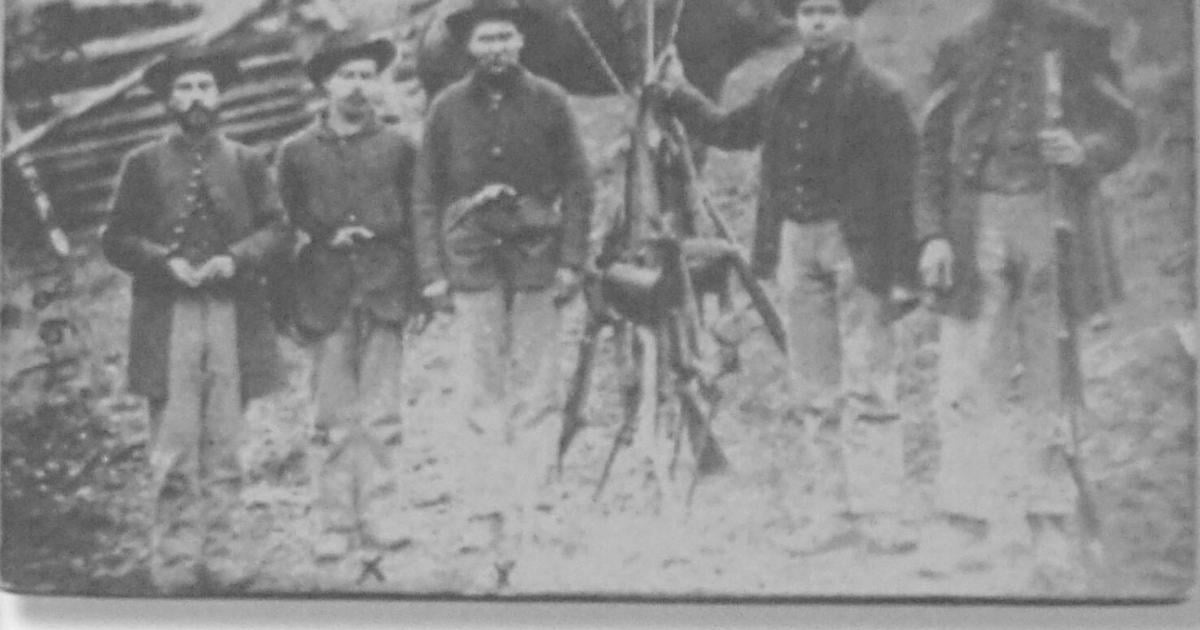
Zach Nunamaker, of Momence, gave a presentation on Iroquois County soldiers who served in the two largest Illinois infantries – the 76th and 113th – during the Civil War. Not a professional researcher, Nunamaker is somewhat of a history buff and about a decade ago he developed a keen interest in the Civil War. His program was presented in the courtroom of the Old Courthouse Museum, 103 W. Cherry, Watseka, on Nov. 2.
Illinois ended up being the fourth state in providing the most troops for the war. Ahead of Illinois were New York, Pennsylvania and Ohio. In 1861, the War Department requested six regiments; however, due to the high number of volunteers, the “Ten Regiment Bill” was passed by the Illinois General Assembly, authorizing another 10 regiments. By the end of that year, almost 10 times the initial call (about 43 regiments) were either being organized or were in service.
In 1862, the call was for 300,000 – the 61st through 131st infantries – and these regiments represented 71 new regiments organized that year. Also that year, Illinois raised new calvary and artillery units, which greatly increased the state’s contribution to the Union Army. On Aug. 4, 1862, President Abraham Lincoln issued an executive order authorizing a draft of an additional 300,000 militia to serve for nine months. These were known as the “Hundred Days Men.”
In 1861, Iroquois County regiments included: 20th Infantry Regiment – Company I, 25th Infantry Regiment – Companies F and G, 51st Infantry Regiment – Company C, 9th Calvary Regiment – Company M, and 10th Calvary Regiment – Company C. In 1862, the 76th Infantry Regiment included companies A, E and K; the 88th Infantry Regiment included Company C, the 113th Infantry Regiment included companies B, D, F and I; the 13th Infantry Regiment included Company B, the 150th Infantry Regiment included Company D, and the 155th Infantry Regiment included Company F. According to the US Census for Iroquois County in 1860, the total population was reported as 12,325. Those 17 companies represented almost 1,700 men which means about 14% of Iroquois County’s population served at some point in the war.
Disease accounted for the highest percentage of deaths during the Civil War. The diseases included dysentery (an intestinal infection), pneumonia, yellow fever and scarlet fever.
A few highlights of the service provided by the 20th Illinois Infantry, Company I: Organized and mustered at Joliet on June 13, 1861; took part in the Fort Henry and Donnelson campaign in February, 1862; moved to Savannah, Tenn., and participated in Shiloh April 6-7, 1862; took part in operations against and the siege of Vicksburg, May-July, 1863; were on hand at Bennett’s place when Joseph E. Johnston surrendered on April 26, 1865; and, finally, was discharged at Chicago on July 24, 1865. For this company, there were 331 deaths: seven officers and 132 enlisted men were killed and mortally wounded, and one officer and 191 enlisted men died by disease.
The 25th Illinois Infantry, Company F, organized at St. Louis in August,1861. This group first saw action at the Battle of Pea Ridge in March 1862, and took part in heavy fighting at the Battle of Stones River, 1862-63. These men were part of the Tullahoma and Chickamauga campaigns, suffering severe losses at the Chickamauga-Chattanooga campaign in 1863. This group marched with General Sherman in the Atlanta campaign. All told, there were 232 lives lost: three officers and 80 enlisted men were killed and mortally wounded, one officer and 148 enlisted men died by disease. The remaining members of this troop were honorably discharged in September 1865.
The 9th Illinois Calvary, Company M, formed in October 1861 at Chicago. They took part in the Battle of Corinth in October 1862, and the Battle of Jackson, Miss., in May 1863, and then were part of the siege of Vicksburg May-July 1863. They were involved in the Meridian, Franklin-Nashville, and Mobile campaigns. These men were honorably discharged in October 1865. One officer and 45 enlisted men were killed, another six officers and 241 enlisted men died by disease.
The 10th Illinois Cavalry Regiment mustered in on Nov. 25, 1861 at Camp Butler, IL. This unit was involved in two distinct operational spheres: Army of the Frontier and separate battalion service.
Army of the Frontier included the Battle of Prairie Grove, Ark., an early engagement in which the cavalry supported Union artillery; Steele’s Campaign against Little Rock, Ark., where they played a significant role in the capture of the Arkansas capital, and the Camden Expedition which was an unsuccessful Union movement. As to Battalion service, this unit took part in the Battle of Cotton Plant, the capture of Arkansas Post, and the siege of Vicksburg.
The 10th Illinois Cavalry Regiment reorganized in January 1865 and was consolidated with the veterans and recruits of the 15th IL Cavalry to form the reorganized 10th Illinois Veteran Volunteer Cavalry. Following the surrender of Confederate armies, this regiment was dispatched to Texas as part of the occupation forces – marching over 500 miles to San Antonio. The survivors mustered out honorably on Nov. 22, 1865. Those killed and mortally wounded were one officer and 24 enlisted men; death due to disease included three officers and 242 enlisted men.
The 76th Illinois Infantry, Company A, E and K, organized Aug. 22, 1862, in Kankakee. This unit served in western Kentucky, western Tennessee and central Mississippi August 1862-May 1863. It moved into operations against Vicksburg May 18-July 14, 1863, and participated in assaults on fortifications. These men took part Sherman’s Meridian campaign, February-March 1864, and remained on duty in Mississippi, Louisiana, Tennessee and Arkansas until January 1865. This regiment was one of the first to plant colors at the capture of Fort Blakely on April 9, 1865. These men served in the occupation of Galveston, Texas, until mustering out in August 1865. There were 259 deaths for this unit: one officer and 51 enlisted men died due to being killed or mortally wounded, and two officers and 205 enlisted men died because of disease.
The 113th Illinois Infantry, Company B, D, F and I, was organized at Camp Hancock, near Chicago, and mustered in on Oct. 1, 1862. Serving in this unit was William W. Scoon, Company B, of Martinton, who survived the war. His two brothers (James and John) also served. This group took part at Chickasaw Bayou and Chickasaw Bluffs Dec. 26-29, 1852; part of Arkansas Post and capture of Fort Hindman in January 1863; was involved in battles leading up to the Vicksburg campaign and siege March-July 1863; were part of the Battle of Brice’s Crossroads with many of these men being captured in this horrible defeat; and was present for Nathan Forrest’s Memphis riad on Aug. 21, 1864. This unit mustered out in June 1865. Casualties of battle were one officer and 25 enlisted men; those succumbing to disease were four officers and 273 enlisted men.
The 134th Illinois Infantry, Company B, was organized at Camp Fry, Chicago, by Colonel Waters M. McChesney and mustered in on May 31, 1864, for 100 days. The group left camp on June 3 for Columbus, Ky., where it was assigned garrison duty. It was mustered out of service on Oct. 24, 1864, at Chicago by Lieutenant Joseph Horr, 13th US Infantry.
The 150th Illinois Infantry, Company D, organized at Camp Butler and mustered in for one year’s service on Feb. 14, 1865. The men were assigned garrison duty at Bridgeport, Alabama, at Forts 3 and 4 in addition to block houses on the Nashville/Chattanooga Railroad from Bridgeport to Chattanooga until March 24, 1865. The group moved to Atlanta July 7-8, then to Griffen, Ga., on August 14. The unit mustered out on Jan. 16, 1866, having suffered the loss of 58 men, all to disease.
The 155th Illinois Infantry, Company F, organized at Camp Butler on Feb. 28, 1863. They guarded block houses on the Nashville/Chattanooga Railroad by detachments from Nashville to Duck River until September 1864. Seventy-one men died of disease and the group mustered out Sept. 4, 1865.
There were several Grand Army of the Republic posts in Iroquois County:, including Williams Post #25, Watseka, which was named for Colonel Thomas D. Williams (1826-1862) of Chebanse, a member of the 25th Illinois Infantry. Williams was killed in action at Stones River, Tenn., on Dec. 31, 1862. Other posts were LB Brown Post #151, Sheldon; WA Babcock Post #416, Onarga; Vennum Post #471, Milford; Kirkpatrick Post #225, Loda; JL Torbet Post #415, Iroquois; Gilman Post #186, Crescent City Post #717; GH Neel Post #576, Cissna Park, named for First Sergeant Green H. Neel, 1827-1875, a member of Company K, 76th Illinois Infantry; Jaquith Post #293, Chebanse; and Will Carter Post #653, Buckley.
Anyone with information to share, or seeking information, is welcome to find Zachary Nunamaker on Facebook. He hasn’t been able to visit a lot of Civil War areas and he’s always open to information others may have on people, places and things pertaining to the local connections to Iroquois County.
This program was sponsored by Iroquois County Historical Society, a non-profit group which is in charge of the Old Courthouse Museum. For more information on ICHS, call 815-432-2215, between 10am-4pm, Monday-Friday. The general public is always invited to stop by and tour the museum during business hours.